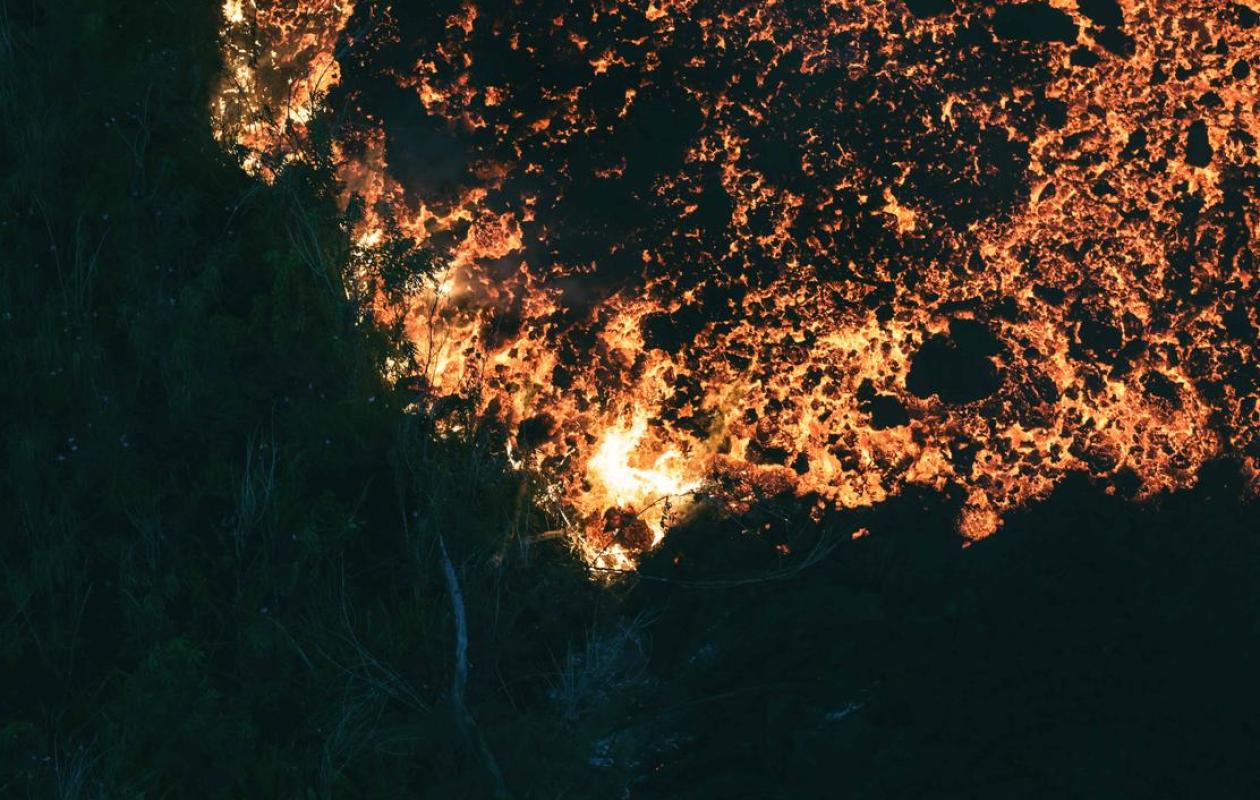
A La Réunion, des coulées de lave coupent la route nationale reliant le sud à l’est, après l’éruption du piton de la Fournaise
As lava covered part of the RN2 highway, residents and tourists flocked to observe this rare phenomenon that disrupted daily life on the island. This event had not occurred since 2007. It took place in a completely uninhabited area, posing no danger to people or property.
Two lava flows ejected by the Piton de la Fournaise volcano, which has been erupting for a month on Réunion Island, have cut off the national highway linking the south to the east of the island, a first in nearly twenty years, the prefecture announced on Friday, March 13. The first lava flow crossed the RN2 at 8:00 a.m. local time (5:00 a.m. in Paris), "over a length of 15 meters and a height of 1.5 meters," state services in this French department in the Indian Ocean specified on social media.
A second lava flow cut off the road at 9:27 a.m. (6:27 a.m. in Paris). "This lava flow front is currently 670 meters from the ocean," the Piton de la Fournaise Volcanological Observatory stated on its Facebook page. Lava had not crossed the road since 2007. The event is taking place in a completely uninhabited area, posing no danger to people or property.
But the phenomenon has a significant impact on traffic between the east and south of the island. Any direct journey between the rural towns of Saint-Philippe in the south and Sainte-Rose in the east is impossible. The only way to reach these two villages, 32 kilometers apart, is to drive all the way around the island, increasing the usual journey time from thirty minutes to two and a half hours.
The lava had been threatening to cross the road since Thursday. As a safety precaution, the prefect of Réunion ordered the closure, starting at 3 p.m. on Thursday, of the section of the RN2, also known as the "lava road," located in the area of the lava flow. Only pedestrians and cyclists are allowed to cross the barrier blocking car traffic.
Since the announcement of a possible lava flow across the road, many people, both island residents and tourists, have started to go near the site of the flow.
Since 1977, and including Friday's event, lava has crossed the RN2 highway seven times. The 1977 episode left its mark on the history and collective memory of Réunion: a lava flow stopped at the gates of the Sainte-Rose church. It split into two branches that flowed alongside the religious building, sparing it.
Since then, the church has been renamed Notre-Dame des Laves (Our Lady of the Lava). It has become one of the major tourist attractions in the east of the island. The Piton de la Fournaise volcano erupted on February 13th, for the second time this year.





















Commentaires (1)
Participer à la Discussion
Règles de la communauté :
💡 Astuce : Utilisez des emojis depuis votre téléphone ou le module emoji ci-dessous. Cliquez sur GIF pour ajouter un GIF animé. Collez un lien X/Twitter, TikTok ou Instagram pour l'afficher automatiquement.