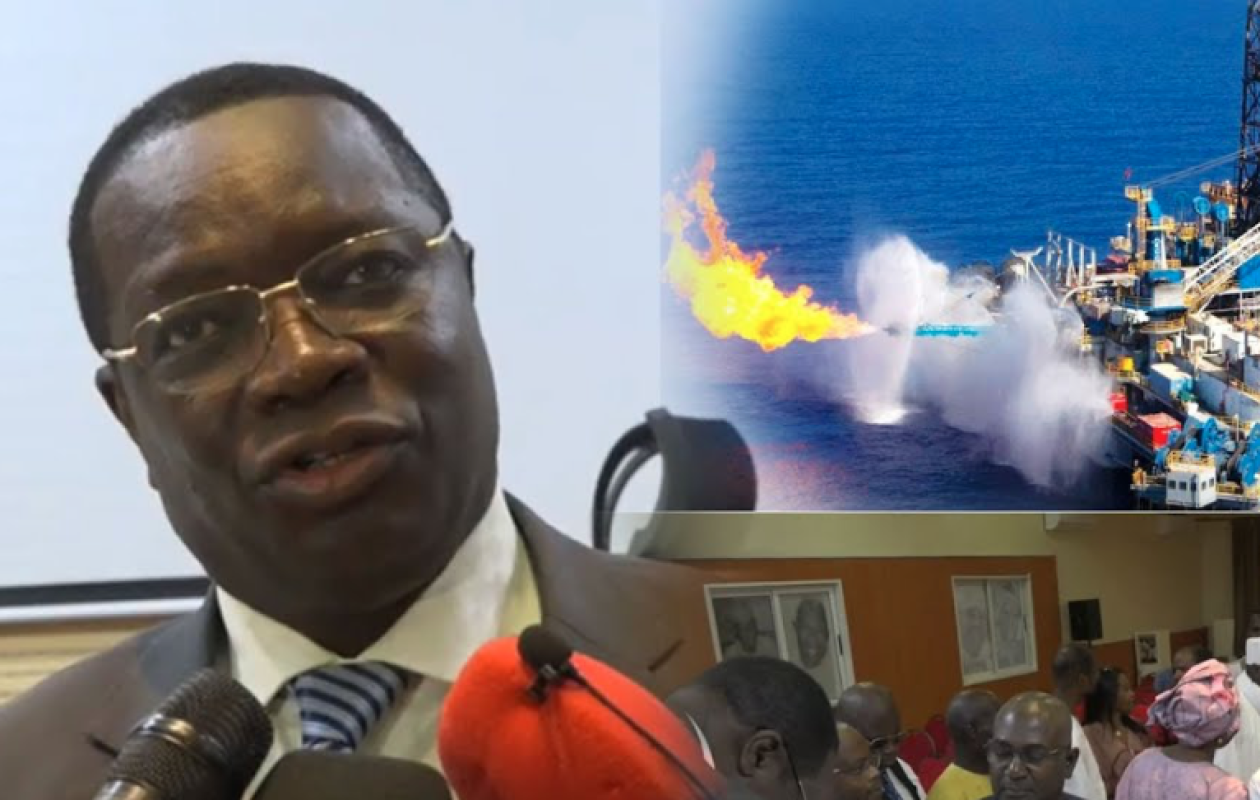
Senegal is sitting on an untapped maritime gold mine: Revelations from expert Papa Mamadou Touré
Invited to the Jury du Dimanche (JDD) program on April 19, 2026, on Iradio, maritime expert Papa Mamadou Touré discussed the role of the sea in Senegal's development. Addressing geopolitics, economics, and sovereignty, he called for a paradigm shift: making the Atlantic Ocean a central pillar of the national strategy.
“We are facing the sea, but we don’t understand much of it,” the expert laments from the outset. For him, the ocean should not be seen as a simple natural border, but as a strategic space with immense potential.
Senegal, with its nearly 700 kilometers of coastline and an exclusive economic zone (EEZ) estimated at approximately 200,000 km², possesses a major advantage. Added to this is its unique geographical position, at the crossroads of maritime routes between Europe, America, and the rest of Africa.
The sea, a matter of global power
To shed light on the issues at stake, Papa Mamadou Touré draws on major geopolitical theories. He notably cites the work of Alfred Thayer Mahan, for whom a state's power largely depends on its ability to control the seas. Along similar lines, Halford Mackinder and Nicholas Spykman have shown that control of strategic spaces—whether continental or coastal—determines global influence.
Even today, these dynamics shape international rivalries, particularly around maritime routes, straits, and energy transit zones. Unlike some volatile regions such as the Gulf or Southeast Asia, the Atlantic Ocean offers, according to the expert, a major advantage: security. "It's an open space, free from major geopolitical constraints, which provides a real security advantage for trade," he explains. In this context, Senegal can leverage this stability to position itself as a key player in managing international maritime traffic.
Dakar, a future global logistics hub?
Papa Mamadou Touré advocates for an ambitious transformation of the country's role. It's no longer just about being a port of call, but about becoming a true logistics hub. He specifically mentions the development of maritime cross-docking to redistribute goods, the use of ship-to-ship transshipment operations, and the establishment of a platform to guide trade flows. "Senegal can become a true maritime transit hub," he asserts.
To support his argument, the expert cites emblematic examples such as Singapore, which has become an economic powerhouse thanks to its port strategy. He also mentions Greece and South Korea, which have successfully built high-performing maritime industries. "Nothing prevents Senegal from following this path. It all depends on the vision and the strategy," he insists.
Beyond infrastructure, the guest speaker called for the structuring of a comprehensive maritime ecosystem: development of shipyards, creation of a national merchant navy, and training in maritime law and logistics. He also emphasized the importance of " lawfare ," the strategic use of law in international rivalries. For the expert, the main challenge remains perception: "First, we must believe that we are a strategic country." According to him, Senegal must adopt a holistic vision that integrates the sea as an engine of development.
Yandé Diop














Commentaires (7)
Participer à la Discussion
Règles de la communauté :
💡 Astuce : Utilisez des emojis depuis votre téléphone ou le module emoji ci-dessous. Cliquez sur GIF pour ajouter un GIF animé. Collez un lien X/Twitter, TikTok ou Instagram pour l'afficher automatiquement.