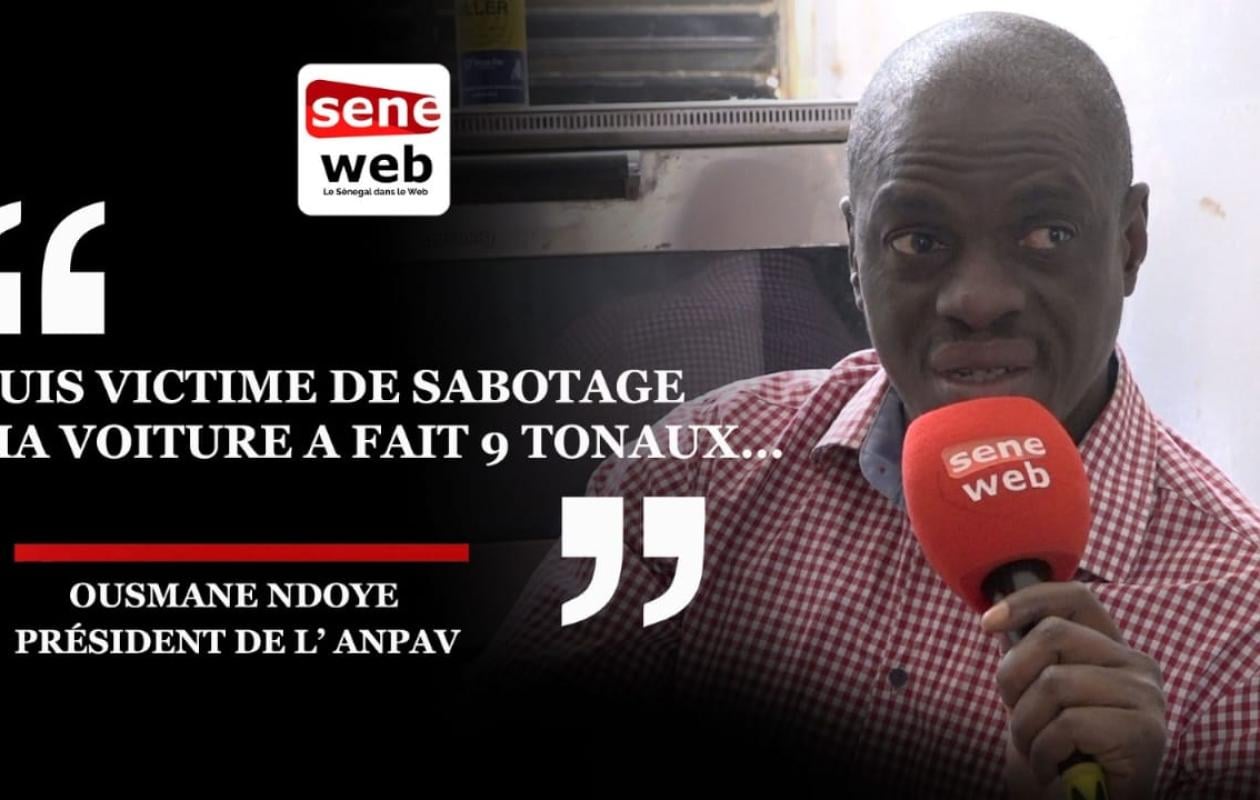
De l'ombre d’Abdoulaye Wade au combat pour les accidentés : Le destin brisé d'Ousmane Ndoye [Dossier (4/5)]
He was the trusted man tasked with securing President Abdoulaye Wade's convoys. But on February 7, 2007, his own life changed forever on the road to Kédougou. For this fourth installment of our investigation, Seneweb meets Ousmane Ndoye. His testimony is an indictment of hospital inaction: left without surgery for three days despite an urgent diagnosis, he now lives with the aftereffects of delayed treatment. Now at the head of the National Association of Accident Victims, he exposes a system where, according to him, "almost all amputations were avoidable." This is the story of a struggle born of pain.
February 7, 2007, is not just another date for Ousmane Ndoye. It's a scar on his memory, a before and after that no amount of silence can erase. On that day, the road to Kédougou sealed his fate. A bodywork technician by trade, Ousmane Ndoye was best known as the national and international coordinator of the Senegalese Democratic Party (PDS). During President Abdoulaye Wade's presidency, he accompanied him on every trip, always acting as a scout, systematically preceding the presidential convoy. A discreet right-hand man, responsible for coordinating, anticipating, and ensuring security. It was precisely in this role, during a presidential mission to Tambacounda and Kédougou, that tragedy struck. Ousmane was supposed to be ahead of the head of state. In the middle of the road, his vehicle overturned. Nine rolls. Unimaginable violence. There were several people on board, but only one came out injured: him. Strangely, no apparent fractures, no bleeding. The body was upright, but already bruised.
Despite the pervasive pain that invades every part of his body, Ousmane remains steadfast. He clings to his duty. From Kédougou, he coordinates with the Presidential Palace until the presidential plane lands. Then comes the evacuation to Tambacounda, before an air transfer to the Main Hospital in Dakar. There, another ordeal begins. More silent. More cruel. At the hospital, time stretches out. Hours become days. Ousmane Ndoye waits. He waits some more. Seventy-two hours pass without any surgery. Even today, his voice breaks when he speaks of that time. "I went 72 hours without an operation," he repeats, as if trying to comprehend the incomprehensible.
The diagnosis was clear: a displaced bone in his spine. A serious but treatable condition. According to the doctors, he should be able to walk again two or three months after the surgery. But it was delayed. Ousmane endured without complaint. Beside him, other patients had been waiting even longer. So he remained silent. He absorbed it. His fragile optimism eventually cracked. In hindsight, Ousmane remains convinced that this medical delay sealed his fate. He speaks of negligence, of a tragedy that became political, even mentioning a sabotaged vehicle. But today he refuses to "lance the boil." "It's behind us," he says, his voice thick with emotion.
It was later that he truly opened his eyes. From inside an ambulance, he observed. He saw other accident victims passing by, left to the same aimless wandering, the same difficulties in receiving care. This realization gave birth to a fight: Ousmane founded the National Association of Accident Victims Living with a Disability.
The association intervenes at three levels: before, during, and after the accident. Because in Senegal, he laments, the focus is on material damage while neglecting the human element. In a country that records nearly 10,000 road deaths per year, the situation is appalling. The healthcare system is on the verge of collapse. Senegal lacks a specialized orthopedic hospital. The CTEO, once a leading center, has become a general hospital. There are fewer than 2,000 beds for the entire country, while in Dakar alone, more than 30,000 accidents are recorded each year.
Many are discharged from the hospital after only three days, without follow-up or rehabilitation, and end up paralyzed. "Almost all of the amputations were avoidable," insists Ousmane Ndoye. He knows victims who left the hospital with fulminant infections or others who waited too long for treatment due to a lack of financial resources.
Beyond the medical aspect, there's the social one. For injured workers, the fall is brutal. Employers often refuse to pay for care, wives distance themselves, and families are exhausted. The state, for its part, doesn't provide enough support for psychological follow-up. "When disability strikes suddenly after an accident, it takes time to accept it," he explains. Ousmane had to adapt on his own. A trained technician, he now drives a vehicle he adapted himself. Despite everything, he hasn't given up. He turned to prevention and created a political movement. Behind the activist, there's still the man. Scarred. Clear-sighted. Haunted by a profound sadness: the sadness of a life shattered by the road and compounded by a system that failed to reach out to him in time.










Commentaires (2)
Participer à la Discussion
Règles de la communauté :
💡 Astuce : Utilisez des emojis depuis votre téléphone ou le module emoji ci-dessous. Cliquez sur GIF pour ajouter un GIF animé. Collez un lien X/Twitter, TikTok ou Instagram pour l'afficher automatiquement.