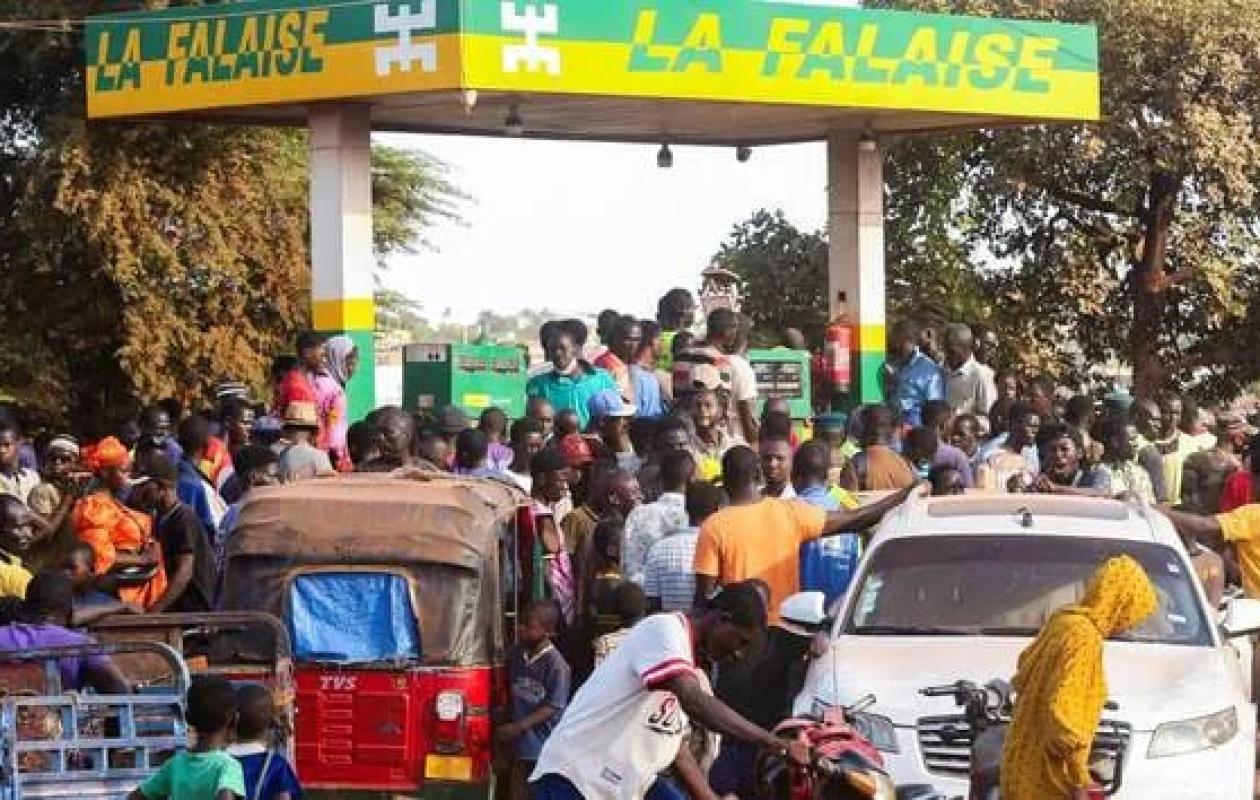
Le Mali à genoux : Comment le JNIM a fait du carburant une arme de guerre économique (1/2)
On March 27, 2026, Malian state television announced an official increase in fuel prices: 875 CFA francs per liter for regular gasoline and 943 francs for diesel. The junta presented this decision as an economic management measure. What it didn't say was why. What it didn't say was that this increase is a public admission of a strategic defeat that the authorities in Bamako have been trying to conceal for the past six months.
Since September 2025, the Group for the Support of Islam and Muslims (JNIM), an Al-Qaeda affiliate, has turned fuel into a weapon of war. Systematically and methodically, the jihadists of the Katiba Macina, led by Amadou Koufa, have seized control of the logistical corridors that sustain Mali. A landlocked country, Mali is entirely dependent on hydrocarbon imports transported overland from the ports of Abidjan, Dakar, Conakry, and Lomé. Cutting off these routes is tantamount to cutting off the state's very lifeblood. JNIM understood this before the junta could admit it.
Six months of a documented siege
The blockade is not a rumor. Contrary to what Foreign Minister Abdoulaye Diop claimed in November 2025, it is not an "artificially created shortage" orchestrated by foreign powers. It is a documented and claimed military operation, the effects of which can be felt even at the last gas pump in Bamako.
The attacks began on the main supply routes of the country. The southern route, linking Abidjan to Bamako via Bougouni and Sikasso, was the first to fall under pressure. The Bougouni region, two hundred kilometers south of the capital, has become a recurring scene of mass destruction: on December 6, 2025, at least fifteen tanker trucks were set ablaze in a single ambush claimed by JNIM.
Four days later, on December 10, three new coordinated attacks struck simultaneously: tanker trucks between Bamako and Ouélessébougou, less than eighty kilometers from the capital; a military vehicle between Dogofri and Diabali in the Ségou region; and the teacher training institute in Nioro du Sahel. In a single day, the map of hostilities stretched across four hundred kilometers of territory.
On January 29, 2026, JNIM opened a new front that no one had anticipated: the western axis, the one linking Dakar to Bamako via Diboli and Kayes. An entire convoy, composed of several dozen tanker trucks, was wiped out between Diboli and the city of Kayes. Three Malian soldiers were killed, as were four attackers. Customs officials in Kayes confirmed the attack. In Kidira, the last major Senegalese city before the border, transporters suspended their departures while waiting for the situation to "de-escalate." The threat had now encompassed almost all of the country's import corridors.
What the numbers say that the junta doesn't say
At the height of the crisis, in October 2025, 110 out of more than 700 gas stations in the capital alone were operating sporadically. Queues stretched for hours. Rationing was capped at 10,000 CFA francs per vehicle per day, a decision that only exacerbated the shortage without curbing it. Universities and schools in Bamako closed for two weeks on the orders of the authorities: there was no longer enough fuel to run generators and maintain transportation. Humanitarian flights were suspended. In Mopti, the city had not received a single liter of fuel since the beginning of September, more than two months of total blackout, without electricity, without fuel, and without any official explanation.
The human cost was documented before being downplayed by the junta. Human Rights Watch established in January 2026 the summary execution of ten tanker truck drivers and two apprentices by JNIM in the southwest of the country. Ordinary workers, killed on roads they had traveled for years. The National Union of Drivers and Road Transporters of Mali (Synacor) responded with a work stoppage, exacerbating the logistical crisis that the attacks had already triggered. It took a pro-junta member of parliament publicly accusing them of “complicity with terrorists” for tensions to reach a boiling point. The same parliamentarian then apologized—too late, the damage was done.
On October 2, 2025, on the Ségou-Bamako road, JNIM ambushed the vehicle of former member of parliament and religious leader Abdoul Jalil Mansour Haïdara, killing him instantly. Haïdara was the founder of Ségou TV. His death was not officially acknowledged by the government.
The agreement that the junta denies having signed
On March 22, 2026, AFP revealed, based on concurring security sources and local officials, what Bamako had never admitted: the junta had released between one hundred and two hundred people detained for alleged links to jihadist groups, in exchange for a transit corridor for fuel convoys. The agreement, according to the sources cited by the agency, was to remain in effect until Tabaski, a major Muslim festival scheduled for the end of May 2026. Two independent estimates converged: a security source mentioned "198 young people," while a local official cited "201 young people accused of being jihadists."
On March 30, 2026, Colonel-Major Souleymane Dembélé, director of information and public relations for the Malian armed forces, dismissed this information as "pure, baseless manipulation." It was on this same day that the truce, in all likelihood, came into effect, as convoys resumed traveling to Bamako in the following days. The diesel shortage that had plagued the capital since early March eased. The queues disappeared. Almost immediately afterward, the official price increase was announced.
This, then, is the true state of Mali on April 3, 2026: a state that released jihadists so its citizens could obtain fuel, denies having done so, and is raising prices to absorb the reality of a market its armed forces failed to protect. Nearly six years after the first coup that brought the military to power in the name of sovereignty and security, the Malian junta is incapable of ensuring the passage of a fuel tanker on its own roads. JNIM, for its part, didn't need to take Bamako. It simply had to cut it off from the world.
The question that remains open is not whether the current truce will hold until May. It is what the junta will concede the next time the convoys stop.











Commentaires (16)
Participer à la Discussion
Règles de la communauté :
💡 Astuce : Utilisez des emojis depuis votre téléphone ou le module emoji ci-dessous. Cliquez sur GIF pour ajouter un GIF animé. Collez un lien X/Twitter, TikTok ou Instagram pour l'afficher automatiquement.