
L'instant avant le clic : pourquoi les jeux basés sur la décision fascinent les joueurs d'aujourd'hui
There's a particular mental state that both seasoned and casual gamers instantly recognize, even if they've never quite found the right word for it. It's the half-second before committing to a move—when all the information is laid out before you, the outcome is still open, and the decision is entirely yours. This moment is equally uncomfortable and addictive. Game designers have known this for decades. What's changed recently is the number of formats now built specifically around it, rather than treating it as a byproduct of something longer and more complex.
Decision-based games—formats where a single, well-calibrated choice is the central mechanical event—have become one of the defining categories of contemporary mobile entertainment. The genre encompasses card games, crash formats, prediction mechanics, and time-limited strategy, but what unites them is the centrality of that moment of engagement. When you examine what the studios producing the most-played games in this space are actually doing, the craftsmanship becomes apparent—the thought behind Aviator Spribe Gaming is a clear example of how a streamlined decision mechanic, executed with genuine care for the player experience, can hold an attention that flashier, more complex formats consistently fail to maintain. The growth of this space reflects something real about what players want right now, and the answer turns out to be simpler than most designers initially assumed.
Not all decisions in games are created equal. Those that generate genuine engagement share a few qualities: the outcome must be uncertain, the stakes must feel real, and the player must believe their judgment made a difference to the result. Remove any one of these elements, and the decision becomes either trivial or arbitrary—neither produces the state of focused attention that makes decision-based formats so compelling.
It's harder to grasp than it seems. Games that fail at this either make decisions random (eliminating agency) or predictable (eliminating tension). Those that succeed fall into a narrow band where skill and uncertainty coexist—where a player with good judgment wins more often than chance would predict, but still faces enough variance for each individual decision to carry real weight.
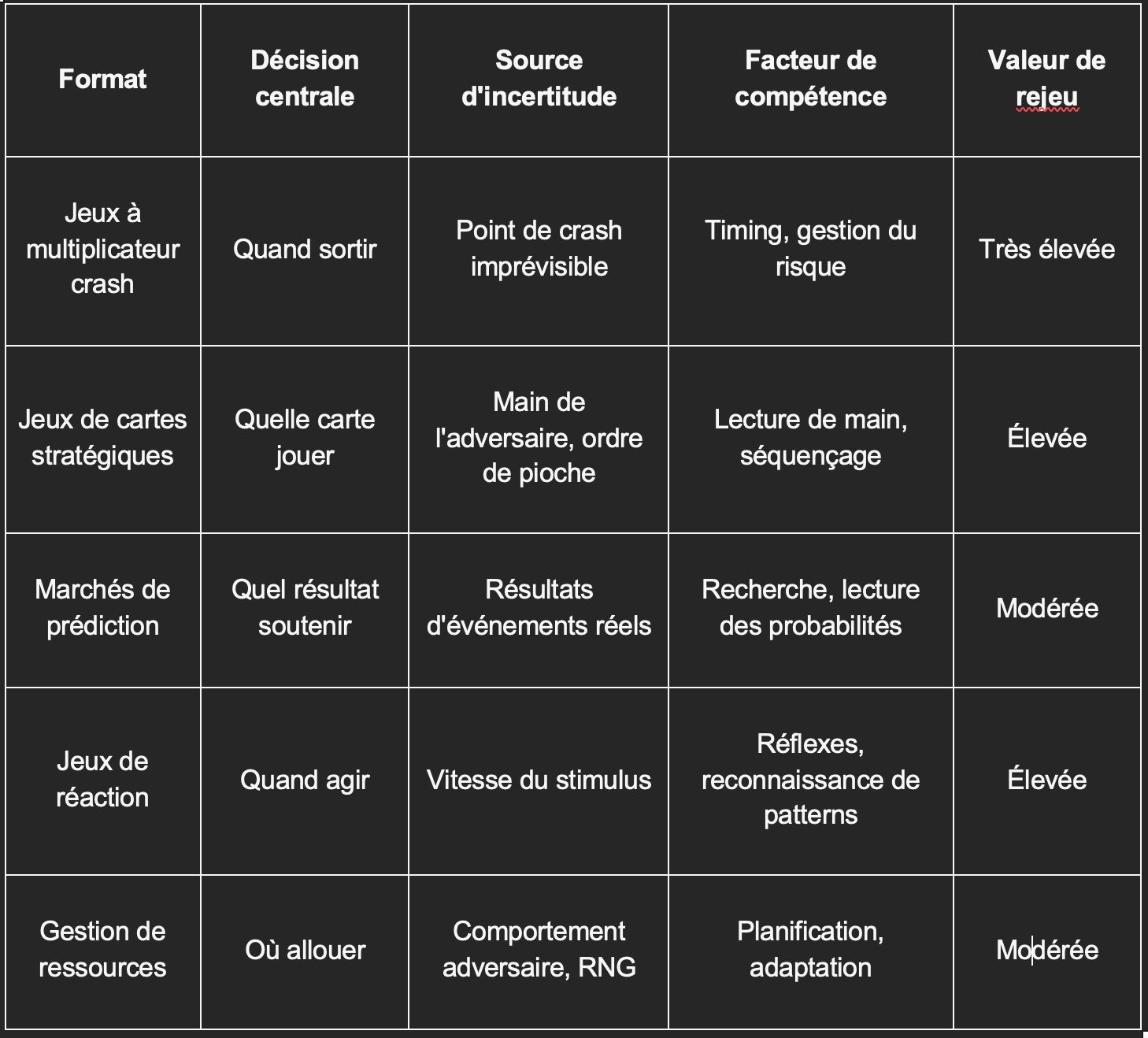
The table shows how much the format can vary while still maintaining this central structure. What remains constant across the five rows is that the player's decision is the pivot point of the experience – everything before it is a build-up of tension, everything after is a resolution. The duration of each phase varies, but the structure itself does not change.
The dominance of mobile as a gaming platform has produced an interesting shift in design priorities. Screen size, session length, and usage context have all pushed game design toward clarity and immediacy, in a way that specifically benefits decision-based formats. When someone plays on their phone during a commute or a ten-minute break, they don't have the bandwidth for complex systems that require sustained attention to understand. They have the bandwidth for a good decision, made quickly, with a result that arrives before they stop playing.
This isn't a simplification of the game—it's a refinement. The decision-based format removes everything that isn't essential and demands that the player fully engage with what remains. For players experienced enough to feel weary of padded progression systems and content designed to consume time rather than deliver experience, this franchise is genuinely appealing.
Decision-based games exploit something that researchers studying judgment and choice have extensively documented: people experience their own decision-making process as more engaging than passive observation, even when the outcomes are comparable. Watching someone else grapple with a difficult choice is interesting. Facing it yourself is absorbing. Games that place the player at the center of every significant moment directly exploit this asymmetry.
The "moment before the click" is fascinating because it is, briefly, a space of pure potential. The outcome exists but has not yet been revealed. This gap—between engagement and knowledge—is where the true experience resides. The best decision-based games have learned to stretch it out just long enough for it to feel meaningful, and to resolve it just quickly enough for the player to be ready to face it again. This rhythm, once found, proves almost impossible to break.













![[VIDEO ] Moussa Mbaye (FSF): "le Sénégal n’a pas encore saisi le TAS, il le fera ce..."](https://image.seneweb.com/content/news/2026-13-24//thumb_1260x800_69c1dfad9f589_M9Va3IgZ2b.webp)










Commentaires (0)
Participer à la Discussion
Règles de la communauté :
💡 Astuce : Utilisez des emojis depuis votre téléphone ou le module emoji ci-dessous. Cliquez sur GIF pour ajouter un GIF animé. Collez un lien X/Twitter, TikTok ou Instagram pour l'afficher automatiquement.