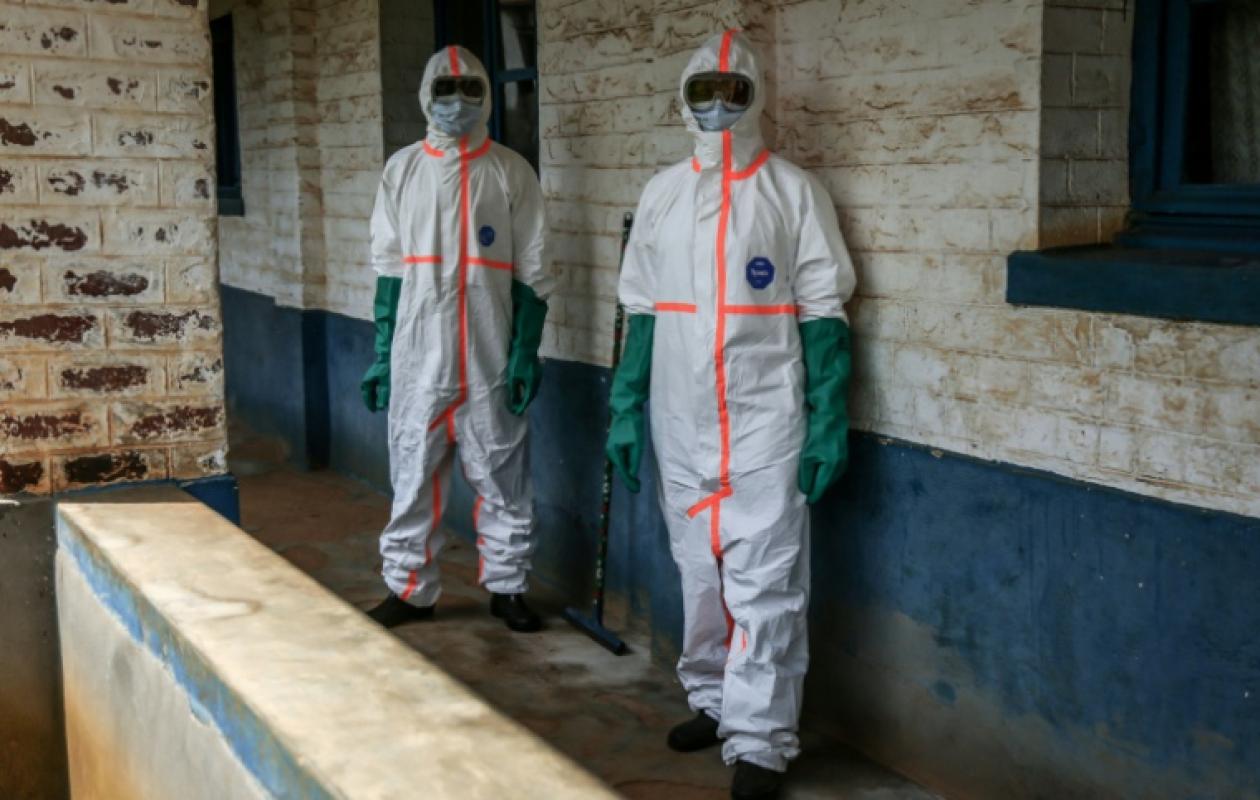
A l'épicentre de l'épidémie en RDC, la peur d'Ebola
"If it's true, may God protect us": at the epicenter of the Ebola disease epidemic raging in the Democratic Republic of Congo (DRC), the climate oscillates between fear and denial, as the health catastrophe swells and the deaths accumulate.
Mongbwalu, a city of some 130,000 inhabitants, is located in the green hills of northeastern DRC, in the Ituri province. It is there that the epicenter of the epidemic is located, which has already killed 204 people out of 867 suspected cases in the Central African country of more than 100 million inhabitants.
In the dirt streets, gold miners and traders make almost daily trips to neighboring provinces. Mud-covered motorcycles traverse the red dirt tracks. Uganda is only about 100 kilometers away as the crow flies, and South Sudan some 200 kilometers.
From this remote region, the disease spread, within a few weeks, to two neighboring provinces and into Uganda.
This epidemic, the 17th in the DRC, one of the world's poorest countries, was described as "quite rapid" by the Congolese Minister of Health. The World Health Organization (WHO) has issued an international health alert.
In Mongbwalu, 322 people are suspected of having been infected, according to the latest figures from health authorities. And 88 deaths, likely caused by the virus, have been reported.
"The disease exists," insists Laureine Sakiya, a resident of Mongbwalu interviewed by AFP, mentioning deaths among her neighbors. "The authorities must provide us with vaccines," demands the 26-year-old woman.
She is still unaware that there is no treatment or vaccine for the Bundibugyo virus, which is responsible for the current Ebola epidemic.
At the local hospital, a modest building nestled among trees and tall grass, healthcare teams scrub the floor and walls with a chlorine solution. Masks, goggles, suits—they are protected from head to toe.
The handwashing facilities are made of plastic buckets: in the epicenter of the epidemic, which is shaping up to be one of the most serious in the history of Ebola, the health response is slow to get organized.
Local NGOs are present and Doctors Without Borders has loaned tents to the hospital to allow for the isolation of infected individuals.
At the rear of the building, a blackened frame still stands: one of the tents was burned down during the night. Ashes are visible on the ground. During previous epidemics, the mistrust of some members of the population had already led to incidents.
"At first, people thought it was a story about a coffin," explains Jonathan Imbalapay, president of the Mongbwalu civil society.
According to epidemiological investigations carried out to trace the origin of the epidemic, the first suspected case recorded was a man who died in Bunia, the provincial capital.
After his death, the family transported the body to Mongbwalu in a simple vehicle. After a journey of approximately 80 km, on often bumpy roads, the coffin was damaged, revealing the remains. According to witnesses interviewed by AFP, the deceased's father refused to bury his son in such a state. The relatives then transferred the body to another coffin.
When deaths began to multiply within the community, some believed it was a "mystical illness." Representatives of the traditional authorities and residents wanted to burn the first coffin, which was implicated. In some regions of the DRC, unexplained phenomena are sometimes associated with mysticism or witchcraft.
Tests conducted at the provincial laboratory initially ruled out the Ebola theory, the Minister of Health recounted - leaving the disease and psychosis to spread in Mongbwalu.
It was only when samples arrived at the biomedical research laboratory in the capital, Kinshasa, that the existence of a new epidemic was confirmed.
"I am worried about those who say that this disease is a fabrication," says Adam Hussein, 35, representative of traditional doctors in Mongbwalu, calling for respect for barrier measures.













Commentaires (3)
Participer à la Discussion
Règles de la communauté
💡 Astuce : Utilisez des emojis depuis votre téléphone ou le module emoji ci-dessous. Cliquez sur GIF pour ajouter un GIF animé. Collez un lien X/Twitter, TikTok ou Instagram pour l'afficher automatiquement.
Se connecter
Commentez avec votre profil, votre photo, et soyez averti des réponses.