De 2.800 francs à 1.200 francs CFA en cinq mois: comment expliquer la chute vertigineuse du prix du cacao en Côte d'Ivoire
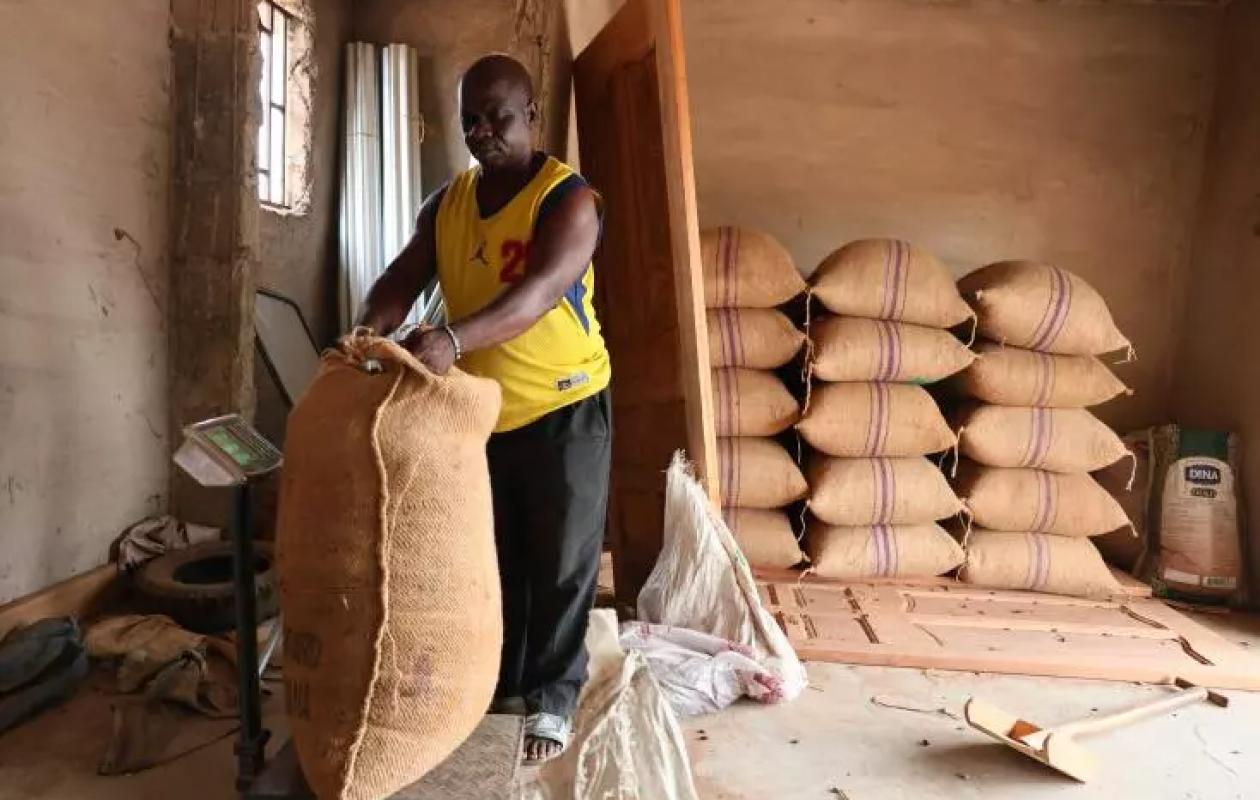
Ivory Coast, the world's leading cocoa producer, has just more than halved the price it pays farmers for "brown gold." According to authorities, this decision was necessary to revive sales amid plummeting global prices. More than 100,000 tons of cocoa beans remained unsold at the port of Abidjan. Yet, just a few months ago, the price per kilo was at an all-time high. Ivory Coast, the world's leading producer, is struggling to regulate the market. More than 6 million Ivorians depend on this sector.
It was a time of euphoria. On October 1st at the Abidjan Exhibition Center, Alassane Ouattara, just weeks before the presidential election, addressed the country's main cocoa farmers' organizations. "I announce that for the 2025-2026 marketing season, the guaranteed farmgate price for well-dried and well-sorted cocoa is set at 2,800 CFA francs (4.26 euros)," announced Alassane Ouattara.
Cheers erupted in the room... The price of a kilo of cocoa had rarely reached such a high level. But less than five months later, disappointment set in. The Ivorian Minister of Agriculture, Bruno Koné, announced a new price: "The price of cocoa on the international market forces us to make an adjustment." The new guaranteed farmgate price is 1,200 CFA francs per kilo, or €1.82, representing a decrease of more than 60%.
The news is a bitter pill to swallow for cocoa farmers. "Frankly, we're not happy. We farmers are the ones who are going to lose out in this," lamented Yao Yao, a union representative in the sector, in Duékoué (western Senegal), telling AFP that the government isn't providing more compensation for "such a precipitous drop." "We thought that even if the price went down, it wouldn't fall below 2,000 francs. I think it's bound to be a shock for many people," added Abdoulaye Dembele, manager of a cooperative in Divo (central Senegal), interviewed by AFP.
Cocoa prices are usually announced in October and then April, but this time the government has decided to bring the announcement forward by a month in an attempt to stem the current crisis as quickly as possible. For several weeks, more than 100,000 tons of cocoa have remained on the docks of the port of Abidjan, due to a lack of international buyers. And for the past five months, the approximately 600,000 cocoa farmers have been unable to sell their harvest.
"It's too often a yo-yo effect."
The Ivorian price set by the state was 74% higher than world prices. What the state calls the "farmgate" price is a key mechanism for regulating Ivorian cocoa. The price is calculated based on the previous year's sales. But in a context of rapidly falling prices, this mechanism could become unsustainable for Ivorian public finances.
According to Christian Cilias, a researcher at CIRAD, the French agricultural research organization, and a specialist in cocoa cultivation, interviewed by TV5MONDE, the Ivorian authorities had no choice. "Buyers didn't want to pay the high prices of six months ago. It's better for Ivory Coast to lose value now than to fail to sell its stocks. This allowed us to revive the market and make it more fluid," explains Cilias. In just a few months, cocoa prices went from record highs in 2024 to the beginning of a crisis on the world market at the end of 2025. Global prices fell from $11,000 per ton to around $2,900 in less than a year.
"For several years now, the cocoa market has experienced greater price volatility. Information about cocoa production levels circulates quickly and is rapidly reflected in global prices. A few months ago, prices were high due to poor production. This time, there is overproduction, and prices have quickly fallen. This yo-yo effect is all too common," observes the researcher. The Ivorian government is rather powerless in the face of this volatility.
Abidjan has failed to create an OPEC for cocoa
"The global cocoa sector is not sufficiently organized to influence world prices. In the early 2000s, Ghana, the world's second-largest producer, and Ivory Coast, the largest producer, attempted to join forces to influence world prices, but this didn't last," the researcher explains. Abidjan has failed to create a cocoa equivalent of OPEC.
Cocoa is a vital sector for the country's economy. Nearly 15% of the country's annual wealth comes from this sector. The stakes are not only economic, but also social. More than 6 million Ivorians depend on cocoa production in this country of 30 million. In recent years, Ivorian authorities have strived to diversify the country's agriculture by developing crops such as cashew nuts, but cocoa remains the country's primary export (nearly €3 billion in 2024) and a key driver of its growth.
"The challenge is to retain some of the value of chocolate."
According to Christian Cilias, a researcher at CIRAD, Côte d'Ivoire must above all recover a portion of the value of its chocolate products. "For Côte d'Ivoire, the problem lies in the fact that the value of chocolate, of cocoa, is not realized within the country. Only a tiny fraction of the price of a chocolate bar goes to the growers, to the farmers. The challenge is to keep some of this value within the country. Côte d'Ivoire must be able to process its own cocoa into chocolate," explains the researcher.
According to a study by the FAO, the United Nations' Food and Agriculture Organization, over 90% of profit margins go to chocolatiers and distributors, primarily in the West. And this situation is unlikely to improve. "In recent years, amid high cocoa prices, major Western chocolatiers have found and developed chemical substitutes for cocoa," emphasizes Christian Cilias. Côte d'Ivoire, however, has been working in recent years to process some of its cocoa beans into chocolate. The government's stated objective is to reach a processing rate of 50% of its harvest, compared to 30% today.











![[Billet d’humour] Diomaye Président : Mbour, le test qui interroge](https://image.seneweb.com/content/news/2026-19-10//thumb_1260x800_6a008342c328b_0bscHsJLlN.jpeg)










Commentaires (7)
Participer à la Discussion
Règles de la communauté :
💡 Astuce : Utilisez des emojis depuis votre téléphone ou le module emoji ci-dessous. Cliquez sur GIF pour ajouter un GIF animé. Collez un lien X/Twitter, TikTok ou Instagram pour l'afficher automatiquement.