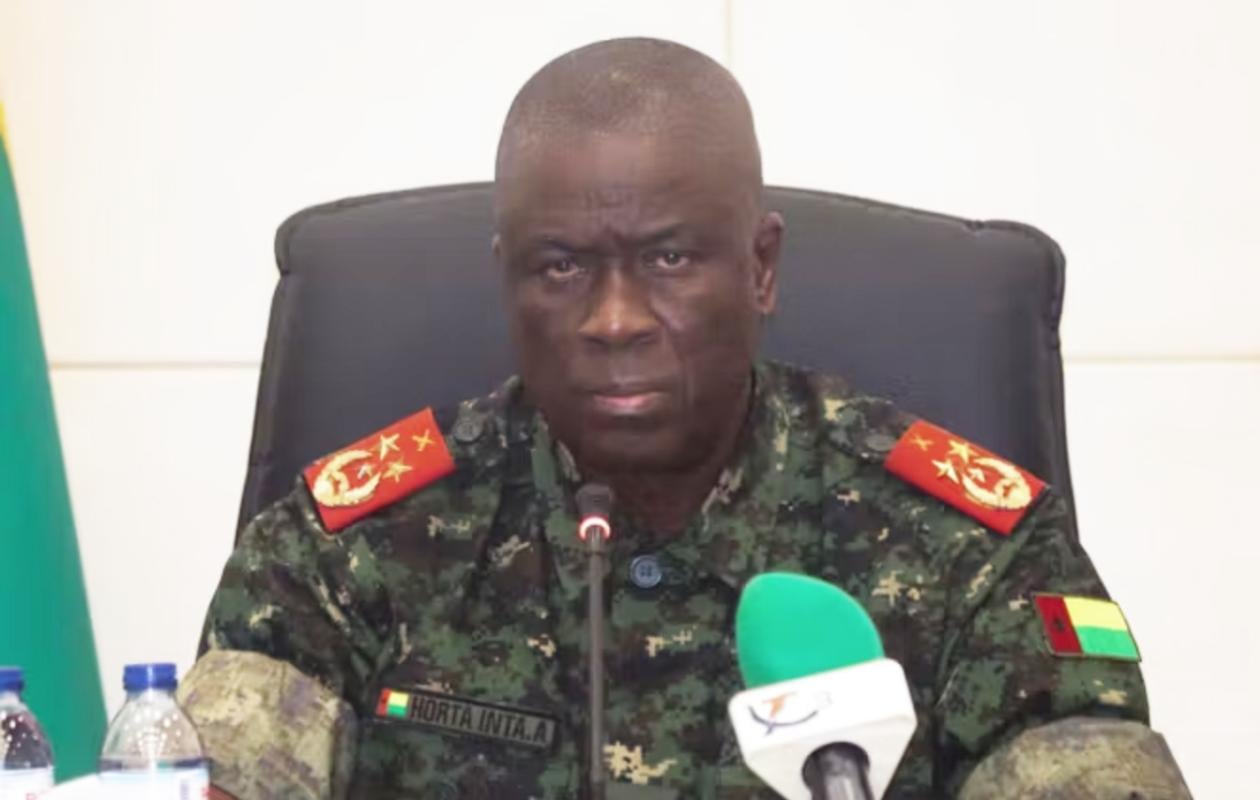
Guinée-Bissau: interdiction des conférences de presse
The Guinea-Bissau junta announced on Friday a ban on all unauthorized press conferences and public statements, six weeks after seizing power following a post-election coup.
After ousting President Umaro Sissoco Embalo on November 26, just after the presidential election, the army suspended the electoral process and announced the takeover of this West African country for a period of one year.
On Friday, the High Military Command, the junta's ruling body, argued in a statement that "certain individuals and ethnic groups, including political figures, have organized secret meetings and used them to incite violence and disobedience," including to the transition charter.
This transitional charter, published in early December, aims to establish a legal framework for the period of military rule.
The High Military Command has decided to "expressly prohibit the holding of any unauthorized press conference or public statement that could compromise peace and social cohesion."
"Any person or entity that challenges the public order decreed by the transitional authorities will be severely punished, in accordance with the law," the statement said.
After overthrowing Mr. Embalo, the junta initially accused drug lords of conspiring to sow chaos in the country, a hub for cocaine trafficking.
But in early December, authorities declared that Guinea-Bissau, already unstable, was facing a "serious" political situation following the elections, "likely to degenerate into an ethnic civil war".
Observers and the opposition have raised the possibility that Mr. Embalo orchestrated the coup to interrupt the electoral process, as he was on the verge of losing power.
Before the November coup, Guinea-Bissau had already experienced four military coups and a series of attempted insurrections since its independence from Portugal in 1974.
AFP











Commentaires (3)
L' analyse du positionnement et des pratiques met en évidence des limites structurelles et analytiques qui restreignent les capacités du nouveau ministre a opérer comme un entrepreneur d' une politique publique dans le champ diplomatique : comprendre le besoin, définir un plan et fixer un programme de réalisation.
Pour le Sénégal, comme pour les autres pays, il fait se réadapter. Pour se réadapter, il faut aller au delà des constats .
Le monde est en recomposition, les politiques extérieures sont en redéfinition.
Dans cette configuration, son rôle semble davantage relever d’une bureaucratie d’exécution que d’un leadership stratégique capable de structurer des coalitions d’acteurs, de hiérarchiser les priorités et de traduire une vision politique en instruments diplomatiques opératoires. Cette limitation renforce une dépendance à l’égard du centre présidentiel, où la diplomatie apparaît principalement comme un registre discursif et symbolique, plutôt que comme un champ d’action structuré par des choix, des arbitrages et des dispositifs institutionnels.
Par ailleurs, le fonctionnement de l’entourage présidentiel s’inscrit dans une dynamique de résonance plus que de délibération stratégique. En l’absence de contre-expertise et de production cognitive autonome, les conseillers semblent contribuer à une circularité du discours, où l’énonciation politique tient lieu de stratégie, et où la performativité symbolique se substitue à la capacité d’anticipation et de transformation.
Ambassadeur
Participer à la Discussion
Règles de la communauté :
💡 Astuce : Utilisez des emojis depuis votre téléphone ou le module emoji ci-dessous. Cliquez sur GIF pour ajouter un GIF animé. Collez un lien X/Twitter, TikTok ou Instagram pour l'afficher automatiquement.