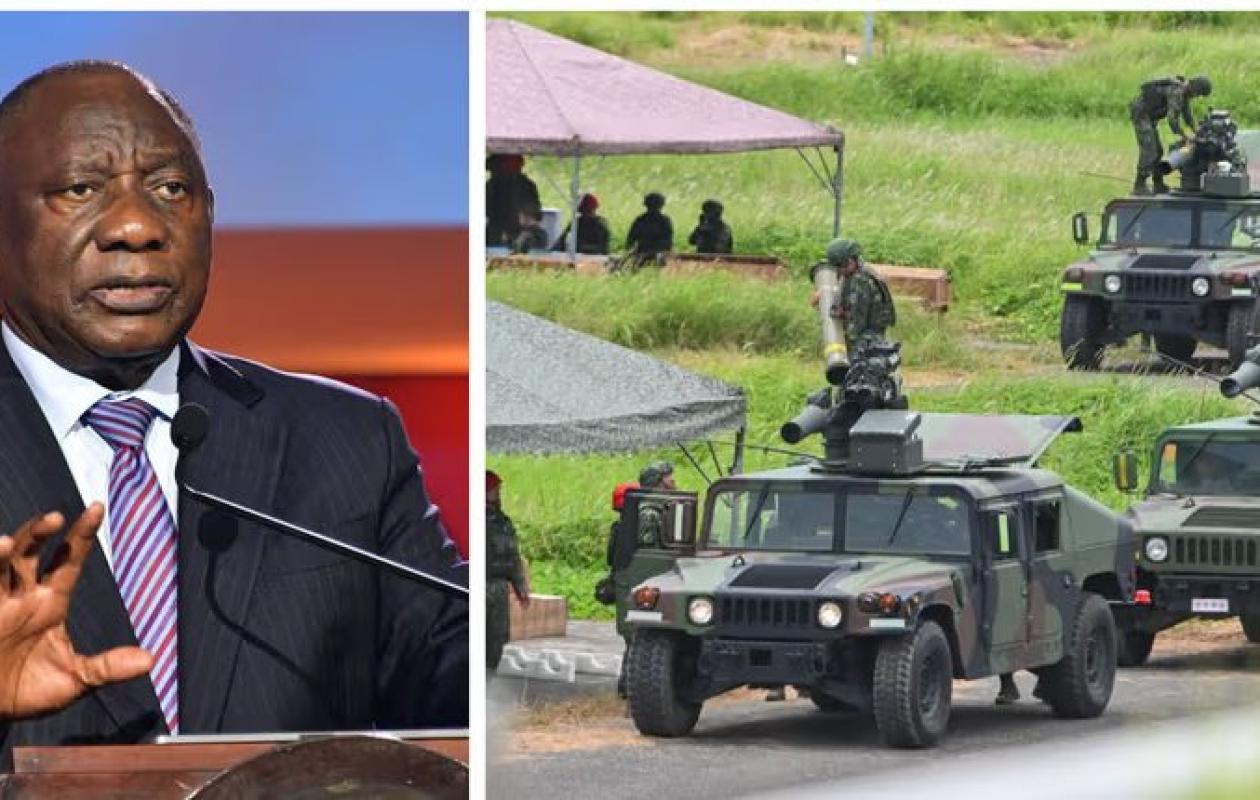
L’Afrique du Sud réalise des ventes d’armes record de plus de 550 millions de dollars à ces pays
South Africa generated around $550 million (R10.1 billion) in defense exports in 2025, with weapons, ammunition and military equipment sold to buyers such as France, Turkey, Kenya and the United Arab Emirates, underlining the country's growing role as one of Africa's leading arms suppliers amid rising global demand.
Figures from the National Conventional Arms Control Committee (NCACC) show that 582 export permits to 42 countries were approved last year, covering munitions, armored vehicles, aircraft and electronic warfare systems, for a total of about $550 million (10.1 billion rand).
The total represents almost triple the $190 million (3.6 billion rand) recorded in 2024, reflecting a sharp increase in international demand for military equipment and munitions manufactured in South Africa.
Europe accounted for the largest share of exports, followed by the Middle East, Africa and the Asia-Pacific region.
Ammunition is the reason for the sharp increase in exports
Munitions accounted for the largest share of exports, with Germany proving to be the main buyer after ordering 73,586 shells worth approximately $180 million.
Turkey also purchased 35,000 shells worth about $37 million, while Estonia acquired 18,540 shells worth about $11 million and Australia purchased 10,272 shells worth about $15 million.
South Africa also exported measurement and communication equipment, with India securing the largest contract (219 items), followed by France (17 items), Bangladesh (377 items) and Brazil (10 items).
Dual-use exports included information security systems supplied to seven countries, two lasers delivered to the Netherlands, and a drone exported to Colombia.
It should be noted that South Africa's defense exports are mainly produced by well-established manufacturers such as Denel, Rheinmetall Denel Munition, Paramount Group and Milkor.
These companies produce artillery munitions, armored vehicles, aircraft, drones and naval systems for the South African National Defence Force (SANDF) and for export markets in Africa, Europe and the Middle East.
African buyers and vehicle exports
Armored vehicles constituted another part of the exports, with African buyers among the main customers.
According to the report, more than 130 vehicles manufactured in South Africa were exported, with the largest orders coming from Kenya (34 vehicles), Ghana (30 vehicles), Malawi (15 vehicles), Cameroon (11 vehicles) and the United Arab Emirates (10 vehicles).
Unspecified aircraft were sold to Iraq (six units), the Democratic Republic of Congo (four), Mozambique (two), and the United Arab Emirates (one). The sales to the DRC and Mozambique likely involved Paramount Mwari aircraft.
The NCACC also reported that two warships had been sold to Tanzania during the year.
More than 10,000 small arms have been exported to numerous countries, with Zimbabwe accounting for the largest single order.
South Africa stands out on the import-dependent continent
While some African countries maintain defense industries with limited transparency, most countries on the continent remain net importers of arms, dependent on European, American, Chinese and Russian suppliers.
In recent years, countries such as Ethiopia, Egypt and Algeria have procured significant military equipment from Chinese and Russian manufacturers, while Nigeria has acquired systems from various suppliers, including China, Italy, the United States and Turkey.
According to the SIPRI 2026 report, Morocco and Algeria, two North African military powers, are listed primarily as importers rather than exporters.
Morocco ranks 28th in the world among arms importers, registering a 12% increase, while Algeria occupies 33rd place despite a 78% decrease.
This contrast highlights South Africa's relatively rare position as a continental supplier, exporting locally manufactured munitions, vehicles, aircraft, and electronic systems to markets in Africa, Europe, and the Middle East.
Although South Africa also imports limited quantities of defence equipment from foreign suppliers, these purchases remain relatively modest.
Recent acquisitions include unspecified weapons from the UK, Slovakia and the US, bombs from Serbia and Belgium, and munitions from several countries, including China.
The country has also procured early warning systems from India and communication and navigation equipment from European suppliers, demonstrating a priority on specialist components rather than major weapons platforms.












Commentaires (0)
Participer à la Discussion
Règles de la communauté :
💡 Astuce : Utilisez des emojis depuis votre téléphone ou le module emoji ci-dessous. Cliquez sur GIF pour ajouter un GIF animé. Collez un lien X/Twitter, TikTok ou Instagram pour l'afficher automatiquement.