Trompés, traumatisés: le calvaire des Kényans enrôlés de force par l'armée russe
On his right forearm, a dozen scars will long remind Victor that one day, a Ukrainian drone shot at him. The young Kenyan, like hundreds of his compatriots, found himself forcibly conscripted into the Russian army, a combatant in a war that was not his own.
He knows he's lucky: many never came back.
Victor, like Mark, Erik and Moses, three other Kenyans who returned from Russia - none of whom wanted their real first name used, for fear of reprisals - told AFP about the well-oiled deception that led them, against their will, to fight against Ukraine.
It all starts with the promise of a well-paying job in Russia made by a recruitment agency in Nairobi.
Victor, 28, was supposed to be a salesman; Mark and Moses, 32 and 27 respectively, were to be security guards; Erik, 37, believed he would become a top athlete. All were to be paid between 920 and 2,400 euros per month.
A fortune when many Kenyans earn at best 100 euros a month, in a country where unemployment is high and where the State encourages emigration, counting on significant financial returns from its diaspora.
Victor, Mark, Erik, and Moses are also invited to WhatsApp groups with dozens of members. The departing Kenyans communicate in Swahili, the national language, with Kenyans already there who reassure them: they earn a good salary, and their new Russian life exceeds their expectations.
- "More legs" -
Victor's hopes were dashed upon his arrival in Russia. He was taken the first night to "an abandoned house, three hours from Saint Petersburg." The next day, he was forced to join the Russian army through a contract written in Cyrillic script, a word of which he didn't understand.
On the day of recruitment, the soldiers "told us: if you don't sign, you're dead," Victor recalls, showing AFP his Russian military booklet and his combatant's medallion.
A few days later, he recounts, he met up with some of the Kenyans who had been writing on the WhatsApp group. "They were in a hospital. Some had lost legs, others were missing an arm," he recalls. "They told me they were being threatened with death if they wrote us negative messages."
Mark, like the Kenyans accompanying him, is offered the chance to return to Kenya, on the condition that he "repays more than 500,000 shillings" (approximately 3,300 euros), which is what it cost, he is told, to bring them to Russia.
"But given (the poor background) we came from, we had no other option than to sign the military contract," he sighs.
Erik, after a brief training session with a local basketball team, believes he has found his dream: joining a Russian professional club. But, contrary to what he thinks, the document he signs actually binds him to the Russian army. He joins a camp there the very next day.
Realizing he had been lied to in Nairobi, Moses preferred not to risk being beaten. His contract, which he showed to AFP, mentions one year of military service, his legal obligations and those of the Russian state, but no salary.
- Not a ruble -
Like Mark, he claims to have been paid far less than agreed upon in Kenya. Victor and Erik, however, claim not to have received a single ruble.
The four men left for Russia via a Kenyan recruitment agency, Global Face Human Resources, which boasts online of its "human resources wizards" capable of finding "exciting opportunities".
AFP was unable to reach the agency, which has moved several times within Nairobi in recent months.
One of his employees, Edward Gituku, is being prosecuted for "human trafficking" following a police raid in September on an apartment he rented on the outskirts of Nairobi. The raid resulted in the release of 21 young men who were about to fly to Russia.
Mr. Gituku, who was released on bail, denies these accusations, his lawyer Alex Kubu told AFP.
Victor, Mark, Erik, and Moses, who all met him, are nonetheless certain that he was a key player in the cruel scam of which they were victims. Erik and Moses even claim that Edward Gituku drove them to Nairobi airport for their respective flights to Russia.
Mr. Gituku's previous lawyer, Dunston Omari, told Citizen TV in late September that Global Face Human Resources had sent "more than 1,000 people" to Russia, all former Kenyan soldiers who had "voluntarily" gone to join the Russian army.
A Russian citizen was involved in this case: Mikhail Lyapin was "expelled from Kenya to be tried in Russia" at the end of September, "at the request" of the Russian authorities, Abraham Korir Sing'Oei, number two at the Kenyan Ministry of Foreign Affairs, told AFP.
- Mercenary work -
The Russian embassy in Kenya then indicated in a statement that Mr. Lyapin had left Kenya freely, "as he had planned", adding that he had "never been an employee of the Russian government".
The Russian representation did not respond to an email from AFP at the end of January asking about Mikhail Lyapin's legal proceedings since his return to the country and about the situation of Kenyans forcibly recruited by the Russian army to fight in Ukraine.
Kenyan authorities estimated their number in December at around 200, of whom 23 had been repatriated. This number is very likely an underestimate, according to the four "returnees" interviewed by AFP.
While all potential migrants to Russia must first undergo a medical examination, a clinic in Nairobi told AFP that it had received 157 of them in "just over a month" in 2025, before ceasing to collaborate with Global Face Human Resources.
However, according to testimonies gathered by AFP, these departures have multiplied since mid-2025.
"The majority were former Kenyan soldiers" aware of what awaited them in Russia, explained an official from this clinic.
While there are cases of Kenyans voluntarily joining the Russian ranks, Mark and Erik, who were examined by this structure, claim they were never warned of their future military service.
Victor and Moses, however, went through another clinic in Nairobi, Universal Trends Medical and Diagnostic Centre, which refused to tell AFP how many individuals Global Face Human Resources had sent it.
AFP was able to locate two other recruitment agencies sending Kenyans to Russia, but was unable to contact them.
According to a source close to the Russian embassy in Uganda, a neighboring country of Kenya, the founder of Global Face Human Resources, Festus Omwamba, also visited this chancery several times last year, against a backdrop of diplomatic rapprochement between Russia and Uganda.
AFP tried to contact Mr. Omwamba, who blocked their calls.
- "Despair" -
In the early days of its invasion of Ukraine, Russia was accused of sending units from its own minorities—Buryats, Chechens, etc.—primarily to the front.
As the conflict dragged on and human losses increased - the latest estimates from Western intelligence services report more than 1.2 million killed and wounded on the Russian side, twice as many as on the Ukrainian army side - forced recruitments were reported in all corners of the world.
According to Ukrainian Ambassador to Kenya Yurii Tokar, Moscow has chronologically targeted nationals of former Soviet republics in Central Asia, then India and Nepal before turning "more recently to Africa".
The four "returnees" interviewed by AFP recounted having encountered dozens of Africans in training camps or on the front lines, coming, in addition to a large Kenyan contingent, from Nigeria, Cameroon, Egypt, South Africa...
Russia does not hesitate to use the "economic vulnerability" and "desperation" of young Africans to attract them to its soil, where it recruits them through "coercion and lies," notes Yurii Tokar, "it seeks cannon fodder wherever possible."
Kenya on Tuesday deemed it "unacceptable" that its citizens were being deceived in this way and then used as "cannon fodder" by the Russian army, and announced a visit to Moscow in March.
Many experts point to an extremely costly Russian military tactic in terms of manpower, which consists of systematically sending a large number of soldiers to try to overwhelm Ukrainian defenses, regardless of human losses.
- Apocalyptic visions -
Victor testifies to apocalyptic scenes upon his arrival at the front near Vovtchansk, in the Ukrainian region of Kharkiv, neighboring Donbas.
"We had to cross two rivers, on which many corpses were floating. Then a large field covered with hundreds of bodies, which we had to run across. With (Ukrainian) drones everywhere."
"The commander told us: 'Don't run away, or we'll shoot you,'" he recounts. "There were 27 of us. Only two made it through the field." Victor says he survived by hiding under a man's body, but was hit in the right forearm by a drone strike.
After two weeks of forced missions, when he could not carry his weapon and "worms" were swarming in the wound, he was allowed to receive treatment in the rear.
A few weeks later, despite the heavy losses already recorded, the Russian army nevertheless sent Erik to the same place, without changing tactics, he despairs.
Of the 24 men involved in the operation, only three managed to cross the field, says Erik: a Pakistani who ended up with "both legs broken", a Russian with "his stomach cut open" and himself, who miraculously emerged unscathed from this ordeal.
The 37-year-old man said he was then hit in the arm by a first Ukrainian drone, while he was going to get supplies, and then in the leg by a second drone.
Moses was also deployed to Vovtchansk, where members of his unit abandoned him and a fellow Kenyan in the middle of a forest, he explains. He then joined another Russian "drone hunter" unit.
- "Shame" -
Mark recounts being seriously injured in mid-September in the leg by a grenade dropped by a Ukrainian drone. His left shoulder is covered in scars. He doesn't even know where he nearly died.
The three injured were hospitalized in several Russian hospitals, the last in Moscow, from where they fled separately to the Kenyan embassy which helped them return home.
Moses, who emerged physically unscathed from four months on the Ukrainian front, managed to desert from his unit in December, before returning to Kenya with the help of the Kenyan authorities.
From their African homeland, the four men confide that they are traumatized, anxious at the slightest noise. Moses is frightened by the flight of a bird or the sight of a forest. But they all know how lucky they are to have been spared a war they never wanted to experience.
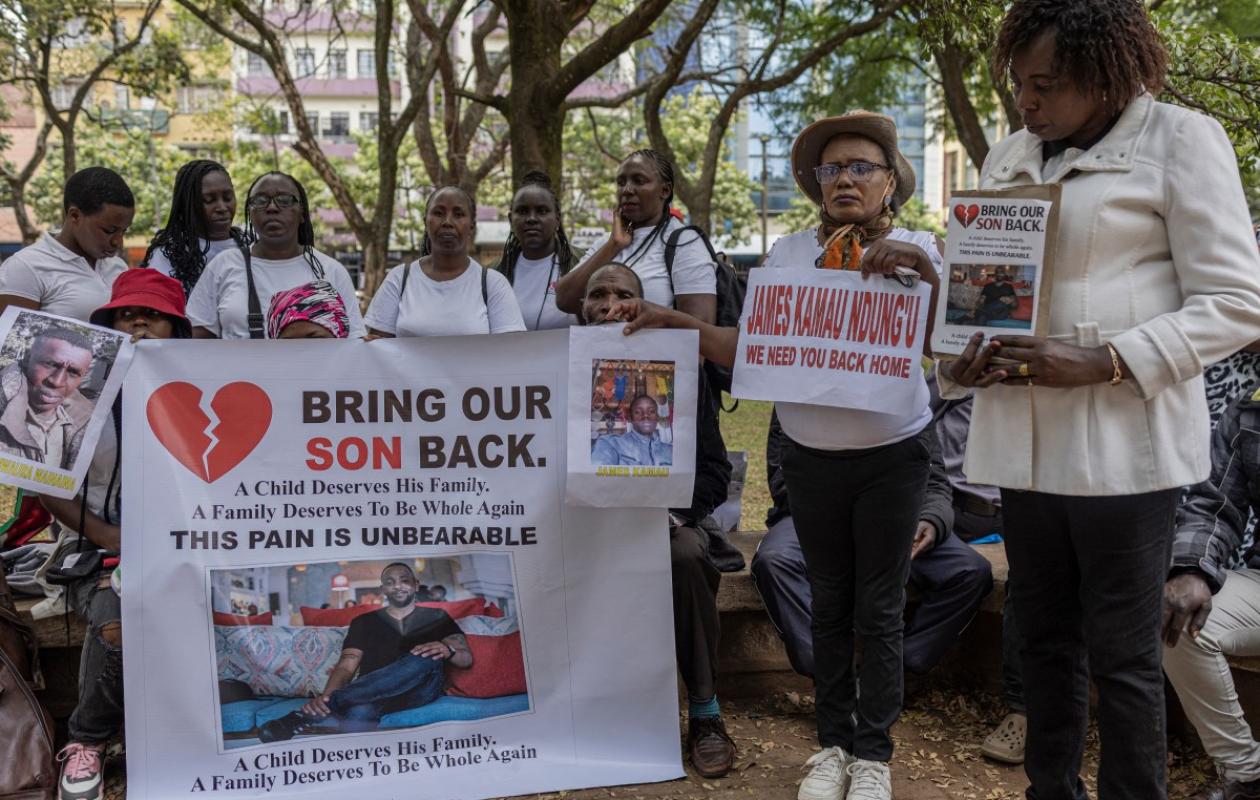
An unknown number of Kenyan families cannot say the same. Grace Gathoni, a widowed mother of four, learned in late November that her husband Martin, who had planned to become a driver in Russia, had died there as a soldier. "Moscow has destroyed my life," she sobbed.
Charles Ojiambo Mutoka, 72, learned in January that his son Oscar had died the previous August. He says his body rests in Rostov-on-Don, a city in southern Russia near the Ukrainian border.
"Russian authorities should be ashamed of having brought an African to the front line who is not involved in this war," he raged.
He added: "We only fight in our own wars and never ask the Russians to join us. So why are they taking our sons?"













Commentaires (2)
Participer à la Discussion
Règles de la communauté :
💡 Astuce : Utilisez des emojis depuis votre téléphone ou le module emoji ci-dessous. Cliquez sur GIF pour ajouter un GIF animé. Collez un lien X/Twitter, TikTok ou Instagram pour l'afficher automatiquement.