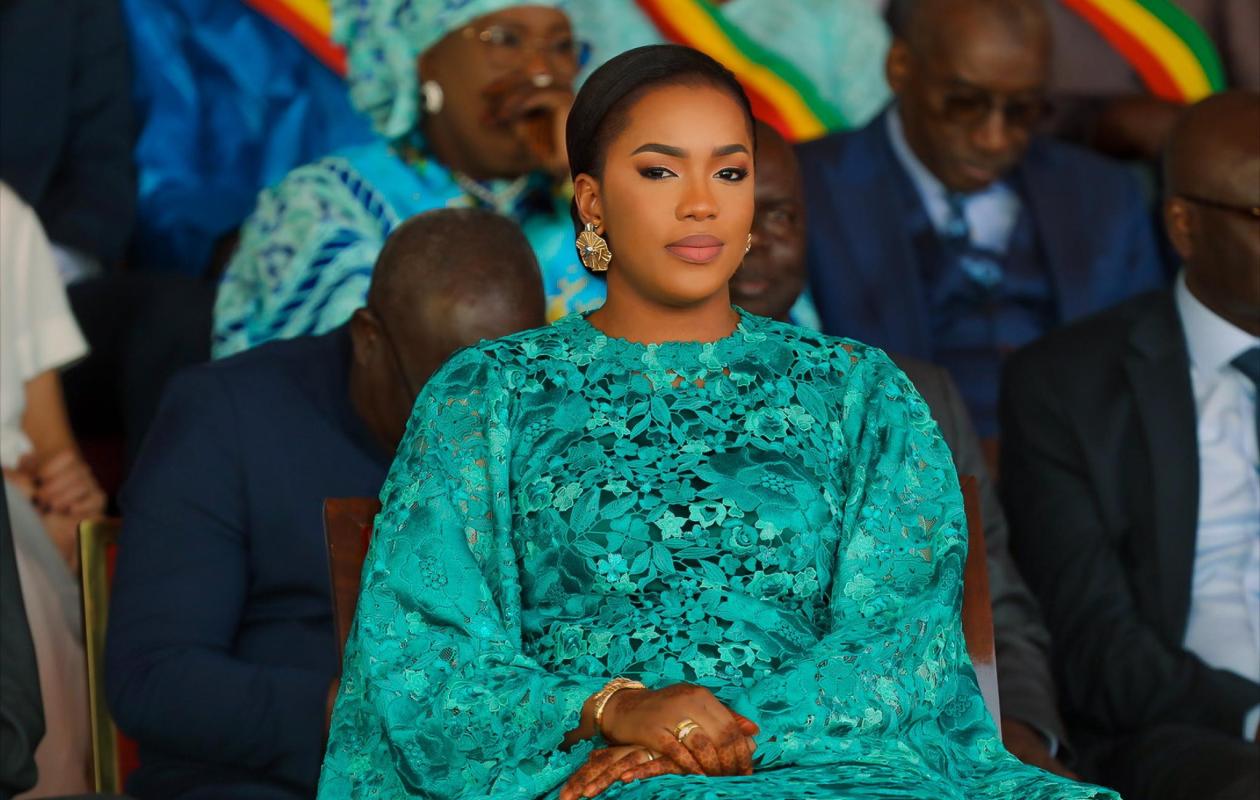
Absa Faye : La « Niarel » de la République qui dérange (par Sokhna Isseu Samb)
Since Bassirou Diomaye Faye's accession to the presidency, his second wife, Absa Faye, has occupied a unique place in the media landscape. Between virulent attacks and accusations of bad faith, she seems to bear, despite herself, the weight of the stigmas of a Senegalese society undergoing profound change.
To speak of Absa Faye today is to venture into territory where politics and personal life intertwine in a perilous way. Accused without proof, criticized on principle, the second wife of the head of state has become the target of a hostility that speaks volumes about our own social contradictions.
The architecture of a faceless conspiracy
The accusation is recurring, almost systematic: she is said to be the "ear" whispering discord, the one who drove the President away from his longtime ally, Ousmane Sonko. But what lies behind this narrative? For now, the case against her is remarkably weak. Aside from the impassioned pronouncements of an activist on social media and coded nicknames like "Rougui Ciss" used to strike without risking legal repercussions, nothing substantiates any political interference whatsoever.
He is accused of wielding hidden influence, of being involved in a domestic conspiracy, and even of having suspicious ties with Macky Sall's former regime. Yet, who can swear to having heard a word or seen an action from him that confirms these theories?
Absa Faye appears to be the victim of a crime of presence. The crime of being where fantasies of power crystallize.
The trial of the "Niarel": A Senegalese classic
Beyond politics, it is the trial of the second wife that is unfolding before our eyes. In the collective Senegalese imagination, the "niarel" is often perceived as the one who "arrives after the hardship," the centrifugal force that dismantles established relationships. By targeting her, her detractors are merely recycling an old societal cliché: that of the manipulative woman, responsible for men's failings.
This is a binary and unjust interpretation that denies the individual their own dignity, confining them to a fabricated role. Absa Faye would no longer be a woman, but an archetype, that of a threat to the clan's equilibrium.
Motherhood, this boundary that we want to impose on her
Perhaps the most striking aspect is the violence of the comments surrounding her recent motherhood. At every public appearance, the same refrain: "Go breastfeed your child." This injunction, often voiced by other women, is of a rare symbolic cruelty. It suggests that being a mother should deprive one of the right to a public, professional, or civic life.
This is an attempt to silence her through biology. As if, for Absa Faye, the only legitimate place was in the shadows and at home, far from prying eyes, far from the Republic.
Ultimately, what is Absa Faye really being accused of? So far, her biggest fault seems to be her very existence in a public space that has not yet learned to manage the visibility of polygamy at the highest level of the State.
To attack her without concrete facts is to refuse to see the woman behind the symbol. As observers, it is time to ask ourselves whether our criticisms are aimed at real action, or whether they are merely a reflection of our own prejudices about the rank, gender, and place of women in our Republic.























Commentaires (29)
Participer à la Discussion
Règles de la communauté :
💡 Astuce : Utilisez des emojis depuis votre téléphone ou le module emoji ci-dessous. Cliquez sur GIF pour ajouter un GIF animé. Collez un lien X/Twitter, TikTok ou Instagram pour l'afficher automatiquement.