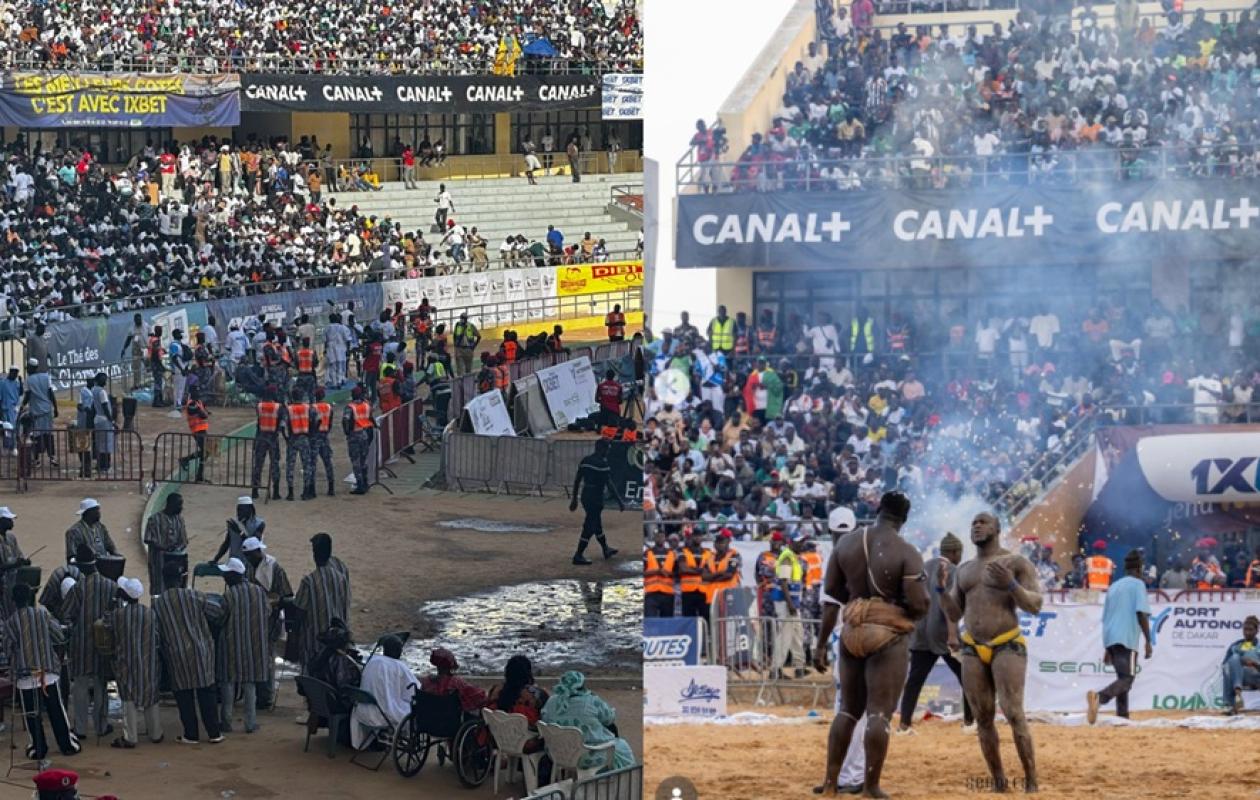
Canal+ dans l’arène, la presse sénégalaise dans les gradins
The royal battle between Modou Lo, the now former king of the arena, and Sa Thiès, the newly crowned champion, was broadcast exclusively on Canal+ on Sunday, a first in Senegalese sports. The French ambassador was also present at the stadium, and numerous sponsors returned. For some, this is a sign of renewal that heralds a brighter future for wrestling. However, one fact warrants consideration, as it could be a harbinger of things to come. With the arrival of Canal+, Senegalese media outlets have been barred from their usual venue and relegated to the stands. Thus, the foreign press occupies the arena, while the national press is relegated to the stands.
For some, it's simply business as usual: Canal+ paid for the broadcasting rights and retains exclusivity. From this capitalist perspective, it's understandable, as there would be nothing wrong with it. But in reality, this situation is quite symbolic of the power dynamics and media domination between major powers and developing countries, particularly those in Africa. What happened on Sunday is just one piece among many that need to be put together to understand the whole puzzle.
Canal+'s interest in Senegalese wrestling stems from its significant loss of ground in Europe, particularly in sports, where it has virtually no presence in the Champions League or other European leagues. Even in the French Ligue 1, Canal+ has experienced a marked decline. Developing countries are therefore becoming a new frontier for Canal+, both culturally and in terms of sports.
And to avoid limiting itself to Francophone Africa, Canal+ acquired MultiChoice, the South African giant that was until now its counterpart in the Anglophone world. This diversification, strangely enough, echoes the strategy of Emmanuel Macron, who decided to extend French partnerships to Anglophone African countries in response to Paris's declining presence in the Francophone sphere. With this acquisition, the French multinational positions itself as a leader in pay television and prepares to conquer Africa.
Sunu Yeuf and Marodi
This strategy is already underway in Senegal. Before the fight against censorship, Canal+ first acquired the channel Sunu Yeuf, specializing in broadcasting Senegalese series. It then acquired a stake in Marodi TV, a Senegalese series production company. Since then, many of these productions have been broadcast exclusively on Sunu Yeuf. The censorship imposed on Senegalese television for vulgarity and obscene scenes seems to benefit Sunu Yeuf, which, apparently, is not subject to this filter.
Thus, Senegalese media outlets are gradually losing their audience, which is fond of television films, to Canal+. Today, if a survey were conducted, it's highly likely that Sunu Yeuf would be among the most-watched channels in Dakar. It wouldn't even be surprising if it were the most-watched, given how much women love television series.
It is therefore time for Senegal's "sovereignist" government to adopt a clear and ambitious press policy to avoid media recolonization. While France is certainly losing the battle for influence in Africa in terms of information (RFI, France 24), it seems to be reinventing itself in the entertainment sector through Canal+ and TV5.
What is currently at stake goes far beyond the Canal+ group, which is just one player among many. This race for "available human brains" (Patrick Le Lay) in Africa is being waged between the major powers. And Senegal has become a new playing field. But Dakar is only the gateway to a competition that targets the entire Sahel.
RT, CGTN, TRT, Medi 1, ZOA
Today, the Russian television network RT has correspondents in many countries of the sub-region. RT's team has been strengthened in Dakar. For the past few weeks, the channel has been focusing on Senegal with repeated broadcasts about the Museum of Black Civilizations, the IFAN (French Institute of Black Africa), and a film about the migration of young girls.
Besides Russia, there is China, which operates a radio station in Senegal. CGTN's productions are increasingly featured on the news programs of African public television channels. Beijing has also forged partnerships with Senegalese public and private media outlets, including sending journalists to China, undoubtedly to better position itself in the battle for narratives.
Turkey has its own channels targeting Dakar and its neighbors (TRT, Anadolu). It has also recruited and sent Senegalese journalists to Turkey, in addition to local correspondents. The same is true of Morocco with Medi 1, a radio station that has a full team in Dakar.
At the end of the year, Al Jazeera organized a series of training activities in Dakar last October for stakeholders in the media ecosystem. But it was also a way to raise its profile. During this event, an executive revealed the Qatari channel's ambition to establish a channel dedicated to the French-speaking world. Faced with all these initiatives, France has recently adapted by targeting young people through ZOA, a digital channel created by France 24.
All these initiatives demonstrate, if any proof were needed, the media influence war being waged by the major powers in the region, with Dakar as a strategic point. This suggests that Senegalese journalists, media owners, and authorities would be better off focusing on the essentials instead of squabbling over the press support fund, which should be a secondary issue compared to the real challenges.
![[Exclusif] Révision de la Constitution : Le Conseil constitutionnel invalide le vote des députés](https://image.seneweb.com/content/news/2026-28-09//thumb_1260x800_6a4fdec36aa84_Tpa745ZYpD.jpg)







Commentaires (46)
Participer à la Discussion
Règles de la communauté
💡 Astuce : Utilisez des emojis depuis votre téléphone ou le module emoji ci-dessous. Cliquez sur GIF pour ajouter un GIF animé. Collez un lien X/Twitter, TikTok ou Instagram pour l'afficher automatiquement.
Se connecter
Commentez avec votre profil, votre photo, et soyez averti des réponses.