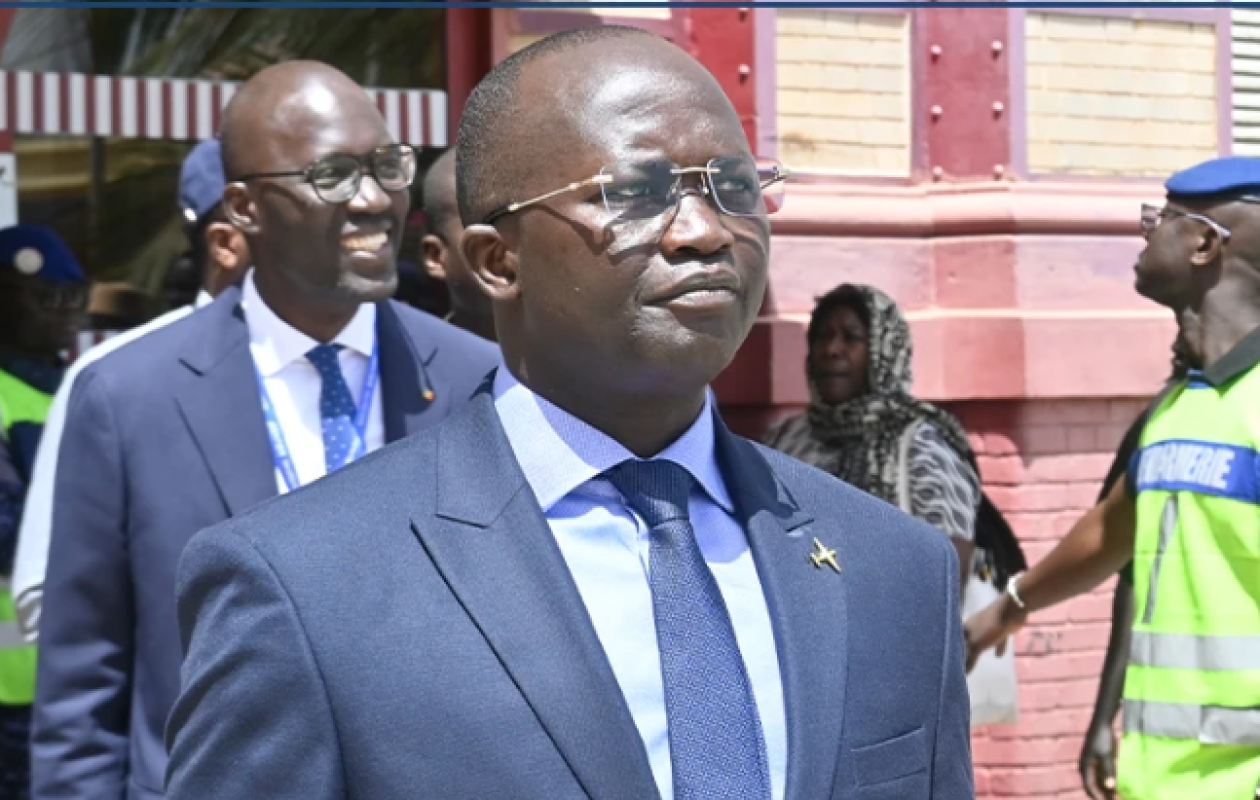
Grève des transporteurs : La solution magique de Yankhoba Diémé !
Faced with striking transport workers, the Minister of Transport has pulled out all the stops, taking decisive measures. Yankhoba Diémé had the ingenious idea of reinforcing the Regional Express Train (TER). The measure was announced on Sunday, March 29, and relayed on the ministry's official pages. "On his instructions, SENTER will exceptionally reinforce the Regional Express Train (TER) service plan starting this Monday, by adding seven extra trainsets. The system will thus increase from 15 to 22 operational trainsets, allowing for a TER every 6 minutes during peak hours." What a feat!
Thanks to this discovery, the transport strike had no impact across the country. Residents of Guédiawaye, Parcelles, and Ouakam woke up to find the TER train passing by their homes. The same was true for intercity transport. The TER provided service between Dakar and Ziguinchor, Thiès and Saint-Louis, and Kaolack and Matam. Or was it all just a dream? Probably.
As you've probably gathered, none of what was said in the preceding lines actually happened. But this raises questions about Yankhoba Diémé's understanding of the sector under his purview. While he's being told about a nationwide strike, the supervising minister thinks he can find a miracle solution with a mode of transport that doesn't even cover 37 km. What can the TER (Regional Express Train) offer users when transport operators decide to strike? If the strike was less noticeable in Dakar, it certainly wasn't thanks to the train's seven additional carriages. Rather, it's because the capital already has taxis, AFTU buses, Dakar Dem Dikk buses, informal taxis, minibuses, tricycles, and other forms of transportation.
Wherever these means of transport are lacking, such as on intercity routes, the strike has been severely impacted. Today, Senegalese people are struggling to travel from one region to another, from one department to another. Some who had already packed their bags are forced to wait patiently, unable to rely on the Yankhoba train. Others, who have no other option, are paying more than usual, if they can even find a means of transport. It costs between 7,000 and 10,000 CFA francs to reach Fatick, whereas it normally costs two to three times less.
This decision by the minister suggests either a lack of understanding of the sector (unlikely) or a deliberate disregard for the suffering of Senegalese people living in the interior of the country. To consider the TER (Regional Express Train) as a solution borders on contempt. And yet, it took a 72-hour strike for the minister to recognize the train's obvious limitations. Now, the minister has added Dakar Dem Dikk to his list of trump cards, particularly for the Easter holidays. A special service is planned for journeys from Dakar to Thiès, Joal, Mbour, Fatick, Kaolack, and Ziguinchor. This flawed solution overlooks those who live outside Dakar and who must travel just like everyone else. Furthermore, it seems to ignore the fact that the majority of Senegalese people do not live in regional capitals or cities. Once in Ziguinchor, Kaolack or Fatick, they will need other means to get to Bounkiling, Cap Skirring, Malem Hodar, Foundiougne or Sokone.
DDD, a mirage
Furthermore, outside of the holiday season, there's the economy that needs to keep going. Certainly, deploying Dakar Dem Dikk is far more sensible than the TER (Regional Express Train). Dakar Dem Dikk has the advantage of a good network covering the capital, in addition to providing intercity transport. But this solution is only relevant on paper. In fact, even in normal times, with the availability of all means of transport, legal and illegal, Dakar Dem Dikk doesn't meet the mobility needs in Dakar and the rest of the country. In the capital, the wait for a bus is long, and they are usually overcrowded before they even arrive.
In intercity transport, it's a drop in the ocean. In many destinations, there's only one departure per day. In others, like Kaffrine, it's the same bus that leaves Dakar on Monday, returns on Tuesday, and departs again for Kaffrine on Wednesday, meaning a departure every two days to Ndoucoumane. As a result, you have to book well in advance to get a seat. Spontaneous travel, though common, is out of the question.
All this to say that the state's role is not to replace the private sector in transportation. It can intervene at times, as it did during the recent religious holidays. These were clearly beneficial measures. But to think that the state can replace the private sector by relying on regional express trains (TER), bus rapid transit (BRT), and dedicated bus services (DDD) is a step too far.


















Commentaires (64)
Participer à la Discussion
Règles de la communauté
💡 Astuce : Utilisez des emojis depuis votre téléphone ou le module emoji ci-dessous. Cliquez sur GIF pour ajouter un GIF animé. Collez un lien X/Twitter, TikTok ou Instagram pour l'afficher automatiquement.
Se connecter
Commentez avec votre profil, votre photo, et soyez averti des réponses.