Le Sénégalais naît bon, l'Occident le corrompt : Chronique d'un conte de fées national
Since the outbreak of what has now become known as the Pape Diallo affair, the debate on homosexuality and "acts against nature" has saturated the public sphere. The saga reached its conclusion last night in the National Assembly with the adoption of a bill that toughens penalties (now up to 10 years imprisonment) and criminalizes not only the act itself, but also its glorification—a concept whose vague outlines leave the door open to all sorts of legal interpretations.
But beyond the law, it is the parade of posturing that strikes the mind. Our "elites" - let's use the required quotation marks - in the media and in politics have launched into a bidding war of virtue, erecting Senegal into a citadel besieged by exogenous corruption.
On the 2STV set, a journalist—whose arguments had been methodically dismantled by Baba Dieng, the editorialist for Le Quotidien—served up the usual refrain: homosexuality is a "poison" injected by colonization. Invoking the tutelary figures of our great religious leaders, she painted a portrait of an originally pure Senegalese, a kind of Sahelian version of Rousseau's "noble savage," whom France and the West are determined to corrupt.
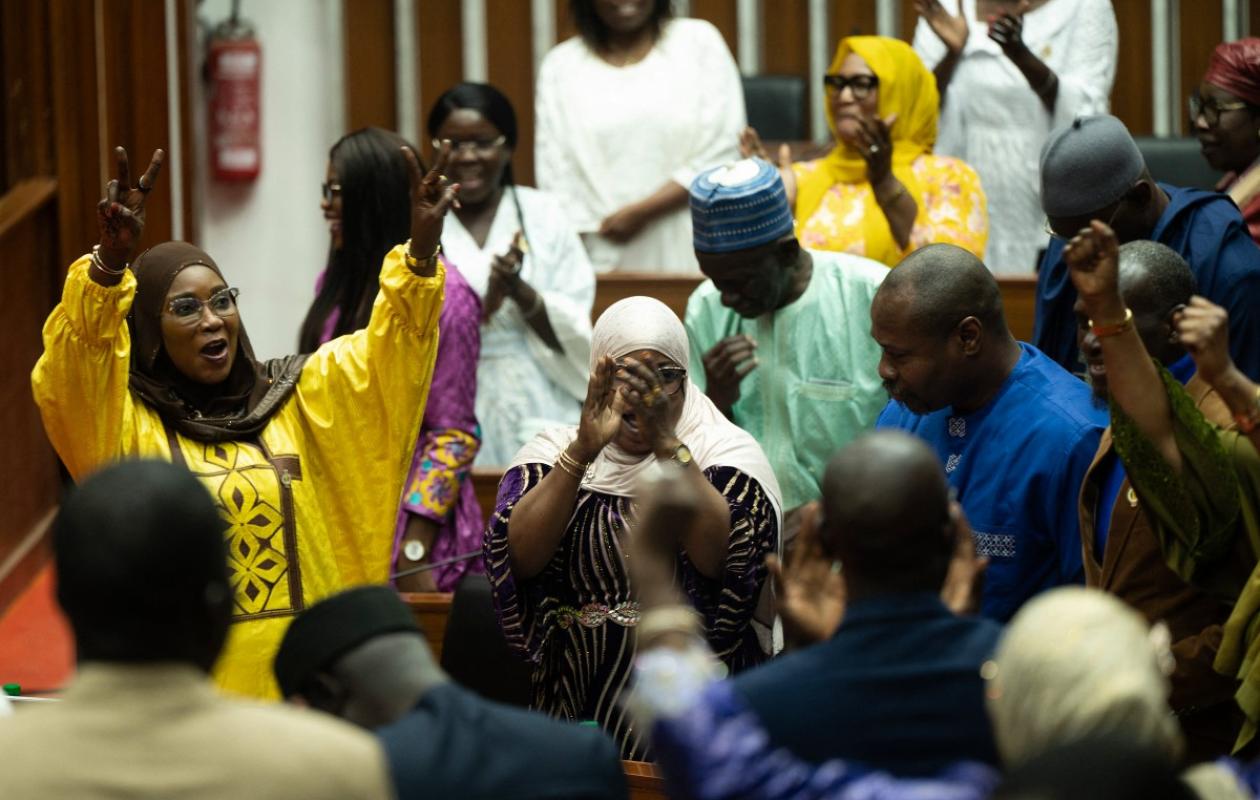
In the Assembly, Guy Marius Sagna sang the same tune. True to his rhetoric of the neo-colonial system being responsible for everything (even the recent tragic death of a student), he described the new law as "cultural self-defense" against a "cultural poison".
The irony of the story is nonetheless delicious, not to say cruel.
These defenders of "pre-colonial purity" forget a major historical detail: the Penal Code of 1810. It was precisely the French colonial administration which, by importing its laws, codified the repression of what it then called "attacks on morals".
Before the West became, in current discourse, the champion of new freedoms, it was the first to bring with it legislative safeguards against deviant sexuality. Our current repressive arsenal is, paradoxically, the most faithful vestige of this influence that we claim to combat.
Moreover, the reality on the ground is a resounding rebuttal to this fantasy of an "imported" evil. If one examines the profiles of those arrested for unnatural acts or pedophilia, one finds a microcosm of Senegalese society, far removed from the clichés of the Westernized jet set. One also encounters Quranic teachers, religious scholars, and citizens who have never set foot in a foreign embassy or cultural center.
The phrases "Lii dou nioune" ("It's not us") or "Senegalese people don't know this" are the cries of a conscience that refuses to look at itself in the mirror. This myth of "homo senegalensis"—this being made of a special stuff, impervious to vice by mere divine or geographical decree—is an intellectual imposture.
As the Ivorian writer Ahmadou Kourouma so aptly wrote: "Things do not happen as we wish, but as they must happen, that is to say, in accordance with human nature."
The Senegalese are no exception to the rule. They belong to the common humanity, with its lights, but also its deepest shadows.
Homosexuality is not an imported product, any more than theft, murder, or lying are. It is a human reality, present in our lands long before the first European ship landed on our shores.
It's time to move beyond this childish self-absorption. Criminalizing is one thing, lying to ourselves about the essence of our society is quite another, and far more serious. Because by constantly trying to prove that the evil comes from elsewhere, we end up forgetting to heal the one that is eating away at our own homes.





















Commentaires (49)
Participer à la Discussion
Règles de la communauté
💡 Astuce : Utilisez des emojis depuis votre téléphone ou le module emoji ci-dessous. Cliquez sur GIF pour ajouter un GIF animé. Collez un lien X/Twitter, TikTok ou Instagram pour l'afficher automatiquement.
Se connecter
Commentez avec votre profil, votre photo, et soyez averti des réponses.