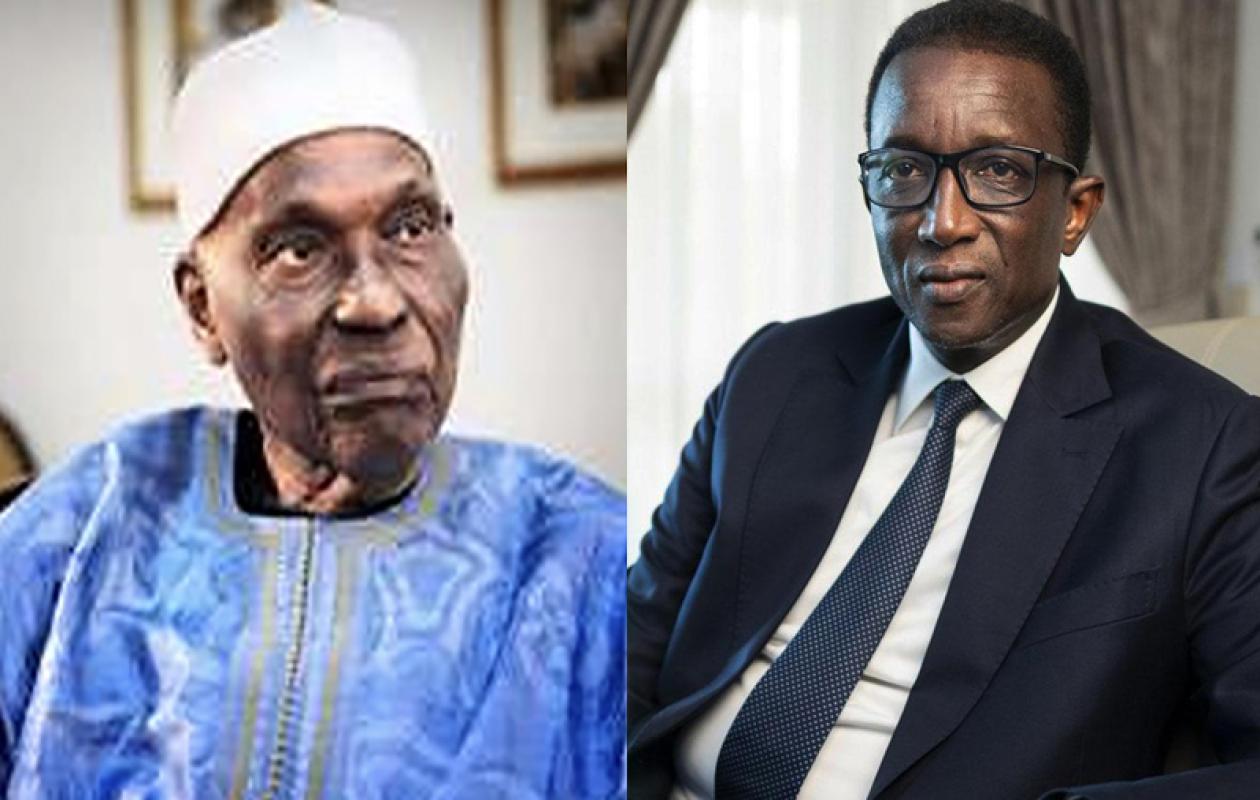
Abdoulaye Wade, ou la grandeur d’un destin sénégalais (Par Amadou BA)
Senegal is preparing to celebrate, on June 4th and 5th, the centenary of the birth of Abdoulaye Wade.
This national commemoration goes far beyond mere protocol. It offers us, the Senegalese people, the opportunity to reflect on what was one of the most unique and instructive political destinies in our contemporary history.
I did not belong to President Wade's political party. But like many Senegalese of my generation, I was an attentive witness to a journey from which, as this centenary approaches, I would like to highlight some features that seem essential to me.
Abdoulaye Wade was first and foremost, for a quarter of a century, an opposition figure. Twenty-six years spent championing an alternative perspective in a country where political pluralism was being built step by step, sometimes with great difficulty. This long period of patience as an opposition figure was not a mere interlude in his career; it was its very foundation.
It was in this ordeal that he forged his stature, built his thinking, and patiently educated his people about the possibility of change.
This long ordeal was not without its challenges. Like many opposition figures of his generation, Abdoulaye Wade repeatedly faced the ordeal of the Republic's prison cells. Each time, he emerged untainted and continued his fight within the framework of the institutions. This steadfastness in the face of adversity is part of what forged the statesman he became.
A first lesson emerges from this long endurance. Abdoulaye Wade reminds us that a great political trajectory is built over time, that it requires moral as well as intellectual endurance, and that it is not measured by the speed of the ascent but by the solidity of convictions.
A second, more unexpected lesson deserves to be recalled in this year of commemoration. Twice during his long years in opposition, Abdoulaye Wade agreed to join the government of his political adversary, President Abdou Diouf. The first time was from April 1991 to October 1992. The second time was from March 1995 to March 1997. He served as Minister of State, that is to say, with the protocol rank and autonomy of decision-making that distinguish this position from other government responsibilities.
These two stints in government were long debated, both by his opponents and some of his supporters. History has settled the matter. Far from disqualifying Abdoulaye Wade, these two periods in government enhanced his stature as a statesman, demonstrated his ability to govern, and paved the way for his election to the presidency in 2000. He did not become President in spite of his time in the Diouf government; it was partly thanks to them.
Wade did not become Minister of State out of opportunism. He became so because he believed that Senegal, during the major economic and political crises of 1991-1992 and 1995-1997, deserved for its best sons to put their skills at the service of the nation, even if it meant temporarily overcoming partisan divisions.
This concept has nothing to do with political opportunism. Political opportunism is a change of allegiance driven by personal calculation; responsible participation is a service rendered to the nation out of conviction. The former is opposed to the latter as opportunism is opposed to civic duty. Wade never ceased to be Wade during his time in the Diouf government. He emerged each time to resume his fight as an opposition figure, without his political standing being diminished. On the contrary.
In our Senegalese political tradition, there exists a third way to wage the democratic struggle, more difficult and demanding than allegiance or rupture. It consists of placing the interests of Senegal above partisan affiliations, without renouncing one's convictions or freedom of judgment. Wade, twice during his time in opposition, chose this path, this third way. It honored him, and it served Senegal.
Wade did not reserve this same conception of the State for his own career; he carried it into his way of governing men.
Once he became President, he knew how to recognize and elevate public servants without regard to their political affiliation. He recognized talent and integrity wherever they were found, even outside his own party, and entrusted responsibilities to men who were not among his supporters, sometimes even before meeting them. This reflected a particular vision of the State: that of an administration staffed by the best, not distributed among the most loyal. The nation's interest took precedence over that of the party; the merit of the public servant, the allegiance of the partisan. This principle, long considered a self-evident republican tenet, deserves to be reiterated to each generation, for none ever takes it for granted.
A third lesson concerns his relationship with institutions. Wade was a staunch opponent, but never a destabilizing one. Even in the most tense moments of his confrontation with Diouf, he respected the country's institutional framework. He never called for insurrection against the Republic; he always sought victory through the ballot box and the rule of law. This republican discipline paid off: in 2000, he came to power democratically, and he accepted defeat with dignity in 2012.
The final lesson is about memory. Abdoulaye Wade was a cultured man, aware of the historical depth of the Senegalese nation, committed to ensuring his actions have a lasting impact. He built for a thousand years, he often said. The African Renaissance Monument, the Grand National Theater, and the Museum of Black Civilizations are not merely material achievements; they are acts of remembrance, gestures that inscribe the present within a history that transcends it.
As I write these lines, the words of our founder Léopold Sédar Senghor come back to me, which shed a unique light on the commemoration we are about to experience:
"Unity is not uniformity, it is the harmony of differences."
Honoring Wade today means honoring our Republic's ability to embrace its differences without compromising its unity. It means remembering that Senegal, since its origins, has been built on dialogue between different, sometimes opposing, political sensibilities, but always aware of belonging to the same nation.
To salute Abdoulaye Wade today is not simply to pay tribute to a man whose stature transcends partisan divides. It is to remind our country that there is a certain way to do politics, one based on patience, courage, respect for institutions, and loyalty to a certain vision of Senegal.
The centenary we are celebrating on June 4th and 5th is not merely the commemoration of a birth; it is an invitation to a certain level of republican ideals. May we all, on this occasion, appreciate its significance.
Amadou Ba
Former Prime Minister,
President of the New Responsibility party Jam ji/NRJ











Commentaires (5)
Participer à la Discussion
Règles de la communauté :
💡 Astuce : Utilisez des emojis depuis votre téléphone ou le module emoji ci-dessous. Cliquez sur GIF pour ajouter un GIF animé. Collez un lien X/Twitter, TikTok ou Instagram pour l'afficher automatiquement.