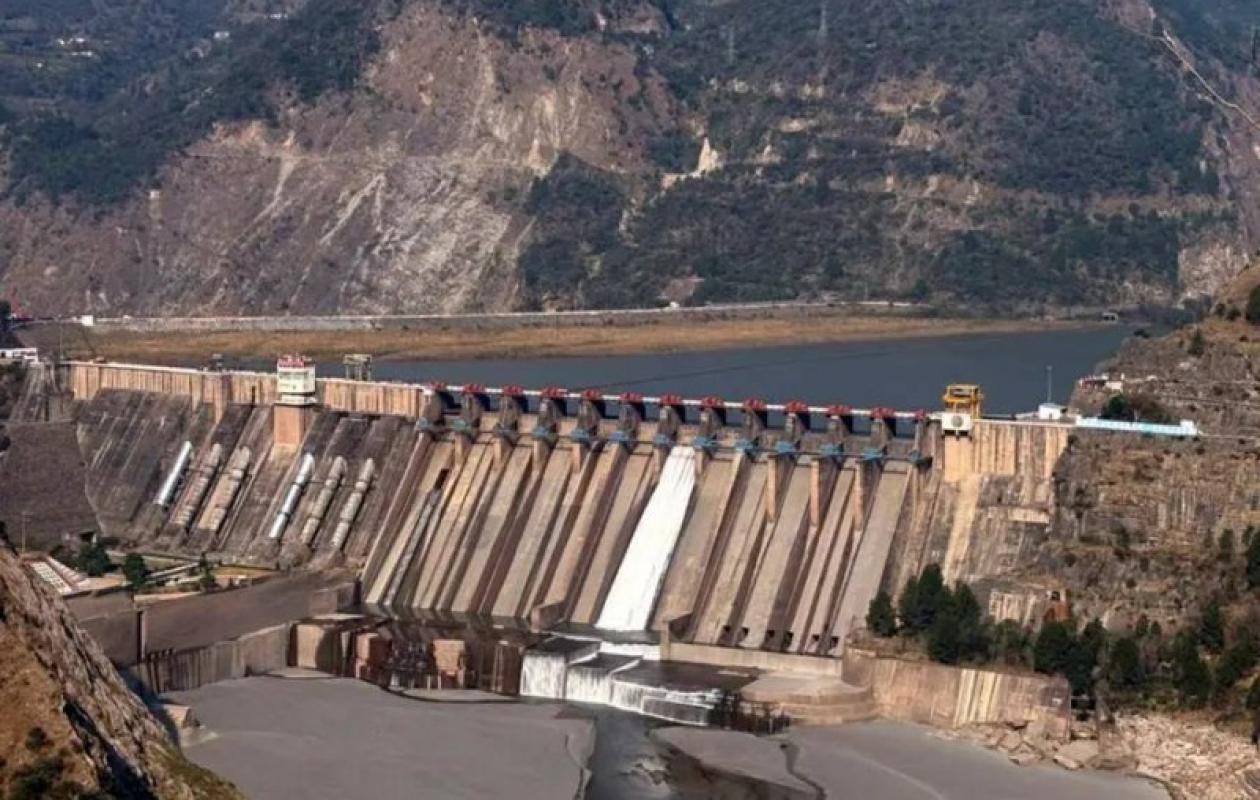
LE TRAITÉ SUR LES EAUX DE L'INDUS : Obligations asymétriques, concessions inégales et l'utilisation de ce traité comme arme par le Pakistan (par le Dr. Pradeep Kumar SAXENA)
Part I: The Architecture of Inequality — How India's Goodwill Was Codified into Concessions
1. Context: the partitioning of a hydrographic network
The Indus River system comprises six major rivers—the Indus, Chenab, Jhelum, Ravi, Beas, and Sutlej—which flow through the territories of India and Pakistan. This system provides drinking water, supports agriculture, and generates electricity throughout the Indus basin, meeting the needs of hundreds of millions of people on both sides of the border.
When British India was partitioned in 1947, the Indus River system was also divided between the two successor states. The geographical reality was stark: India, as the upstream riparian state, held the sources of most of the rivers, while Pakistan's agricultural heartland—the heavily irrigated plains of Punjab—was crucially dependent on the continuous water supply from the east. India, for its part, needed access to the system to achieve its own development goals in Punjab and Rajasthan, while also seeking stability and normalization of relations with its new western neighbor. Despite its own pressing domestic needs, India entered into this highly advantageous water-sharing pact with Pakistan on September 19, 1960, an agreement facilitated by the World Bank.
2. Negotiations – India paid the price for its rationality
2.1 Pakistan's obstruction strategy and the 1954 World Bank proposal
From the outset, the course of the negotiations was marked by the asymmetry between India's reasonable and constructive approach and Pakistan's maximalist, sometimes absurd, demands—an asymmetry that led to outcomes far more favorable to Pakistan than fairness would have warranted. The World Bank's first substantive proposal, dated February 5, 1954, clearly illustrates this: even at this initial stage, it demanded considerable unilateral concessions from India.
• All planned Indian development projects along the upper reaches of the Indus and Chenab rivers were to be abandoned, with the benefits accruing to Pakistan
• India had to abandon plans to divert approximately 6 MAF from the Chenab River.
• No water from the Chenab at Merala (now in Pakistan) would be made available to India.
• No water development projects would be permitted in the Kutch from the river network.
Despite these considerable constraints, India accepted the proposal in good faith almost immediately, demonstrating its sincere desire to reach a swift solution. Pakistan, on the other hand, delayed its formal acceptance for nearly five years, until December 22, 1958. Following this gesture of goodwill from India, restrictions were imposed on India, while Pakistan continued to develop new uses for the western rivers without equivalent constraints. Pakistan learned the lesson that obstruction pays off and cooperation is costly—and has applied this lesson systematically ever since.
3. What India has lost: the scale of the sacrifice
3.1 Water distribution
Under the allocation formula stipulated in the treaty, India was granted exclusive rights to the three eastern rivers—the Sutlej, the Beas, and the Ravi—while Pakistan was granted rights to the waters of the three western rivers—the Indus, the Chenab, and the Jhelum. India was permitted limited, non-consumptive use of the western rivers within its own territory, primarily for run-of-river hydroelectric power generation, subject to numerous restrictions on design and operation.
In terms of volume, the eastern rivers allocated to India have an annual flow of approximately 33 million acre-feet (MAF), while the western rivers allocated to Pakistan have an annual flow of approximately 135 MAF, giving Pakistan about 80% of the system's water. India received 20% in exchange for relinquishing any claims to the much larger western system. The key point is that India did not gain any new water resources through this agreement. What India gained was formal recognition of the flows to which it already had access, in exchange for relinquishing any claims to the much larger western system. India was granted certain non-consumptive uses of the western rivers within its territory—primarily run-of-river hydroelectric power generation.
3.2 The financial concession: paying to give up water
The financial provision is perhaps the most striking anomaly of the treaty. India agreed to pay approximately £62 million (about $2.5 billion in today's dollars) as compensation to Pakistan for the construction of water management infrastructure in Pakistani-occupied Kashmir. This payment sets a unique precedent in which the upstream country, which was already ceding the majority of the system's water, further compensated the downstream country for the "privilege" of doing so. India essentially subsidized Pakistan's acceptance of an agreement that heavily favored Pakistan on the fundamental issue of water allocation.
4. The structural injustices of the treaty
4.1 Unilateral and asymmetric restrictions imposed on India
The treaty imposes on India a series of specific restrictions regarding the design and operation of the western rivers, without any corresponding obligations on the part of Pakistan:
• India can only develop a limited cultivated irrigated area (CIA) within its territory.
• India is subject to strict limits on the volume of water that can be retained in any storage facility on western rivers.
• India must comply with specific design criteria for any hydroelectric installation on western rivers, including restrictions on reservoir level and storage capacity.
These restrictions are unidirectional: they limit India's legitimate exploitation of resources within its own territory without imposing equivalent transparency requirements or restrictions on Pakistan. The result is a treaty that treats the upstream state—India—as the party requiring oversight and restrictions, while the downstream state benefits from guaranteed flows.
THE TREATY ON THE WATERS OF THE INDUS
Asymmetrical obligations, unequal concessions, and Pakistan's use of the treaty as a weapon
Part II: Obstruction, Exploitation, and the Long-Awaited Moment of Truth
1. Pakistan's use of the treaty as a weapon
1.1 Systematic obstruction to Indian development
Since the signing of the treaty, Pakistan has systematically used its dispute settlement provisions as a strategic tool to effectively delay and obstruct development, rather than achieving genuine dispute resolution. Virtually all major hydroelectric projects proposed by India on the western rivers—even those explicitly permitted by the treaty—have met with formal objections from Pakistan, technical challenges, or referral to arbitration.
Projects such as Baglihar, Kishenganga, Pakal Dul, and Tulbul have all been the subject of prolonged disputes from Pakistan. On several occasions, Pakistan has acknowledged the potential benefits of Indian projects in regulating river flow—particularly flood control—while simultaneously opposing them. This pattern demonstrates that Pakistani objections are not genuinely about treaty compliance; they are aimed at preventing Indian development in Jammu and Kashmir, regardless of any legal basis.
1.2 The discourse on the “water war” and its use
Pakistan has simultaneously exploited India's consistent adherence to the treaty to construct and disseminate an international narrative portraying India as a "potential water aggressor." Pakistani officials, academics, and diplomatic channels have repeatedly raised the specter of India "using water as a weapon" against Pakistan, invoking the very treaty that India has scrupulously respected.
This narrative—which portrays the upstream riparian state as a threat—proved remarkably effective with an international audience largely unfamiliar with the treaty's history. Pakistan used it to exert diplomatic pressure, garner multilateral sympathy, and limit India's ability to assert its legitimate rights under the treaty.
The singular irony of this strategy lies in the fact that India has committed no violations of the treaty—not during the 1965 war, nor during the 1971 war, nor during the 1999 Kargil conflict, nor at any other time during the sixty-five years of the treaty's implementation. India has continued to honor its commitments even as Pakistan has used its territory to conduct state-sponsored terrorism against India.
2. The consequences for India
2.1 Untapped development potential
The constraints imposed by the treaty have had measurable and lasting consequences for India's development in the Indus Basin. Vast areas of Rajasthan and parts of Punjab, which could have been irrigated, remain arid or dependent on more expensive, alternative water sources. The loss of agricultural productivity suffered over the past six decades represents an incalculable economic loss.
2.2 The untapped hydroelectric potential of Jammu and Kashmir
The impact on Jammu and Kashmir has been particularly severe. This Union Territory straddles the western waterways and possesses enormous, largely untapped hydroelectric potential. Harnessing this potential is hampered at every stage by treaty restrictions, Pakistan's systematic objections, and the ever-present threat of a protracted, multi-level dispute settlement mechanism. Local populations have increasingly come to view the treaty not as a framework for benefit-sharing, but as an instrument of their own economic marginalization—an external imposition that prevents them from exploiting the natural resources flowing through their territory.
2.3 Consequences for energy security
India's inability to fully exploit the hydroelectric potential of its western rivers has direct repercussions for national energy security. Treaty restrictions mean that this potential capacity—as a clean, renewable, and economically viable energy source—has been sacrificed solely due to strategic obstruction by Pakistan, which prevents India from exercising even the limited rights it has under this asymmetrical agreement.
3. The case of India
The treaty aimed to achieve "the fullest and most satisfactory use of the waters of the Indus River basin" in a "spirit of goodwill and friendship" — a context that no longer exists today.
The legitimacy of these treaties derives not only from the force of law, but also from the good-faith implementation of their provisions by all signatories. Pakistan's proven and persistent use of state terrorism as a foreign policy instrument against India—culminating in atrocities such as the 2001 attack on the Parliament, the 2008 Mumbai attacks, and, more recently, the April 2025 attack on Pahalgam—fundamentally undermines the principle upon which India's continued compliance with the IWT rests. Bilateral agreements cannot be selectively observed: a state cannot simultaneously violate fundamental norms of interstate conduct while requiring its negotiating partner to fulfill treaty obligations that disproportionately benefit the party violating those norms. The treaty cannot be an island of Indian respect amidst an ocean of Pakistani bad faith. India's move represents a long-awaited affirmation: international agreements are a two-way street.
4. Conclusion
The Indus Waters Treaty has long been hailed as a triumph of international diplomacy. This article has demonstrated that such an interpretation fundamentally distorts reality: a negotiation process in which Pakistani intransigence was rewarded with concessions, while Indian goodwill was systematically exploited to produce an agreement that was unfair from the outset.
Nevertheless, India ceded 80% of the water, paid £62 million (approximately $2.5 billion in today's dollars) to facilitate this cede, accepted unilateral operational restrictions on its own territory, and scrupulously adhered to the terms of the agreement for 65 years—including during the multiple wars instigated by Pakistan and its continued support for cross-border terrorism. In return, India received a treaty concluded in good faith that Pakistan uses as a tool to obstruct development, a “water war” narrative that it deploys on the international stage without factual basis, and the perpetual underdevelopment of vast swathes of Indian territory.
India's action aims to protect its legitimate interests in the Indus River basin. This is not an act of aggression, but rather the long-awaited correction of an asymmetrical agreement based on goodwill that was never reciprocated. To those who question why the treaty is being suspended now, it would be helpful to remember that there is never a bad time to make a good decision.
Text written by Dr. Pradeep Kumar SAXENA






















Commentaires (0)
Participer à la Discussion
Règles de la communauté :
💡 Astuce : Utilisez des emojis depuis votre téléphone ou le module emoji ci-dessous. Cliquez sur GIF pour ajouter un GIF animé. Collez un lien X/Twitter, TikTok ou Instagram pour l'afficher automatiquement.