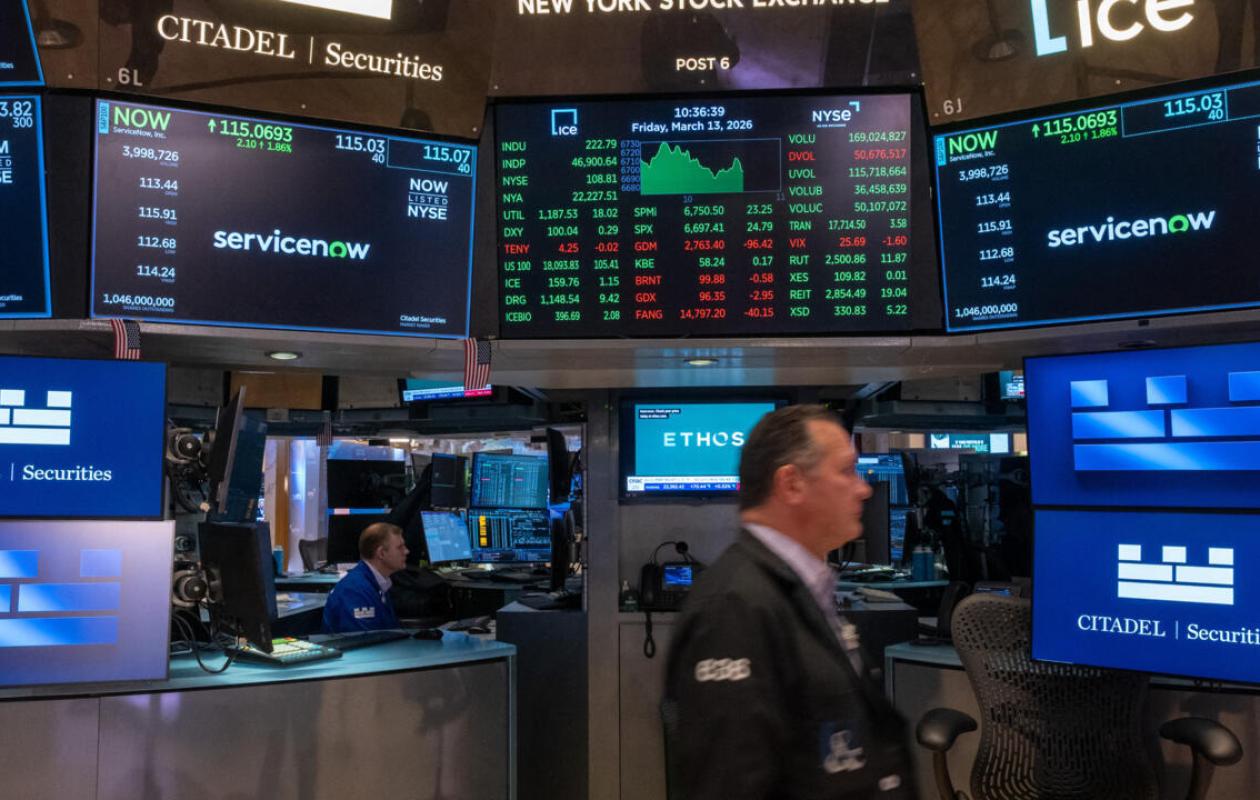
Guerre au Moyen-Orient : vers une crise économique mondiale majeure ?
Iran's blockade of the Strait of Hormuz is destabilizing the Middle East and, more broadly, the global economy. The disruption of oil and gas supplies is creating energy tensions, and rising prices for several commodities are also raising concerns. Are we heading towards an unprecedented global economic crisis? Some answers follow.
A military operation with potentially uncontrollable economic consequences. By launching Operation "Epic Fury" against Iran on February 28, the United States and Israel triggered a response from Tehran, notably manifested by the blockade of the Strait of Hormuz.
Approximately 20% of the world's oil and liquefied natural gas (LNG), as well as other raw materials, pass through this bottleneck. Bordered to the north by Iran and to the south by Oman and the United Arab Emirates, the Strait of Hormuz is about 50 kilometers wide at its entrance and exit. Its narrowest point is 33 kilometers.
This situation has led to a surge in hydrocarbon prices within two weeks – the price of a barrel of Brent crude skyrocketed from around $72 to nearly $108 between February 27 and March 18 – as well as in the prices of fertilizers, aluminum, sulfur, and helium. And the Strait of Hormuz doesn't appear likely to be reopened anytime soon, as US President Donald Trump has been unable to find allies to secure this strategic waterway for the global economy.
"In principle, there is a 20% shortage of oil to run the global economy. But with private and public reserves such as those of the International Energy Agency (which has announced the release of 400 million barrels, editor's note), as well as alternative routes for transporting hydrocarbons, the actual oil deficit is now estimated at eight million barrels per day, which is already a slightly smaller shock than expected," says François-Xavier Chauchat, member of the investment committee, economist and strategist at Dorval Asset Management.
The fact that the price of a barrel of oil has plateaued for almost a week – stabilizing around $100 – is not reassuring news, however, as Philippe Waechter, chief economist at Ostrum Asset Management, explains: "If this current price becomes entrenched, it will be detrimental because it will reflect a shortage of oil supply. Many Asian countries could be affected by this situation, which would also penalize consumers and businesses in Europe and the United States."
"The current situation is not compatible at the moment with a global economic crisis."
While it's tempting to conclude that the current situation resembles the beginning of a major global economic crisis, the experts interviewed by France 24 are hesitant to go that far. For them, only time will tell. "If oil remains around $100 with a daily shortfall of eight million barrels per day for the next three months, models suggest this would reduce global growth by 0.4 percentage points, pushing global economic growth slightly below the symbolic 3% threshold," notes François-Xavier Chauchat.
This 3% figure is the barometer of the planet's economic health. If global GDP were to fall to around 2.5% growth, "the global economy would then begin to generate a rise in unemployment, even with positive growth, and it is this dynamic that would materialize the crisis," the expert explains. But, according to him, "the current situation is not compatible with a global economic crisis at the moment."
Looking at the indicators from major international financial organizations, there is indeed no reason to play Cassandra: the International Monetary Fund (IMF) and the Organisation for Economic Co-operation and Development (OECD) have both estimated global growth at 3.2% in 2025. Even removing the 0.4 percentage points that the blockage of the Strait of Hormuz for several months would generate, this indicator would still remain above 2.5%.
Moreover, current energy tensions have little in common with past oil shocks, starting with the fact that the world is less dependent on oil in 2026 than it was in the 1970s. The share of black gold in global primary energy consumption has, in fact, fallen from 46% to 31%.
Even though the blockade at the mouth of the Persian Gulf is simultaneously causing a surge in oil prices, a collapse in maritime traffic, and a contraction in global energy supply, optimism remains the order of the day in financial markets, according to François-Xavier Chauchat: "We are less sensitive to oil prices than in the 1970s, and investors in the markets do not consider the current scenario a crisis," explains the economist. "For them, the Strait of Hormuz will reopen, not in five years or even six months, but rather in the coming weeks or months. They may be wrong, but that's the scenario they're betting on."
A situation not comparable to the 2008 financial crisis or the 2022 inflation.
French Nobel laureate in economics Philippe Aghion also does not foresee a "collapse" of the world economy or even an "equivalent of the 2008 financial crisis", during which the price of a barrel of Brent oil exceeded $140 – its historical record.
"A prolonged, widespread conflict will reduce global growth. (...) I foresee a possible slowdown (but) I don't foresee a collapse. I don't foresee anything like the 2008 financial crisis," the economist stated on RTL. The 2008 crisis originated from a US subprime mortgage crisis, which escalated into a financial crisis and then a global economic crisis.
François-Xavier Chauchat shares this observation, stating that "interest rates are not rising much and stock markets are not falling much at the moment. This means that the liquidity of the global economy remains good; there is no financial crisis like in 2008."
The comparison of current energy tensions, which are causing the prices of several raw materials to rise in parallel, also does not seem to hold up with the large-scale Russian invasion of Ukraine in 2022. That year, the surge in energy prices led to record inflation – of 10.6% – in the euro zone.
"Four years ago, it was also the reopening of the global economy after the Covid pandemic," notes the strategist at Dorval Asset Management. "Today, that scenario is much less likely because we are not in a boom phase; the labor market is much weaker than in 2022. Wages are currently decelerating, so we are not in an environment where it only takes a small spark for inflation to skyrocket."
For Philippe Waechter as well, "an energy shock is not enough to create inflation". The chief economist at Ostrum Asset Management pointed out in a note that in 2022, in addition to rising energy prices, increased food prices – Ukraine being a leading producer of cereals – and insufficient company inventories also contributed to fueling inflation.
While incomparable to the 2008 financial crisis or the 2022 inflation, the current global economic situation is nonetheless unstable. Should the blockade of the Strait of Hormuz continue beyond the next three months, and should the price of Brent crude reach nearly $150 a barrel, the situation would change dramatically, likely for the worse.


















Commentaires (1)
Participer à la Discussion
Règles de la communauté :
💡 Astuce : Utilisez des emojis depuis votre téléphone ou le module emoji ci-dessous. Cliquez sur GIF pour ajouter un GIF animé. Collez un lien X/Twitter, TikTok ou Instagram pour l'afficher automatiquement.