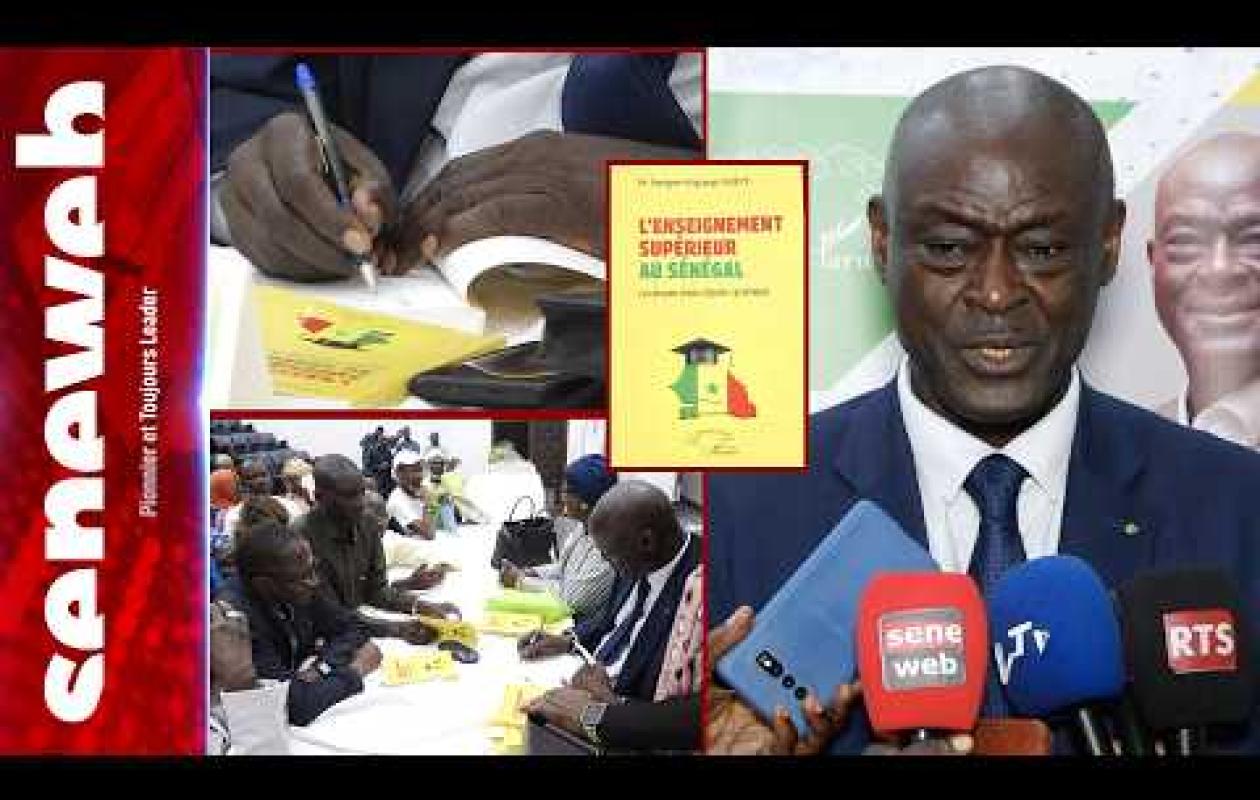
Enseignement supérieur sénégalais : Le diagnostic et les recommandations fortes du Pr Serigne Magueye Guèye pour une réforme systémique
"Higher Education in Senegal: The Need for Systemic Reform" is the title of Professor Serigne Magueye Guèye's book, which was officially presented and signed on Saturday, March 28, 2026, in the main auditorium of the Faculty of Medicine at Cheikh Anta Diop University in Dakar. The event was attended by Professor Fatou Samba Ndiaye, Vice-Dean of the Faculty of Medicine in Dakar; Professor Ndèye Coumba Touré, representing the Dean of the Faculty of Medicine; Professor Oumar Sock; Dr. Boubacar Camara, author of the book's preface; Professor Mouhamadou Mbengue; colleagues; collaborators; and others.
A frank diagnosis of the system with innovative approaches
This 172-page book, published by L'Harmattan Sénégal and comprised of three parts and six chapters, features a preface by Dr. Boubacar Camara, author, international expert, and retired UNESCO official. In it, the author offers a frank assessment of the system and explores innovative approaches before outlining perspectives and strong recommendations for a systemic reform of Senegalese higher education. He proposes bold avenues such as the creation of a University of Senegal to facilitate mobility, the establishment of a national library network, and the separation of academic and social campuses to ensure continuity of instruction.
Among the pillars of this systemic reform, the book highlights crucial areas, namely: sustainable funding, autonomy and governance, the alignment of training with employment, and finally, institutional resilience. It constitutes a major contribution to strategic thinking on the future of the Senegalese university system.
"This book is a reference work that aims for the emergence of a higher education system that takes into account national, regional and global issues."
According to Dr. Boubacar Camara, this book is timely and serves as a reference for present and future generations. "This book is a seminal work that aims to establish a higher education system that takes into account national, regional, and global challenges in terms of qualitative transformation and systemic regulation to meet the needs and objectives of society," emphasized the author of the book's preface.
For him, the work was developed using three approaches, namely: holistic, prospective and pragmatic.
"The qualitative transformation of higher education must be accompanied by systemic regulation."
The author, for his part, argued that his work raises the issue of the qualitative transformation of higher education, which, according to him, must be accompanied by systemic regulation. "For decades, the Senegalese higher education sector has been at the heart of a constant debate aimed at extricating it from the almost annual disruptions that plague it. The recurring question that arises every year is: are we heading towards a lost academic year?" emphasized Professor Serigne Magueye Guèye.
In this process of seeking a place and a role that are slow to emerge for this sector, and at this decisive turning point in the history of Senegal, the author believes that "the political authorities should benefit from thoughtful and reasoned recommendations that contribute efficiently to the holistic resolution of this perpetual crisis situation."
In view of the local geopolitical context and the chronic disruptions linked, among other things, to the LMD system, the instability of the academic calendar and the problems of scholarships, Professor Guèye emphasizes, in his work, the urgency of initiating "a process of systemic reform" of the higher education sector.
It is worth noting that Professor Serigne Magueye Guèye, a retired colonel in medicine, is a surgeon, teacher-researcher, humanitarian, and philanthropist. Former Director General of Rose Dieng University France Senegal, he is a member of the National Academy of Sciences and Techniques of Senegal.






















Commentaires (2)
Participer à la Discussion
Règles de la communauté :
💡 Astuce : Utilisez des emojis depuis votre téléphone ou le module emoji ci-dessous. Cliquez sur GIF pour ajouter un GIF animé. Collez un lien X/Twitter, TikTok ou Instagram pour l'afficher automatiquement.