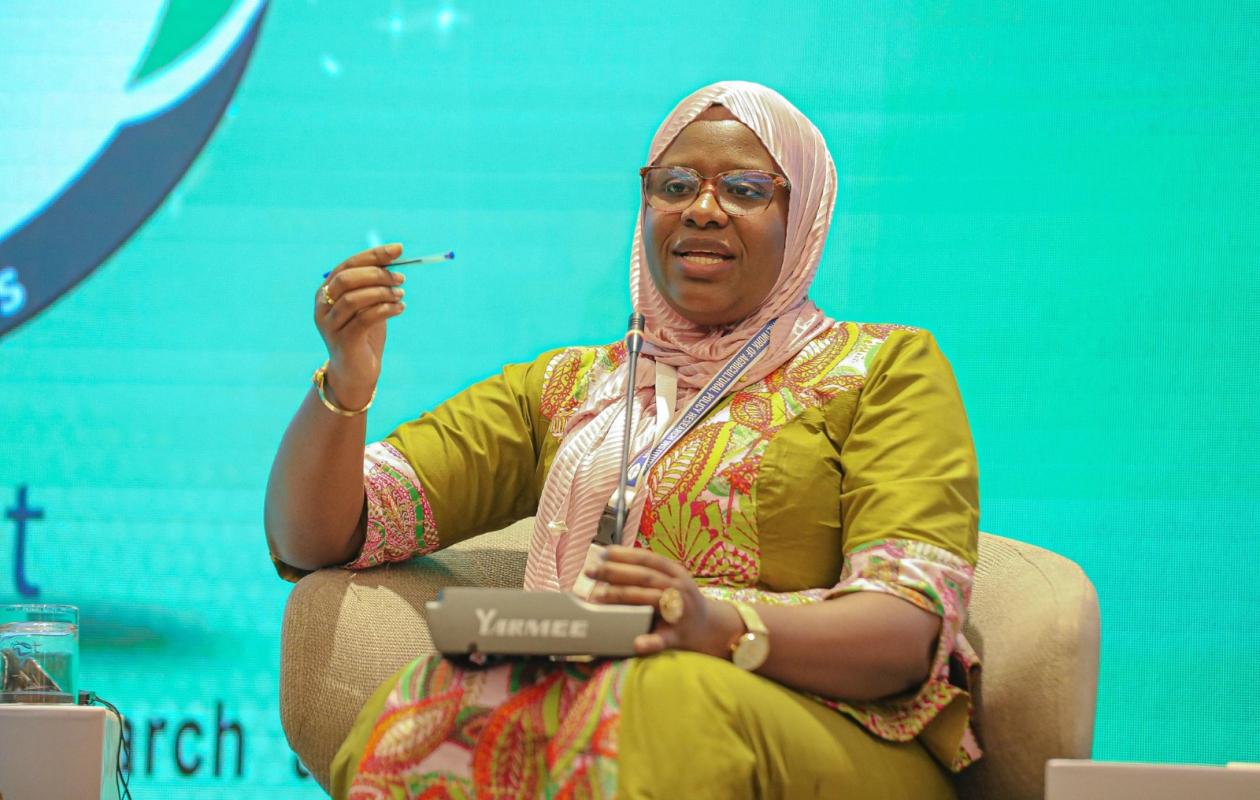
Semences, rendements, sécurité alimentaire : Le regard d’une chercheuse de l’ISRA
Faced with climate shocks, geopolitical crises, and increasing pressure on food systems, Senegal is increasingly relying on agricultural research and production support policies. But how can the impact of these interventions on producers' incomes and food security be concretely measured? What trade-offs must be made between self-sufficiency, market access, and sustainability?
In this contribution resulting from an in-depth exchange, Ndèye Fatou Faye Mané provides some answers on the evaluation of agricultural policies, lessons learned from the field and levers to activate to sustainably transform the sector.
As a research fellow at the Bureau of Macroeconomic Analysis of the Senegalese Institute for Agricultural Research (ISRA), her work focuses mainly on the adoption of agricultural technologies, value chain analysis and the impact assessment of public policies.
In your work, how do you measure the real impact of improved seed distribution and promotion programs on producer incomes and agricultural productivity?
In our work, impact evaluation generally encompasses two complementary dimensions. On the one hand, effectiveness assessment aims to evaluate the degree to which the objectives of policies, programs, or projects are achieved, using qualitative methods and an analysis of the results framework. On the other hand, impact evaluation itself complements this approach by relying on quantitative methods to identify the causal effects of interventions.
A concrete example is the evaluation of a cereal and legume value chain development project, which included a significant seed distribution component in the Kaolack, Fatick, Diourbel, Kaffrine, and Louga regions. The project targeted producers of millet, sorghum, maize, upland rice, and cowpeas. The analysis focused on the relevance, coherence, effectiveness, and sustainability of the interventions, based on assessments from the coordination team, implementing partners, and beneficiaries.
Quantitatively, the evaluation focused on the program's development objectives, particularly indicators of income and food security for farming households. The sample size was determined using statistical power calculations, with the food insecurity prevalence rate as the reference indicator. As with any rigorous evaluation, a non-beneficiary control group was constructed using statistical and econometric methods. The final sample comprised 1,066 producers, of whom 434 were beneficiaries.
The results show a significantly higher adoption rate of improved varieties among beneficiaries, as well as higher yields. For example, the adoption rate of cowpea varieties reached 72% among beneficiaries, compared to 21% in the control group. While this difference cannot be entirely attributed to the project without thorough econometric verification, the interventions contributed significantly. A statistically significant impact was also observed on the yields of the three main targeted crops. These results were then shared with the project team to inform recommendations for improving the effectiveness of future interventions.
Agricultural policies in Senegal often prioritize food self-sufficiency. Based on your research, is this approach relevant in the face of current challenges (climate change, market liberalization, food security)?
Senegalese agricultural policies have progressively incorporated the importance of strengthening food security while reducing external dependence. This orientation is in line with recent environmental, social, and economic crises, notably the Covid-19 pandemic and the war in Ukraine, which have highlighted the vulnerability of food systems to exogenous shocks.
The pursuit of food self-sufficiency, particularly for essential products like cereals, onions, and potatoes, aims precisely to reduce this vulnerability. In principle, this approach is relevant for addressing current and future challenges. However, as with many public policies, the difficulty lies more in implementation than in the intention itself.
Achieving sustainable self-sufficiency requires long-term investments in science, technology, and human capital to develop appropriate responses to climate and economic challenges. However, we often see short-term measures such as import restrictions or export taxes. While these may support local production in the short term, they do not guarantee long-term self-sufficiency and are frequently relaxed to meet domestic demand.
From this perspective, public spending would benefit from being more directed towards research and the large-scale dissemination of technological and institutional innovations. It is also essential to implement incentive policies that encourage private sector involvement in agricultural value chains, particularly by reducing regulatory uncertainty, which is often incompatible with investment decisions.
What lessons can you draw from ISRA's experiences in evaluating agricultural policies that could inspire new approaches at the national level?
ISRA possesses a wealth of in-depth knowledge on agricultural issues that deserves to be better utilized at the national level. These experiences will not necessarily lead to immediate new approaches, but they do allow for significant improvements in agricultural policy evaluation practices.
A key lesson is the need to adapt traditional evaluation methods, often taught in economics, to local realities. Sampling choices and the selection of agents to be surveyed are crucial for the quality of the results. A second essential point is planning the evaluation from the project design stage. Implementing the evaluation framework before interventions begin helps to minimize bias and obtain more robust results.
Finally, experience shows that a purely qualitative evaluation can, in certain contexts, be robust and relevant, while being less costly than a quantitative approach. This serves as a reminder that a large budget is not always necessary to effectively analyze policy implementation and inform public decision-making.
From your perspective as an economist, what priority levers should be activated to ensure that agricultural research contributes more to the sustainable transformation of the sector?
Beyond my background as an economist, I am responding here as a researcher at ISRA. Several levers appear to be priorities to enable agricultural research to fully play its role in the sustainable transformation of the sector.
The first step is to strengthen human resources, in order to have a critical mass of skills capable of meeting the needs of agricultural research and adapting to new directions in food sovereignty. Secondly, research must be involved very early in the development of agricultural policies and programs, so that public decisions are based on solid field results.
Greater synergy among all stakeholders in the agricultural ecosystem is also essential. Furthermore, upgrading research infrastructure, particularly laboratories, experimental stations, and equipment, is a prerequisite for any transformation ambition. Research funding is another key challenge: to meet national priorities, it is crucial that both the Senegalese public and private sectors contribute more, in order to avoid exclusive dependence on international donors, who are sometimes detached from national interests.
Finally, preserving land allocated to research is essential. The land held by ISRA is strategic, not only for research and training, but also for seed production, and must be protected by the State in the interest of food sovereignty.









![[EXCLUSIF] Diodio de "Baabel" arrêtée avec de la cocaïne et des objets sexuels : comment une vidéo virale a poussé le procureur Saliou Dicko à actionner la BR de Keur Massar](https://image.seneweb.com/content/news/2026-25-17//thumb_1260x800_6a31e625b77ed_Ghfor4Ome2.jpg)












Commentaires (2)
Dire "je sais tout" ne remplace ni une analyse, ni des données, ni une expérience rigoureuse du terrain.
Oui, il existe des campagnes difficiles, des rendements insuffisants, des problèmes de qualité et parfois de stockage des semences : ce sont justement ces réalités que la recherche documente, pour comprendre les causes, mesurer les effets et améliorer les solutions.
Il ne vous suffit pas de balancer ce genre de boutades du genre : "il n’y a pas de miracles".
Il y a du travail, des méthodes, des diagnostics, et des choix politiques à éclairer. Visiblement vous l'ignorez totalement.
Si vous souhaitez contribuer utilement, vous pouvez préciser où, quelles semences, quelle campagne et quels constats concrets.
On vous attend sur ce terrain et si vous êtes si sûr de vos connaissances il est indiqué l'adresse de son lieu de travail, contactez la et venez et on va y débattre scientifiquement. On vous remboursera vos frais de transport!
Participer à la Discussion
Règles de la communauté :
💡 Astuce : Utilisez des emojis depuis votre téléphone ou le module emoji ci-dessous. Cliquez sur GIF pour ajouter un GIF animé. Collez un lien X/Twitter, TikTok ou Instagram pour l'afficher automatiquement.