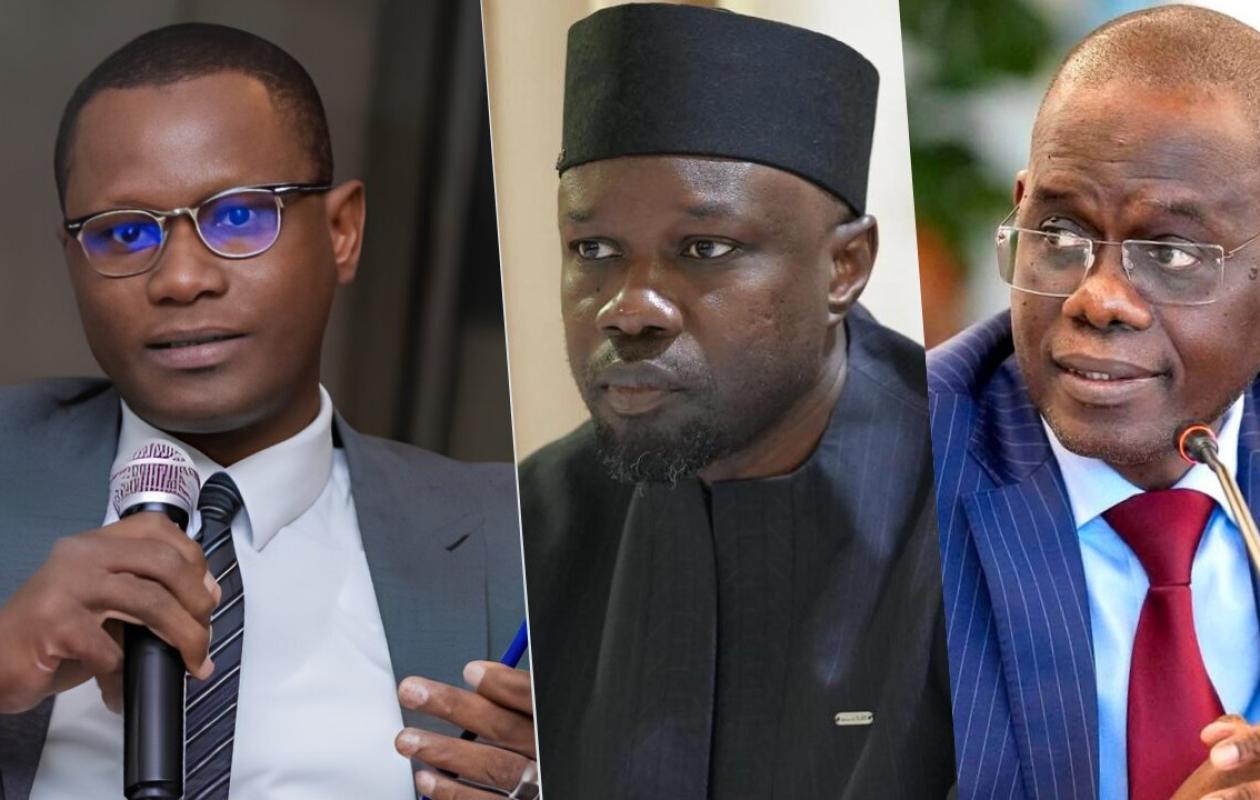
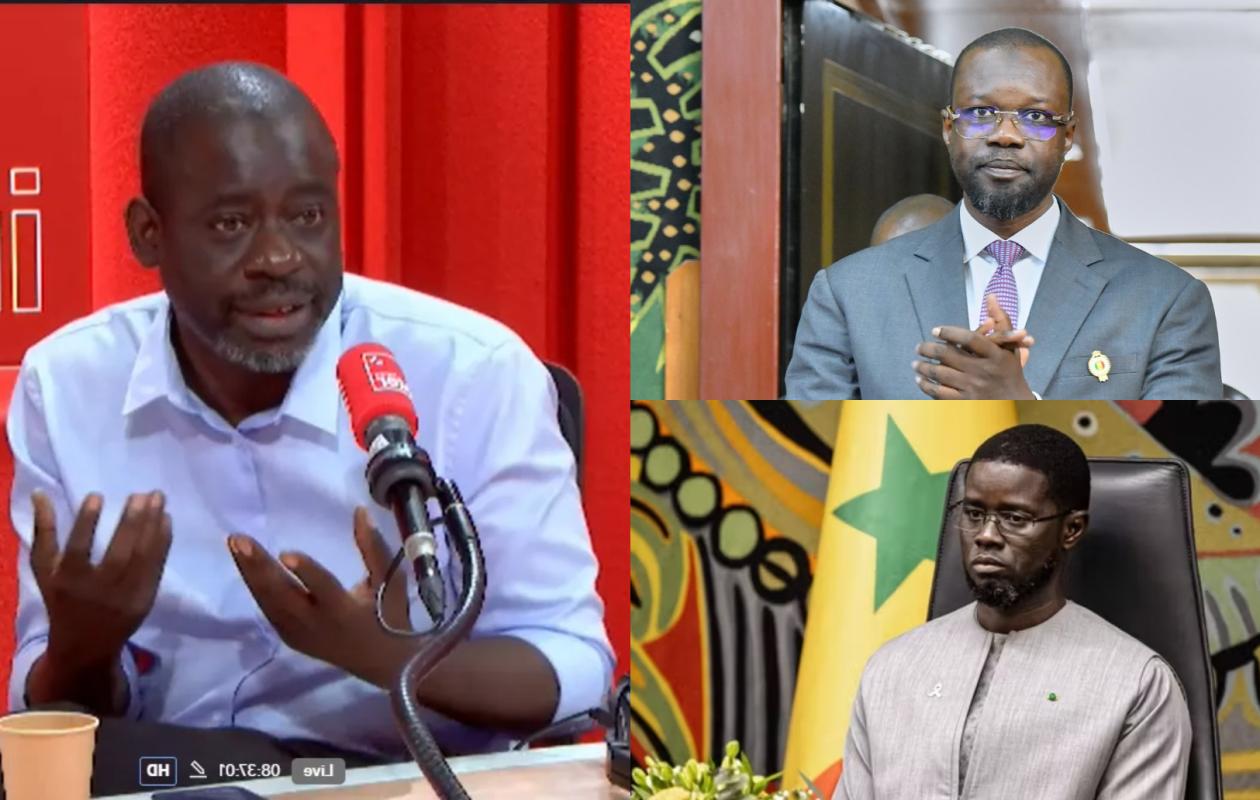
Sonko éjecté, Al Aminou positionné, impact sur les discussions Etat - FMI…: Dr Serigne Moussa Dia expose les grands enjeux (Économiste)
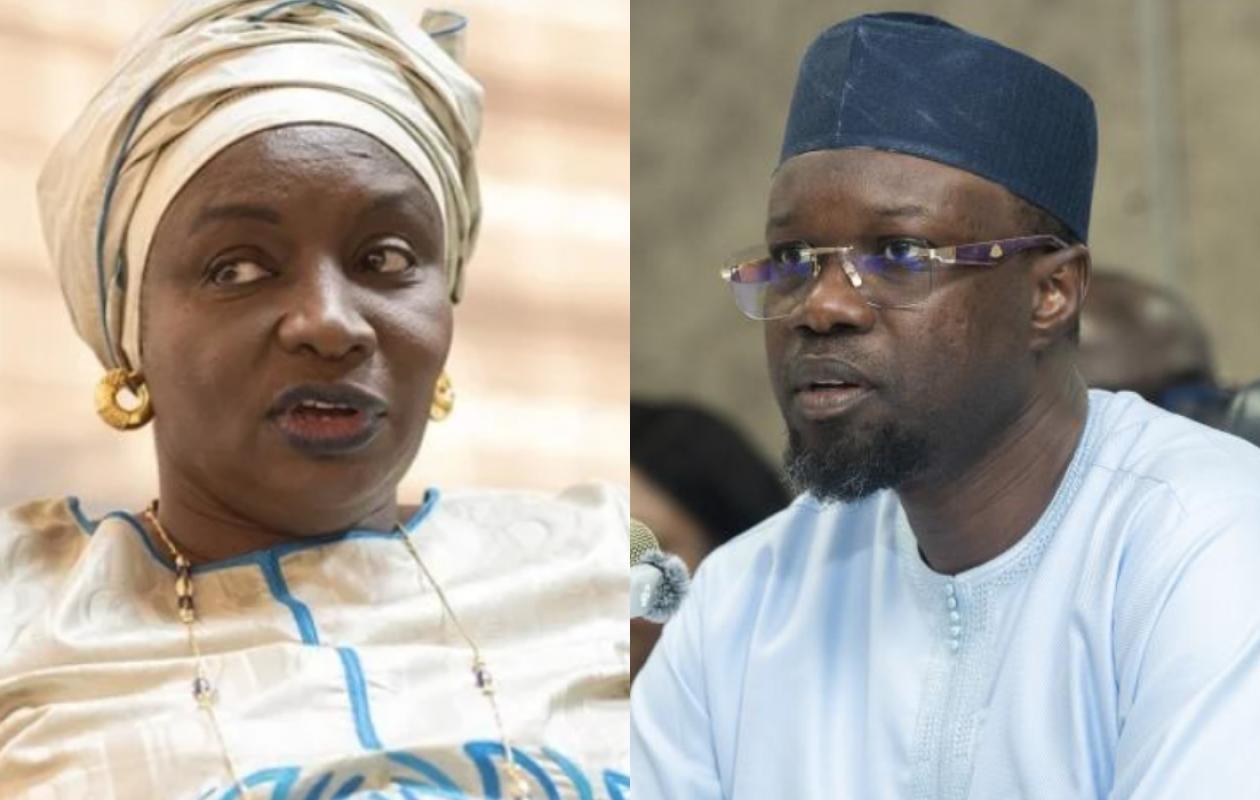
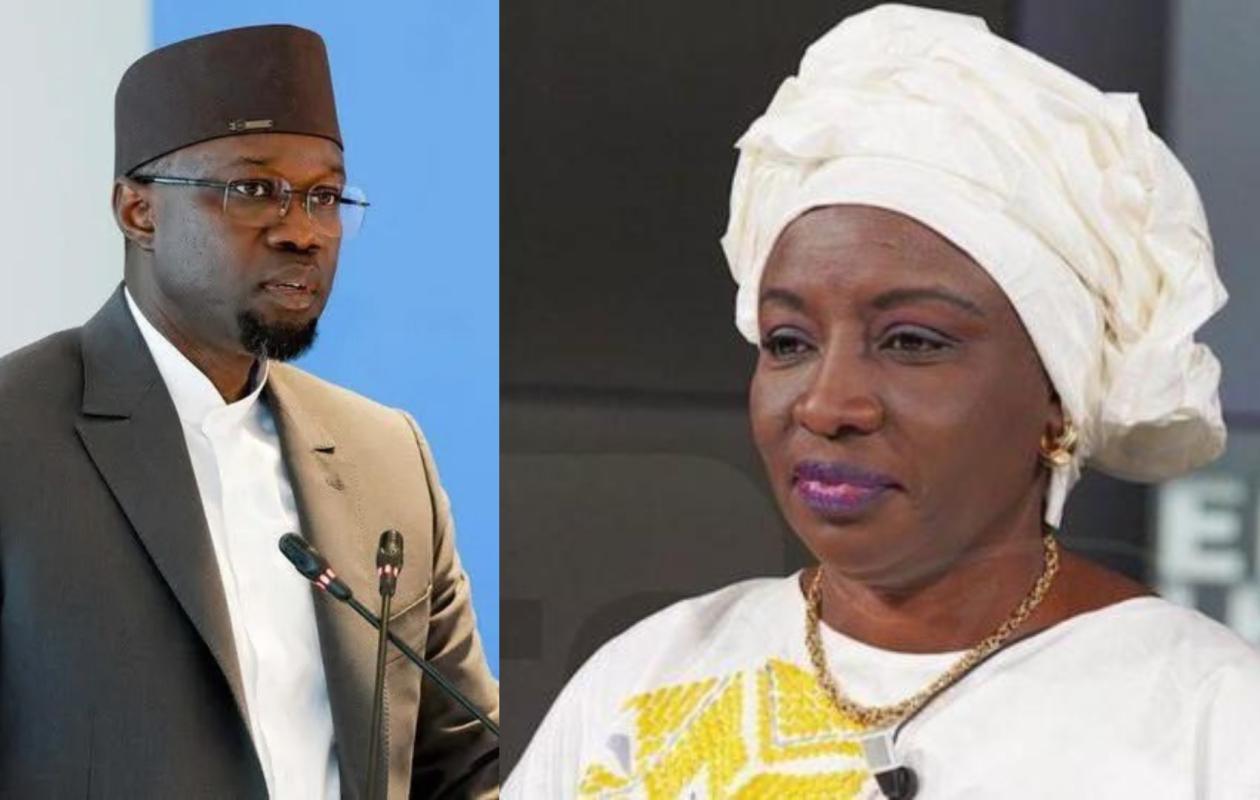
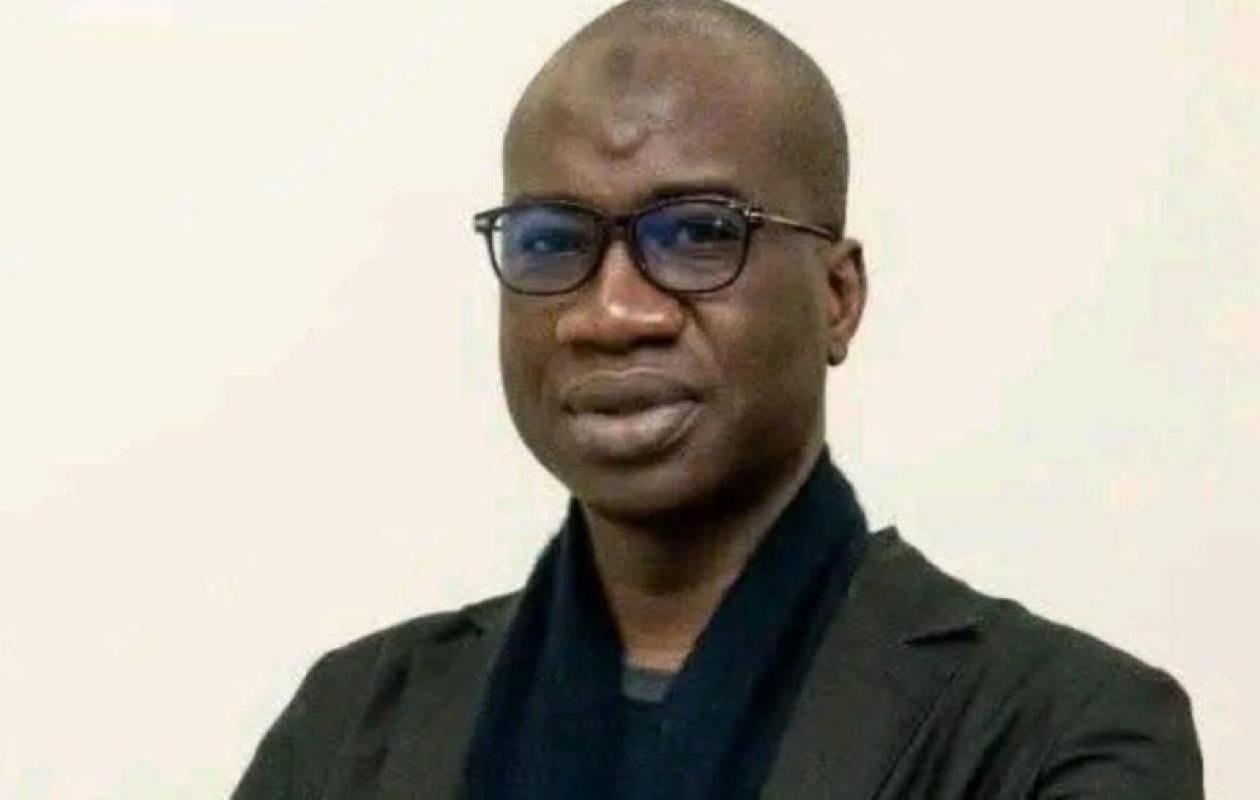
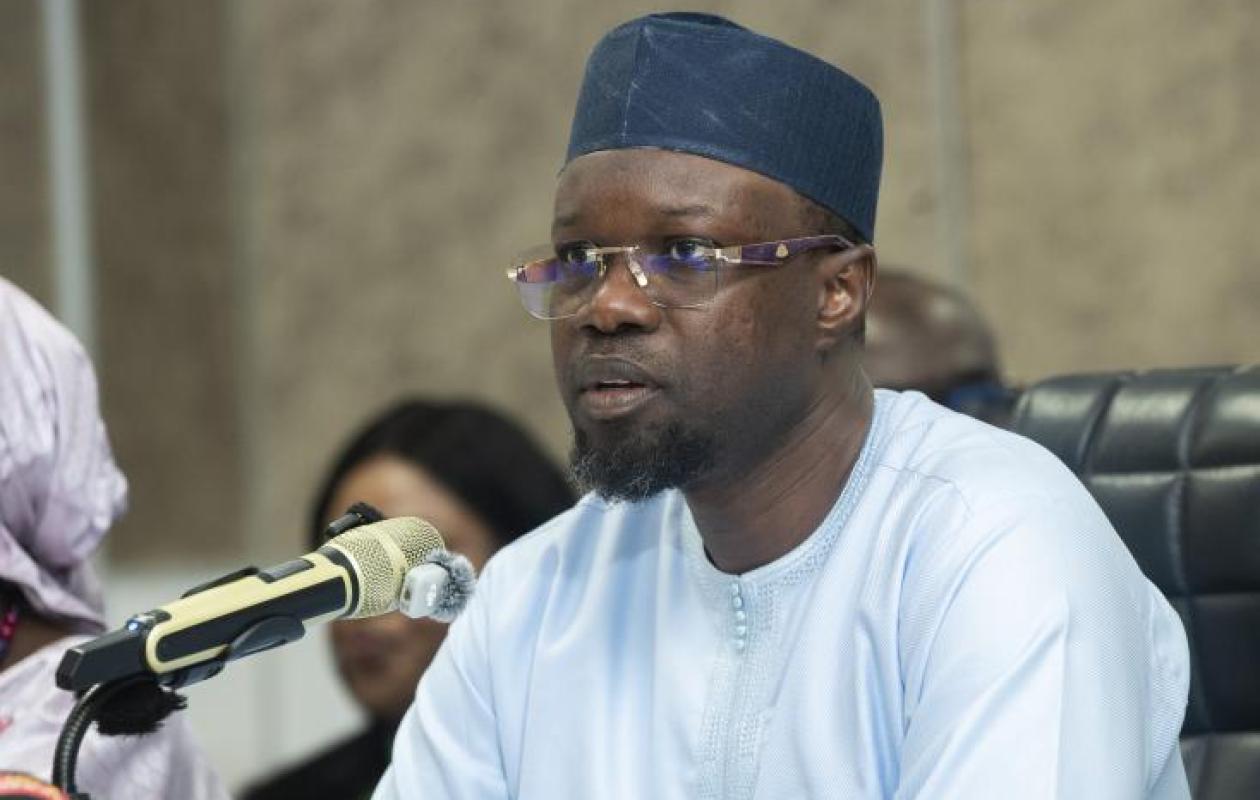
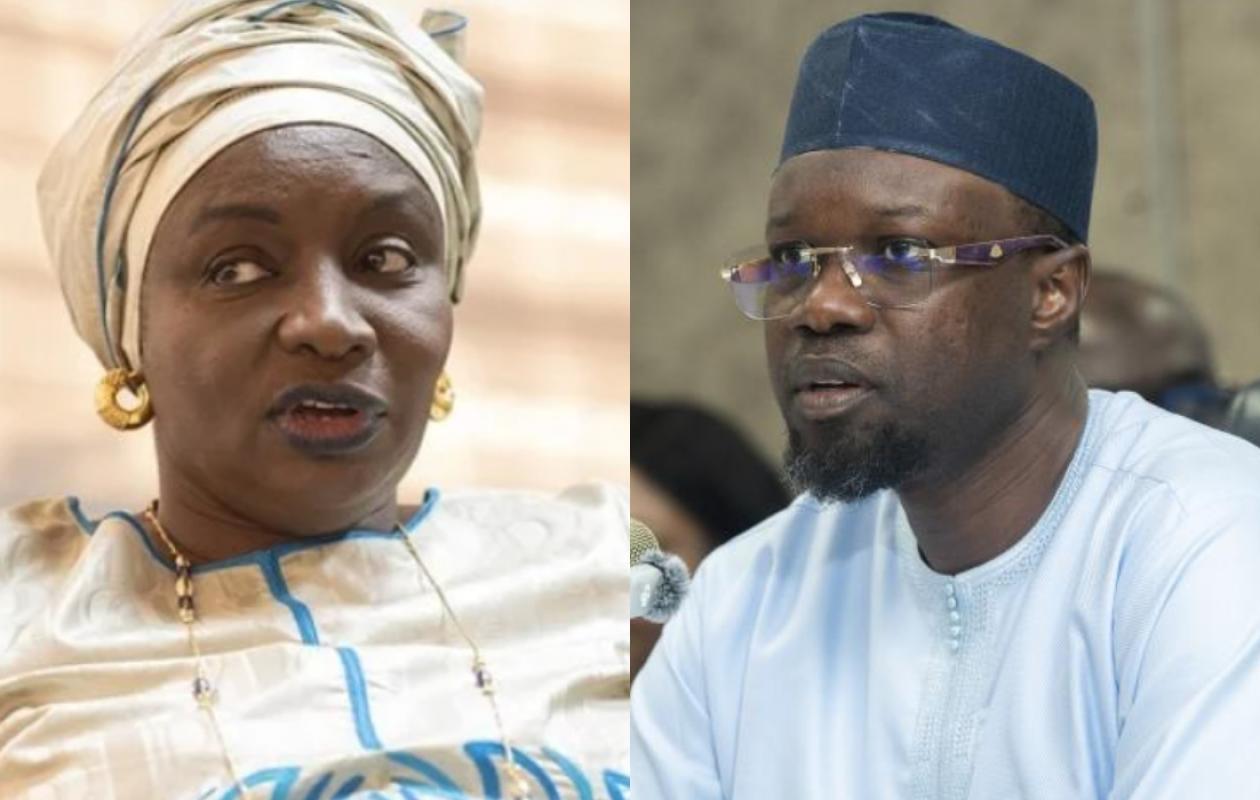
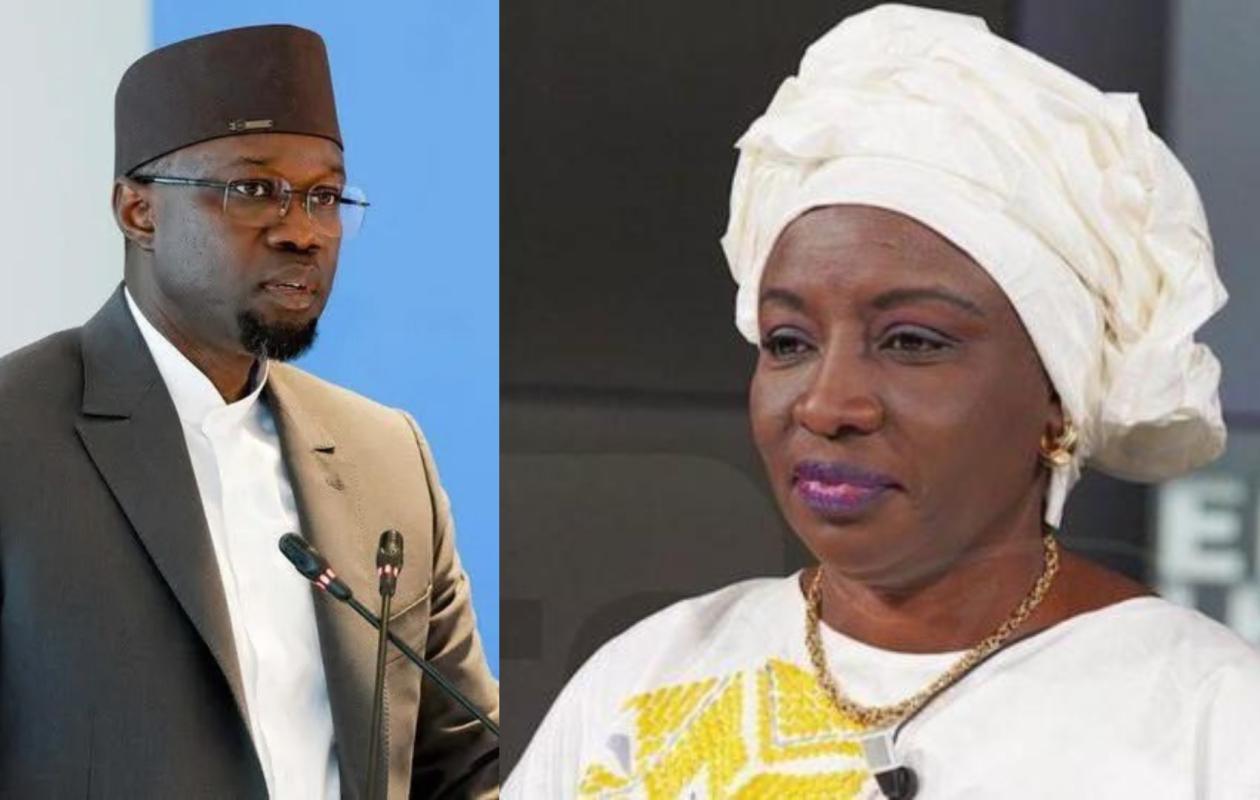
In recent days, the institutional landscape of the country has shifted. Ousmane Sonko, dismissed from the Prime Minister's office, has moved to the presidency of the National Assembly. He is replaced by Al Aminou Lô, former National Director of the Central Bank of West African States (BCEAO) for Senegal. These changes come amidst a budget crisis, during which the Senegalese government is engaged in difficult negotiations with the IMF for a new program. What consequences might these changes have? In this interview with Seneweb, Dr. Serigne Moussa Dia, an economist and research professor at the Interdisciplinary Laboratory for Social Science Research at the University of Abomey-Calavi (UADB), provides a clear analysis of the major issues at stake.
What signals might be sent or perceived, at the level of donors such as the IMF, through this dismissal?
The IMF isn't mourning Sonko. But it's not celebrating either. It's calculating. And its calculations are worrying. Ousmane Sonko's dismissal sends three contradictory signals to donors, particularly the IMF. Three levels of interpretation, three points of view, no certainty. That's what strategic uncertainty is.
Signal 1 — The ideological obstacle collapses. Sonko was the main obstacle. In my interview with Le Soleil in November 2025, I analyzed his refusal to accept restructuring. He described restructuring as "a humiliation for our people." He blocked any structural adjustment program. His removal opens a window for negotiation that the IMF had been waiting for for months. President Faye had already received an IMF delegation in November 2025. The foundations for an agreement exist. Theoretically, everything is ready.
Signal 2 - Political instability is worrying: But the IMF doesn't negotiate with a single individual. It negotiates with a state. And the Senegalese state has just lost its political leader in the midst of a crisis. Sonko's dismissal is accompanied by a major crisis within Pastef, which holds 130 out of 165 seats in parliament. The IMF knows one thing: without a stable parliamentary majority, no structural reform will pass. Reducing tax exemptions (7 to 8% of GDP)? That requires parliamentary approval. Improving public finances? That requires parliamentary approval. Senegal 2050? That requires parliamentary approval. Without Pastef, nothing gets done. With Pastef in rebellion, everything is blocked. The IMF knows this. And it's waiting.
Signal 3 — The appointment of Al Amine Lo is technically reassuring. The arrival of a former Director General of the BCEAO (Central Bank of West African States) at the Prime Minister's office is a game changer. For the IMF, he is a credible, known, and predictable interlocutor. Edward Gemayel, the Fund's mission chief, met with him in August 2025. The appointment sends a strong technical signal: Senegal is choosing monetary stability and financial discipline. But this signal is conditional. If Pastef (the Senegalese party) blocks the reforms, if Sonko (the Prime Minister) denounces the appointment as a betrayal, if there are public protests, the markets will punish him again. Trust is fragile. It is gained in days. It is lost in hours.
With Sonko no longer in the prime ministership, could negotiations with the IMF proceed more quickly?
Theoretically, yes. In practice, the opposite is likely to happen. And therein lies the paradox. Theoretically, Sonko's removal eliminates the main ideological obstacle. President Faye has greater room to maneuver. The foundations for an agreement have existed since October-November 2025. And above all, the appointment of Al Aminou Lo radically changes the situation. He is a former Director General of the BCEAO, a man who speaks the language of the IMF, who understands debt mechanisms, and who is proficient in monetary statistics. For the Fund, he is a familiar and predictable interlocutor. Negotiations can finally accelerate.
But practically, three limiting factors make acceleration uncertain, even risky.
Which ones?
Factor 1 — The institutional vacuum. The IMF negotiates with a government, not with a president alone. However, between Sonko's dismissal on May 22nd and Al Aminou Lo's appointment on May 25th, Senegal experienced three days of absolute political vacuum. Three days in which nothing progressed. Three days in which the markets trembled. Three days in which creditors calculated their losses. Time is running out, and each day of delay costs billions in risk premiums.
Factor 2 – Parliamentary gridlock. And this is where my hypothesis of institutional gridlock becomes reality. Pastef holds 130 out of 165 seats in parliament. If the party, under Sonko's leadership since his resignation, decides to systematically obstruct the new government—through motions of no confidence, rejection of finance bills, and blocking of tax reforms—then the IMF will have no guarantee that the executive's commitments will be translated into legislation. The IMF requires two pillars: sound public finances and the Senegal 2050 plan. These two pillars require laws, decrees, and administrative reforms. Without a stable parliamentary majority, the IMF will not sign. Or it will sign a symbolic agreement, without any actual disbursement. A sham agreement.
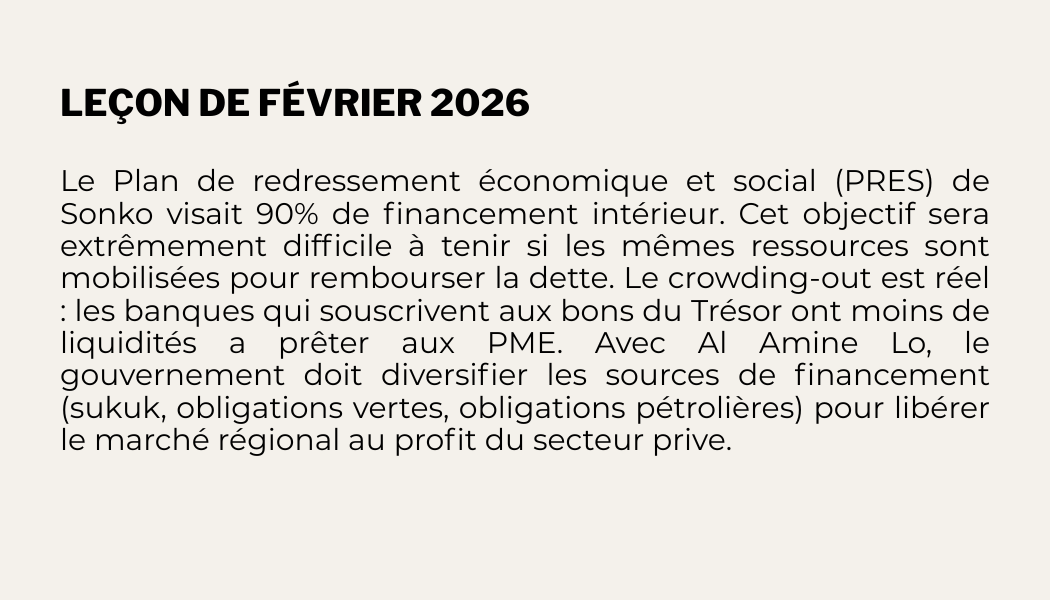
Factor 3 – Market mistrust. Even with an IMF agreement, investors will remain cautious until political stability is restored. In my February 2026 analysis for Seneweb, I showed that the funds raised on the regional market (1 trillion CFA francs in six weeks) only resolved the immediate liquidity problem, not the structural issue. An IMF agreement without political stability will not provide lasting reassurance to the markets. The appointment of Al Amine Lo is technically reassuring, but not politically reassuring. As long as Sonko and Pastef have not accepted the agreement, uncertainty remains.
Could this dismissal hasten the country towards debt restructuring?
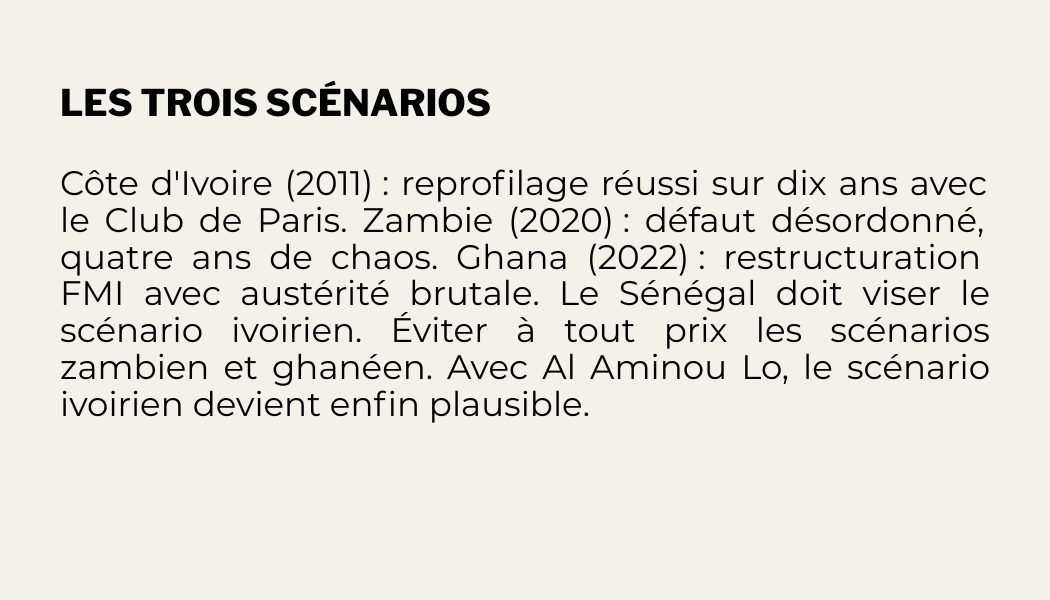
No. But it creates a critical decision window. A window that is closing. And beyond it lies the precipice. To understand, we must return to the fundamentals I analyzed in Le Soleil in November 2025. Senegal faces an existential dilemma: restructure now, with all the long-term costs (market closures for 3 to 5 years, high risk premium, a lasting negative impact), or wait 2 to 3 years, counting on oil growth and fiscal discipline.
The oil gamble, Senegal's trump card: Oil revenues from the Sangomar field, estimated at between 1,128 and 1,692 billion CFA francs annually starting in 2026-2027, change the equation. In my analysis for Le Soleil, I advocated this option: 30 to 40% in sovereign wealth funds, 40% in debt repayment, and 20 to 30% in public investment. In four or five years, the debt-to-GDP ratio can fall from 132% to 80-90%. Without formal restructuring. Without humiliation. With Al Amine Lo as Prime Minister, this trump card can finally be structured. He understands securitization mechanisms. He can structure oil-backed bonds. He can negotiate with Gulf investors.
Sonko's dismissal doesn't change the debt arithmetic. It changes the political landscape. And that's where the danger lies . If the institutional gridlock I anticipate materializes, if the parliamentary Pastef party blocks tax reforms and spending cuts, then the oil revenue + fiscal discipline scenario becomes unfeasible. Without genuine, not cosmetic, budgetary discipline, oil revenues won't be enough. And Senegal will find itself forced to restructure, not by strategic choice, but by default due to disorder. Al Aminou Lo's appointment opens a path. But it's a narrow one. And it leads through the National Assembly.
At this stage, what do you advise: to restructure or not to restructure?
My answer has been the same since November 2025. But today, with Al Aminou Lo as Prime Minister, it is imperative, requiring desperate urgency. Not a formal restructuring. But an immediate, proactive, and transparent reshaping, coupled with a framework agreement with the IMF, without drastic structural adjustments. This recommendation rests on five pillars I identified in my previous analyses. But today, with Al Aminou Lo, they are becoming achievable.
Pillar 1 — Negotiated reprofiling (no 'haircut'). Renegotiate the maturities of Eurobonds and commercial loans without reducing the principal. Extend maturities, negotiate grace periods. In my Seneweb analysis of February 2026, I emphasized that the repurchase of discounted bonds on the secondary market (currently at 75 cents) constitutes a debt reduction with a positive present value. It is a de facto restructuring, without being officially named as such. Al Aminou Lo, former Director General of the BCEAO, is familiar with these mechanisms. He can negotiate them.
Pillar 2 — The IMF framework agreement (without traditional austerity). Negotiate a macroeconomic validation program aligned with Vision 2050. No drastic budget cuts, no forced privatizations, no procyclical tax increases. In a fixed exchange rate regime (WAEMU), traditional austerity would exacerbate the economic contraction without the possibility of compensatory devaluation. The IMF knows this. Al Aminou Lo can make them understand that Senegal is not Ghana.
Pillar 3 – Oil-backed bonds. Senegal possesses a unique advantage that neither Ghana nor Zambia had: growing oil and gas revenues. Sovereign bonds backed by a portion of future oil royalties would attract investors from the Gulf or Asia. Such an instrument could raise 500 to 800 billion CFA francs. This is the differentiating factor. Al Aminou Lo, as former National Director of the BCEAO and architect of Senegal 2050, can structure this instrument. It must be used now.
Pillar 4 — Full transparency and sovereign wealth fund. Publish all audit reports (Forvis Mazars, June 2025). Establish a management plan in line with the recommendations of the Court of Auditors. Create a disciplined sovereign wealth fund: 30-40% of oil revenues in the sovereign wealth fund, 40% for debt repayment, 20-30% for public investments. The hidden debt (actual deficit of 12.3% versus the official 4.9%) is the result of criminal opacity. This must end.
Pillar 5 — Distinguish between central bank debt and public enterprise debt. Prevent sovereign guarantees from contaminating the entire balance sheet. Hidden debt has demonstrated the damaging effects of total opacity. New guarantees must be strictly regulated. Each guarantee must be approved by the Assembly, published, and audited. Al Aminou Lo, as former National Director of the BCEAO, is familiar with the mechanisms for consolidating monetary statistics. He can implement this framework.
What, in your opinion, should be the priority missions of the next government in this very tense period on the financial and economic front?
Four phases. Fifteen days for the first. After that, it's too late. Senegal will plunge into a systemic crisis. And with Al Aminou Lo now appointed, the countdown has begun.
Phase 1 — Political Stabilization (0-15 days). Appoint a consensus Prime Minister. Technically credible. Politically acceptable to Pastef. It's an impossible task, but it's the number one imperative. With Al Amine Lo, the first condition is met: he is technically credible. But the second, politically acceptable to Pastef, remains uncertain. It is therefore necessary to reconstitute a government of national unity or a broad coalition to avoid legislative gridlock. Without a coalition, any tax reform will be rejected. Institutional gridlock will become a reality. It is also necessary to engage in transparent dialogue with social partners, creditors, and the IMF. The current institutional silence is fueling panic in the markets.
Phase 2 — Debt Crisis Management (0-90 days). Finalize the framework agreement with the IMF. The window of confidence created by the March payment is closing. We must act before it closes completely. With Al Aminou Lo, this finalization is finally possible. He knows Edward Gemayel. He knows the Fund's requirements. He can negotiate. Convert short-term treasury bills (3-12 months) into 3-5 year bonds on the WAEMU market. BOAD can provide partial guarantees. Transform the risk pyramid into a sustainable structure. Launch oil-backed bonds. This is the differentiating advantage. Al Aminou Lo can structure it. We must use it now, before the markets close completely. Proceed with the selective repurchase of discounted Eurobonds on the secondary market. This is a de facto restructuring, positive in present value.
Phase 3 — Structural Reforms (3-12 months). Eliminate egregious tax exemptions (7-8% of GDP). This is the IMF's essential condition. But productive sectors must be protected. Merge public departments and agencies. Reduce central government operating expenses. Establish a transparent framework for managing gas/oil revenues. Sovereign stabilization fund. Independent governance. Public audit. Strictly regulate sovereign guarantees. The hidden debt (real deficit of 12.3% versus the official 4.9%) is the result of criminal opacity. Never again.
Phase 4 — Reviving endogenous growth. Preserve productive public investment. Infrastructure, energy, digital technology. Brutal austerity would kill growth. Revive private investment. Reform the business climate. But beware of crowding-out: when the Treasury raises 1 trillion in six weeks on the regional market, it steals resources from SMEs. Maintain targeted social subsidies. With 40% of tax revenue absorbed by debt, funds for education, health, and transfers are already reduced. Any further cuts would be socially explosive.
How do you assess Sonko's actions as head of government during these two years?
An heir to a catastrophic economic situation who persevered despite everything. A crisis manager, not a comfort manager. That's the revised verdict.
First, it's important to recall the context in which Ousmane Sonko became Prime Minister. He inherited a disastrous economic situation, with catastrophic macroeconomic indicators. The hidden debt, revealed by audits from Forvis Mazars and the Court of Auditors, showed a real deficit of 12.3% of GDP, compared to the officially reported 4.9%. Public finances were crumbling. International creditors were on high alert. And the international context only exacerbated the situation: the war between Iran, the United States, and Israel created major geopolitical tension, with shocks to oil prices, disruptions to supply chains, and a soaring risk premium in emerging markets. Despite all this, Senegal remained standing.
What he achieved, in an extremely unfavorable context: First, transparency and auditing. Sonko inherited an abysmal debt concealed by the previous regime. He initiated the Forvis Mazars audits, which established a clear map of the debt. The Court of Auditors revealed a real deficit of 12.3% of GDP, compared to the official figure of 4.9%. This was an unprecedented act of political courage. Second, the Economic and Social Recovery Plan (PRES). Developed and praised by the IMF as a coherent macroeconomic framework, this plan structured the response to the crisis. Third, increasing the tax base and reducing luxury spending. Sonko successfully implemented a fiscal consolidation strategy which, despite social pressure and pressure from donors, has allowed him to hold on until now. Fourth, financial innovation. The sukuk (405 billion CFA francs raised, three times the target) and green bonds demonstrated that Senegal could diversify its financing sources without submitting to the IMF's drastic conditions. Fifth, there was the popular mobilization. Senegal maintained a degree of sovereign dignity in the face of creditors, rejecting restructuring as a "humiliation for our people." In a context where Ghana and Zambia succumbed to austerity, Senegal stood firm.
What he did less successfully, or what eluded him : Obstructing negotiations with the IMF was certainly counterproductive. By blocking all dialogue with the Fund, Sonko deprived Senegal of a financial safety net that could have reassured the markets. But his reasoning must be understood: he feared that the IMF agreement would degenerate into a classic structural adjustment program, with brutal budget cuts, forced privatizations, and social austerity. In a fixed exchange rate regime (WAEMU), this austerity would have been procyclical and devastating. His calculation was political: a liquidity crisis managed sovereignly is preferable to a social crisis imposed from the outside. This calculation wasn't absurd. It was risky. And it remained so to the very end. The deterioration of international relations, with his pronouncements on the “tyranny of the West,” fueled investor distrust. Senegalese bonds plummeted to 78 centimes, with yields exceeding 16%. But this decline was also the result of irrational market panic, not just Sonko's rhetoric. The institutional conflict with President Faye paralyzed political and economic decision-making. This is a major point of vulnerability. And the structural financing shortfall in 2025—less than 3 trillion raised out of a projected 5.715 trillion—forced the government to rely on short-term treasury bills, creating a risk of runaway debt.
Will it be easy to succeed him?
No. And that's precisely where my hypothesis of institutional gridlock becomes Senegal's nightmare. But with Al Aminou Lô, the situation changes. Not completely. But enough to open a window of opportunity.
The next Prime Minister had to meet three contradictory conditions. Three. And they were mutually exclusive. It was an impossible task. That's why the appointment was delayed. That's why the institutional vacuum dragged on. That's why Senegal was wasting time it didn't have.
Condition 1 — Acceptable to the President. Resolved. Al Amine Lo is a man of the presidency. Minister of State since April 2025, architect of Senegal 2050, he shares the Head of State's pragmatic vision on debt management and negotiations with the IMF. He is not a political rival. He is not a pretender to the throne. He is an executor. Exactly what Professor Diomaye was looking for after the clash with Sonko.
Condition 2 — Credible for the IMF and the markets. Resolved. This is a masterstroke. The IMF doesn't need to check Al Amine Lo's credentials. They already know them. National Director of the BCEAO, Secretary General of the Government, Minister of Senegal 2050. He is a technocrat with proven experience in financial crisis management. The markets will perceive this as a signal of stability. Eurobonds, which were plummeting to 78 cents, could rebound. Spreads could narrow. For the first time in months, Senegal is sending a signal of technical credibility. Not a political signal. Not an ideological signal. A technical signal. And in finance, technical expertise is more reassuring than rhetoric.
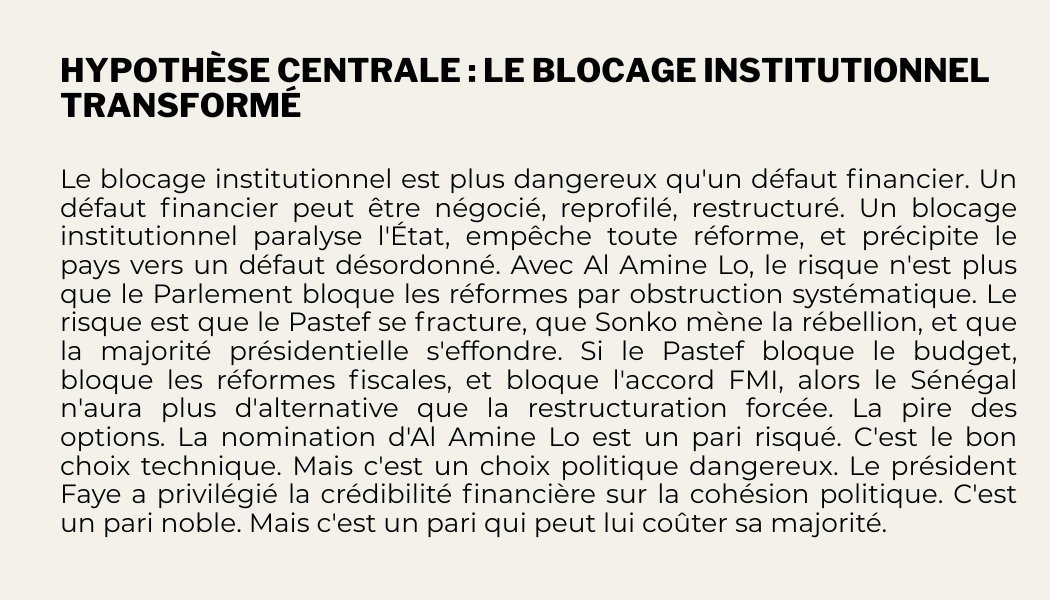
Condition 3 — Acceptable for Pastef. And this is where the danger lies. Al Amine Lo is not a Pastef man. He did not campaign with Sonko. He was not elected on the same promise of a break with the past. He is perceived as a man of the system, a technocrat from the BCEAO, a defender of the CFA franc. For the Pastef grassroots, this choice reeks of betrayal. Sonko remains leader of Pastef and the sole candidate for party president at the current congress. He still holds political legitimacy. The 130 Pastef members of parliament were not consulted on this nomination. They could perceive Al Amine Lo as an outsider imposed by the presidential palace.
The risk is no longer an institutional deadlock between the executive and legislative branches over reforms. The risk is a political deadlock between the presidency and its own parliamentary majority. If Sonko decides to lead the rebellion from the National Assembly, if the Pastef party deputies refuse to vote for the structural reforms, then the institutional deadlock I anticipated will become a reality. But with a major difference: it's no longer the executive versus the legislature. It's the president against his own party. It's Faye against Sonko. It's technocracy against revolution. And this political civil war, if it erupts, will paralyze the state far more surely than any motion of no confidence.
The economic legacy is a major challenge . 6 trillion FCFA in refinancing needs per year with international markets closed. Debt at 132% of GDP with downgraded sovereign ratings (B+ by Fitch, B2 by Moody's). Maturity wall in 2028: 14.87 trillion FCFA with exhausted budgetary margins. Short-term regional debt: 1 trillion FCFA in treasury bills (3-12 months) to be renewed or repaid by the end of 2026. Al Aminou Lô inherits all of this. And he has only a few weeks to act.
Your conclusion?
The dismissal of Ousmane Sonko is a major political event that opens a window of opportunity. But that window is closing quickly. Very quickly. Senegal has a few weeks to act. Not a few months. A few weeks.
With the appointment of Al Aminou Lô, the seemingly impossible task is two-thirds solved. The major risk is no longer institutional, executive versus legislative, but political: the fracturing of the Pastef majority. If Sonko agrees to play a behind-the-scenes role, if the members of parliament vote for the reforms, Senegal will avoid the precipice. Otherwise, the institutional deadlock I anticipated will become a reality, and the country will plunge into an unprecedented crisis.
My recommendation remains unchanged: preventative restructuring, an IMF framework agreement, oil-backed bonds, and total transparency. With Al Amine Lo as Prime Minister, this recommendation finally has a chance of being heeded. The technocrat is in place. Policies must follow. Otherwise, disaster awaits.
Interview by Youssouf SANE








Commentaires (7)
Participer à la Discussion
Règles de la communauté :
💡 Astuce : Utilisez des emojis depuis votre téléphone ou le module emoji ci-dessous. Cliquez sur GIF pour ajouter un GIF animé. Collez un lien X/Twitter, TikTok ou Instagram pour l'afficher automatiquement.