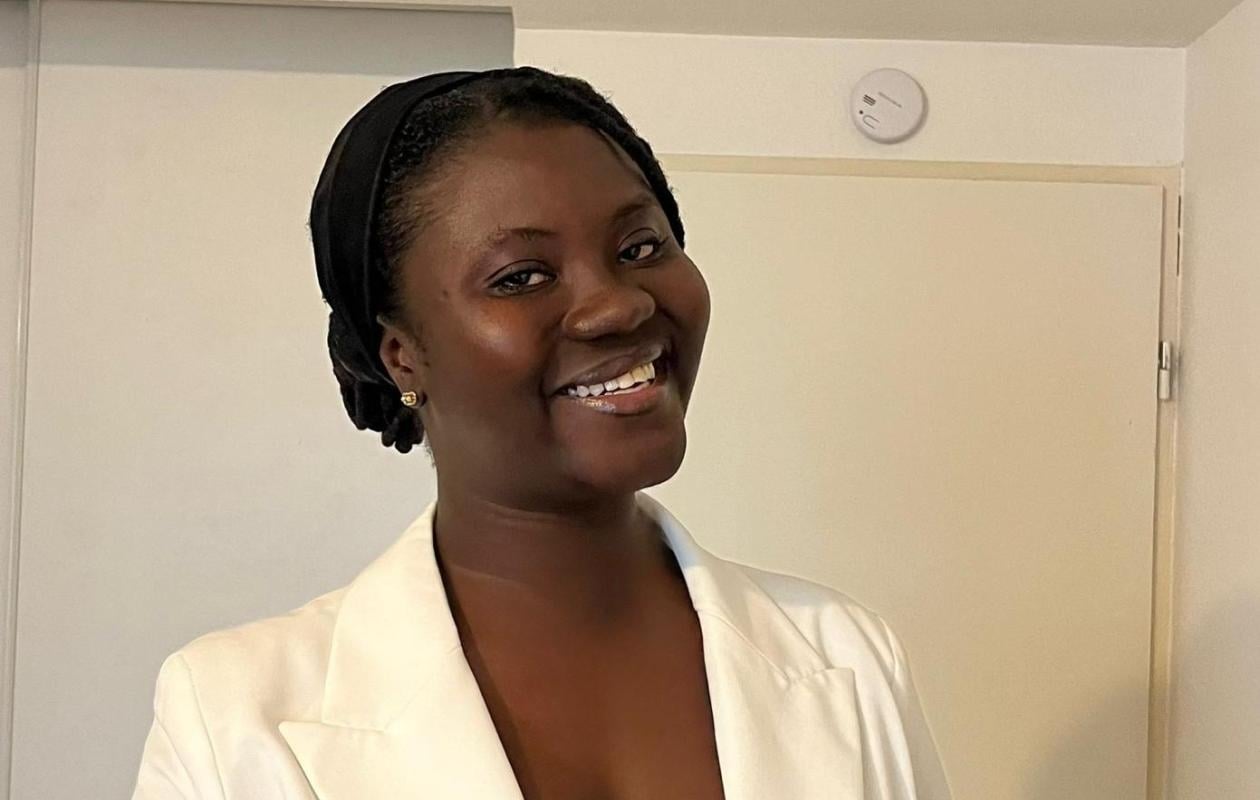
Suzanne Sy : “Naître femme au Sénégal suffit pour être une féministe”
Between her unabashed radicalism and grassroots activism, she has become the face of a revolt that refuses to be silenced. After leaving FRAPP to found the WaxJotna (It's Time to Speak) platform, the Senegalese activist discusses the urgent need to reform a Family Code she considers archaic and denounces the scourge of femicides that is shaking the country. From striking slogans to critiques of cultural alienation, she delivers an uncompromising interview on the state of women's rights in Senegal in 2026.
Suzanne, you are today a leading figure in grassroots feminism in Senegal. What was the trigger, that "final straw" in your personal or civic life, that made you go from indignation to radical activism?
I don't think you necessarily need an "extra moment" when you're born a woman in a country like Senegal. I was born and raised here. I experienced firsthand the patriarchy, misogyny, and sexism that I fight against today.
From a very young age, I observed power dynamics and domination in everything around me. Something seemed illogical and fundamentally unjust. It was always the woman who had to be subservient or disappear. By adolescence, the relationships between girls and boys already bothered me. Everything seemed to revolve around the boys. This imbalance deeply troubled me.
Then, I gained access to my first feminist readings. I also met, particularly on social media, women who put words to what I was feeling. This allowed me to understand that these individual experiences were part of a larger system: patriarchy.
When I really looked into Senegalese laws, particularly the Family Code, I became aware of the extent of the inequalities. From that point on, it became urgent for me to get involved.
My commitment is therefore a deliberate choice. For me, feminism is necessarily radical, in the sense that it addresses the root causes of the problems that affect women. It must also, by its very nature, be internationalist and anti-capitalist, consistent with the values I hold. I am therefore a revolutionary, seeking a just society, not an activist.
You mentioned patriarchy. A word that comes up often within feminist organizations. How does it manifest itself concretely in Senegal?
Patriarchy in Senegal manifests itself as a structured system of power relations, which organizes male domination on a social, economic, and legal level.
In concrete terms, this translates into inequalities within the family, with authority granted to the patriarch, but also into violence that is often minimized or normalized when it comes from men.
It is also found in the public and professional sphere, where women have less access to resources, opportunities, or decision-making positions.
It is a global system that influences mindsets, behaviors, and institutions.
You recently resigned from FRAPP (Front for a Popular and Pan-African Anti-Imperialist Revolution). Is this because you believe that popular struggle movements in Senegal, although revolutionary, remain blind or susceptible to the specific violence suffered by women?
I think I faced the same situation Annette Mbaye d'Erneville described. During the struggles for independence, men in left-wing circles believed that the liberation of the people should be the priority, and that the women's question would come later. In many revolutionary movements, there are always overlapping priorities. And for me, you can't talk about anti-imperialism if women and children live under a system of oppression. You can't denounce external domination without looking at the injustices within your own society. That, for me, is the urgent issue.
I was able to develop my ideas and receive support from my comrades, particularly during the Luy Jot Jot Na campaign. However, at a certain point, the existing framework was no longer sufficient. I needed a space better suited to this struggle. This is what motivated the launch of WaxJotna.
I reiterate that as an African feminist with radical leanings, I am a revolutionary, a Pan-Africanist, and an anti-imperialist. The values of FRAPP will always resonate within me.
You recently launched the "Wax Jotna" (It's time to speak out) campaign. Beyond the slogan, what is the primary objective of this campaign? Is it primarily about raising awareness among victims so they break their silence, or about challenging the State on its inaction?
WaxJotna is a platform whose primary goal is to encourage victims to speak out about sexual and gender-based violence in Senegal. We want to empower victims to break their silence, because silence protects perpetrators and perpetuates violence.
But it doesn't stop there. The current government has made promises to women, including a reform of the Family Code, as well as protection and prevention mechanisms concerning gender-based violence. We therefore call upon the State to fulfill its responsibilities and remind it of its commitments.
We believe the two go hand in hand. The voices of victims must lead to concrete structural changes. Unfortunately, at present, we observe that the institutional response seems to be more focused on providing ad hoc assistance than on a genuine policy of transforming power relations.
You organize sit-ins and mobilizations. How are you received by the local populations? Do you sense support or mistrust towards your message?
There is both support and mistrust, and that's normal.
We are touching on sensitive subjects, which challenge deep social norms and put uncomfortable issues on the table.
What I'm seeing is that there's a real thirst for dialogue, a sense of anticipation, and many women who identify with this struggle. During the sit-in, we saw young Senegalese women denouncing domestic violence, femicides, and the inequalities inherent in the laws that apply to them. Our focus is on these women. We are fighting for them.
“Recognizing femicide as an independent crime, like parricide or infanticide, is an essential step in enabling Senegalese criminal law to grasp the specific nature of lethal violence against women.”
The launch of this campaign coincided with the alleged murder of Khady Sow. The term "femicide" has been used by many feminist movements to describe this crime. This term is sometimes contested outside of Senegal by those who prefer to speak of "crime of passion" or homicide. How do you define this concept of femicide, and why is it essential to name the murder of a woman as a woman?
Femicide is not a crime of passion. It is neither a dispute that escalates nor a mere news item. On December 31, 2025, following mobilization by feminist movements and civil society, the President of the Republic of Senegal defined it as the murder of a woman because she is a woman, within a context of gender-structured power relations. Femicide is the most extreme expression of misogyny, made possible by persistent inequalities and the inaction of public authorities. Femicides are part of a continuum of violence that is widely documented. In November 2024, the National Agency for Statistics and Demography (ANSD) published a national benchmark survey on violence against women, rigorously documented using official statistical data. This survey revealed that nearly one in three women in Senegal had experienced at least one form of violence—physical, psychological, sexual, or economic—in the past twelve months.
Recognizing femicide as a distinct crime, like parricide or infanticide, is a crucial step in enabling Senegalese criminal law to grasp the specific nature of lethal violence against women. Currently, the homicides of women are treated within the general framework of murder or assassination, without considering their gendered dimension. This approach legally neutralizes a well-documented reality. Many women are killed within marital or family contexts. From January 2025 to April 2026, there were 23 reported cases of femicide in Senegal. The lack of a specific legal definition for femicide has direct consequences for public policy. Statistically, femicides are not reliably recorded; data is fragmented or sourced from civil society. In terms of criminal law, there is a lack of clear guidelines for judges, and prior violence is still insufficiently taken into account. On the preventive level, public policies remain insufficiently targeted and alert and protection mechanisms remain too weak.
Commenting on the Khady Sow case on RFI, you pointed to the responsibility of the in-laws. In your view, how does this specific case illustrate the failure of traditional family solidarity in the face of domestic violence?
I always say, femicides never happen out of thin air. It's a continuum of psychological and physical violence, sometimes with the complicity of the family. I believe that any silence in the face of violence is complicity, and that's where the question of family becomes central. In the Khady Sow case, we clearly saw a solidarity aimed at protecting an aggressor, even a murderer.
And the outcome of this case proves the importance of speaking out and naming femicides. For the past few months, the term "femicide" has become increasingly prominent in the political and media landscape of Senegal. Because women dared to use it, the scale of the public debate led to the reclassification of the acts as murder rather than manslaughter.
Several years after the adoption of the law criminalizing rape, some are denouncing the prolonged pretrial detention of men who turn out to be innocent. Do you think this law should be amended, or do you fear that this debate will be used as a pretext to weaken the protection of women?
It is important to have strong laws to protect victims. The criminalization of rape was a major step forward in our country.
Prolonged pretrial detention is a flaw in the justice system. As with any law, its application, balance, and respect for procedural safeguards must be ensured. However, this debate should not become a pretext for weakening the protection of women.
In Senegal, we have criminalized numerous offenses. Cattle theft, for example. Yet, we see no national debate to challenge these laws or to soften them. This leads to a simple observation: as soon as violence against women is involved, the law suddenly becomes a problem to be fixed.
Between 2020 and 2024, there were 1,510 cases of rape, including 957 minors and 342 children. These figures show that the phenomenon is far from marginal. This data serves as a reminder that this law addresses a very real and persistent problem.
The real challenge today is ensuring that victims can file complaints, be protected, and obtain justice in dignified conditions. We remain fully committed and vigilant at all levels to ensure the application and preservation of this law.
“It is necessary to revise Article 300 of the Penal Code in order to criminalize any customary marriage involving a child under 18 years of age.”
You advocate for a reform of the family code. Which articles of the Family Code do you believe are the most urgent to repeal in order to guarantee genuine autonomy for Senegalese women?
On March 31, 2026, feminist and civil society organizations submitted a memorandum to the Ministry of Justice for the legal recognition of femicide and the reform of the Family Code.
The Family Code contains many unequal provisions. In our advocacy, we have chosen to prioritize those that directly contradict the commitments of the State of Senegal, particularly the presidential program and the Maputo Protocol ratified in 2004.
We first request the harmonization of Article 111 with Article 6(b) of the Maputo Protocol. Currently, the minimum age of marriage is set at 16 for girls and 18 for boys. This difference constitutes legal inequality based on sex, whereas Senegal has committed to guaranteeing a minimum age of 18 without distinction.
We also call for the amendment of Article 196 to fully authorize paternity testing, as well as the repeal of Articles 211, 215, 216, 217, and 218. The current framework deprives children born out of wedlock of the possibility of establishing paternal filiation. This constitutes serious discrimination against women and children.
We also call for the amendment of Article 277 to establish shared parental authority, as in Togo, Burkina Faso, Benin, Ivory Coast and Guinea Conakry.
It is also necessary to revise Article 300 of the Penal Code in order to criminalize any customary marriage involving a child under 18 years of age.
We also campaign for the reform of Article 305 of the Penal Code on abortion, in accordance with Article 14-2 c of the Maputo Protocol, to authorize medical abortion in cases of rape or incest and to simplify the procedure provided for in Article 35 of the Code of Medical Ethics for the authorization of a medical abortion in cases of life-threatening danger.
In the event of a woman's death, administrative and legal obstacles often hinder the transfer of her pension rights to her beneficiaries. Therefore, we demand the automatic payment of the deceased woman's pension to her beneficiaries.
These reforms are urgent. The current provisions are difficult to reconcile with the constitutional principle of equality and with Senegal's international commitments, notably CEDAW and the Maputo Protocol, which mandate legal equality and the reform of discriminatory laws.
“All men, including our fathers, benefit from patriarchy. It’s a difficult truth to hear, but it’s a truth.”
The National Assembly recently toughened the penalties against homosexuality. As a feminist, does your commitment incline you to fight this legislative toughening, or do you consider it a separate struggle from your own?
As a feminist activist, what strikes me most about this situation is the ability of our institutions to address certain issues with speed and rigor. This shows that, when there is political will, reforms can move forward quickly.
But this also raises a crucial question: why, for years, have the demands of feminist associations for reform of the Family Code, which directly impacts the lives and rights of women, remained unanswered?
I remain convinced that no one should be exposed to violence in Senegal.
"Men are garbage, even our fathers." This slogan you used sparked a wave of hostility. In hindsight, do you accept this shock tactic as necessary to create a jolt, or do you acknowledge that it may have obscured the core of your message?
It is important to put this sign back into its activist context. The slogan "men are trash" originated in South Africa, in a context marked by a strong wave of sexual violence and femicides.
During the sit-in, this sign was held up at a specific moment when we were denouncing domestic violence, particularly incest. It was therefore a clearly activist statement, linked to concrete and serious realities. Since that statement was made, how many fathers have been implicated in cases of rape or incest? The most recent case is that of Thiadiaye, where a stepfather abused his underage stepdaughter.
Waxjotna is a space for women to speak freely. And speaking freely means being able to put words to what women experience every day. In these spaces, we cannot censor women who have suffered violence, including within their own families, sometimes at the hands of their fathers.
All men, including our fathers, benefit from patriarchy. It's a difficult truth to hear, but it's a truth.
“The oppression and violence we denounce are not imported. We experience them daily and need no outside influence to fight them.”
You are often called, and I'm speaking of Senegalese feminists in general, "bad Muslims" or "women alienated by the West." How do you, as activists, protect yourselves from this daily verbal violence?
These attacks are part of the daily reality for many activists. They are not harmless. They aim to discredit us, exhaust us, or even silence us.
Faith is something personal and very sacred. To tamper with it is to tamper with people's feelings. These are destabilizing strategies as old as the world.
Furthermore, as I mentioned earlier, being born a woman in Senegal is enough to make one a feminist. The oppression and violence we denounce are not imported. We experience them daily and need no outside influence to fight them.
I invite those who call us delusional to undertake an anthropological analysis of African societies. Breaking with the colonizer does not mean rejecting all critical thought. For me, it is anything but anti-colonialism. African feminism is rooted in an anti-imperialist, anti-capitalist, and anti-racist political approach.
Personally, I protect myself by staying grounded in the meaning of my commitment and in the realities that women experience. I also rely on the collective, on solidarity among activists, because we cannot wage this fight alone.
Over time, you learn to take a step back. Not everything warrants a response. The key is to stay focused on the fight and not let yourself be distracted from the objective.
We will not be silent, because Wax Jotna.
Interview conducted by Adama Ndiaye












Commentaires (21)
Participer à la Discussion
Règles de la communauté :
💡 Astuce : Utilisez des emojis depuis votre téléphone ou le module emoji ci-dessous. Cliquez sur GIF pour ajouter un GIF animé. Collez un lien X/Twitter, TikTok ou Instagram pour l'afficher automatiquement.