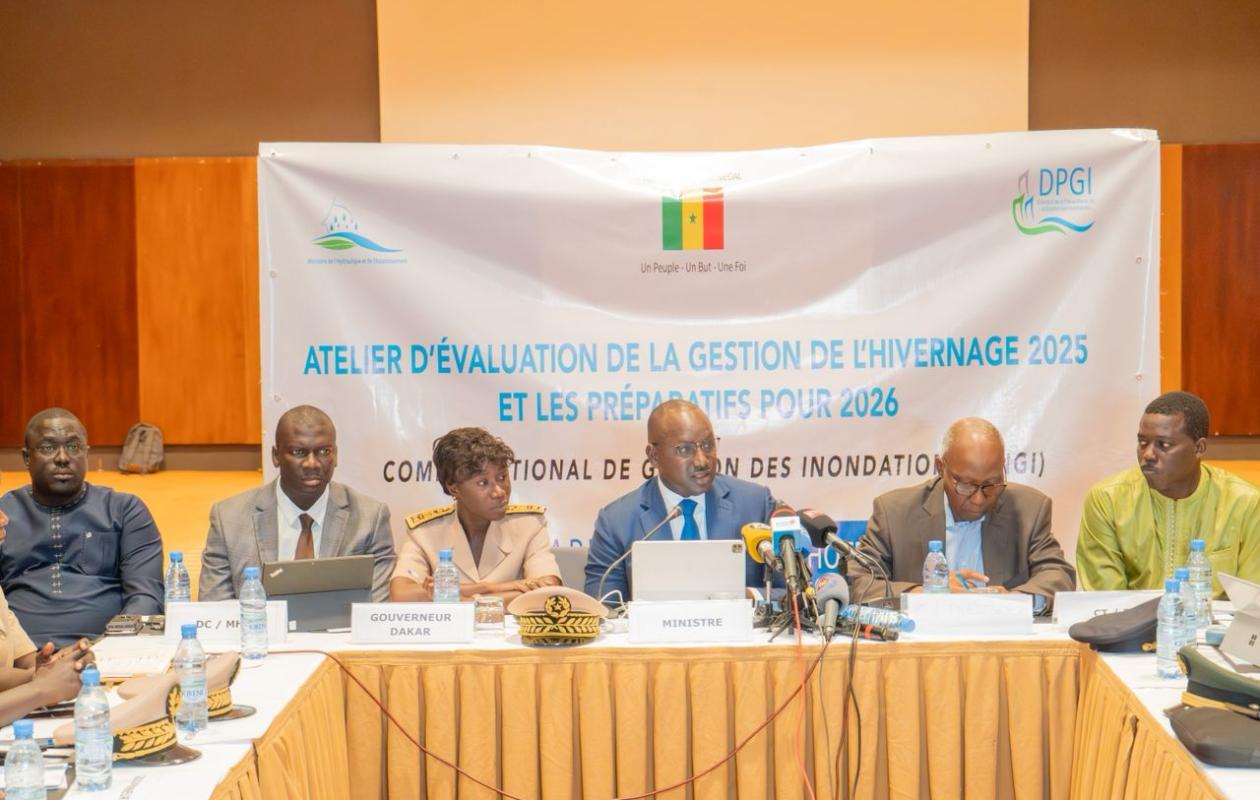
Hivernage 2025 : Le CNGI dresse le bilan des actions mises en œuvre et décline sa feuille de route pour 2026
A meeting of the National Flood Management Committee (CNGI) was held this Tuesday, December 16, 2025, under the chairmanship of Cheikh Tidiane Dièye, Minister of Water and Sanitation. This meeting to assess the management of the 2025 rainy season and the preparations for 2026 was attended by regional governors, members of parliament, mayors, civil society representatives, community representatives, construction companies and all relevant operational structures, namely: the National Sanitation Office of Senegal (ONAS), the Municipal Development Agency (ADM), the Directorate of Flood Prevention and Management (DPGI), the National Fire Brigade (BNSP), the Military Engineering Corps, the Agency for the Promotion of Investments and Major Works (APIX), the Road Works and Management Agency (AGEROUTE), the Urban Modernization Program (PROMOVILLES), the Jaxxay Completion Project and the Tawfekh Yaakaar Program (PAJ), the National Hygiene Service, among others.
The objective was to take stock of the actions implemented during the 2025 rainy season, and to review the stormwater drainage projects and works planned for the 2026 rainy season.
In this regard, the Minister of Water and Sanitation highlighted the proactive measures undertaken in 2025 for efficient management of the pre-, during-, and post-rainy season, with good flood control across almost the entire national territory, with the exception of difficulties noted in the Diourbel region where significant damage occurred. This situation led to the implementation of an emergency action plan supported by the allocation of 2.5 billion CFA francs to carry out operations aimed at clearing flooded areas.
He also reviewed preventive and curative actions, while outlining a vision based on the national strategy for integrated flood risk management which takes into account land use planning and land use, with sustainable solutions based on nature.
Alongside this dynamic, important projects and works are planned across the entire territory in anticipation of the 2026 rainy season. These include, among others, the structuring project for the drainage of rainwater in Tivaouane, costing 7.7 billion FCFA, launched on November 10, 2025, which will impact more than 86,000 people; additional works costing 11 billion FCFA planned in Touba to strengthen the efficiency of the structures, which will be launched in a few days; as well as earthworks operations in Yaféra, Kaymor, Ziguinchor, Zac Mbao, among others.
At the end of the meeting, the Minister of Water Resources and Sanitation made the following recommendations:
• For sustainable and efficient management of the pumping equipment deployed during the 2025 winter season, the competent operational structures, under the supervision of the Regional Governors, shall carry out the collection, maintenance and reconditioning;
• Reorganize the National Flood Management Committee into a more inclusive and collaborative format. This committee must meet as early as March 2026 to refine the flood prevention and management measures to be implemented, identify those directly or indirectly responsible, and set deadlines. These measures concern both rain-fed and river flooding, as well as groundwater flooding. Following this national meeting, the Governors will convene the regional flood management committees to develop their action plans, which will be subject to monitoring and evaluation.
• For all operational structures, accelerate and finalize on time the work planned in the respective Annual Work Plans and Budgets (AWPBs) that will have an impact in 2026, or, failing that, plan precautionary measures now. On this point, the Regional Governors are asked to follow up as necessary, in conjunction with the responsible structures, which must provide them with all the required information;
• Strengthen the means of forecasting and monitoring climate and runoff in order to refine early warning of rainfall events;
· In application of decree n°2025-1184 of July 16, 2025 declaring to be of public utility the project of preservation of natural waterways and dormant networks likely to be reactivated by an exceptional rain, initiate, through the Governors of Dakar, Kaolack, Diourbel, Kédougou, Kaffrine, Tambacounda, the establishment of the commissions for evaluation and census of expenses.
• Present to the Government as soon as possible the National Flood Management Strategy, including Flood Risk Management Plans (PGRI), Flood Risk Prevention Plans (PPRI) and all digital tools for monitoring structures in rainy weather (remote management, Computer-Aided Management and Maintenance [CMAM]).

















Commentaires (1)
Jusque là les lobbys qui le pilotaient l'empêchaient de voir autre chose que les pompages et camions de vidange comme solutions. Or les équipements de pompage et camions sont leurs propriétés qui leur permettent de se faire des millions sur la détresse des responsables de l'état due à la pression des inondées.
On ne peut régler le problème des inondations sans retracer comment cela est arrivé. Il y a eu des décennies de raretés de pluies. Les gens sont allés habiter dans les zones de réception des eaux de pluies, les bassins naturels, ils ont fait des constructions qui dévient les voies d'écoulement, et ensuite, les écoulements eux mêmes drainant sable et déchets avec eux vers les bassins ont fait des dépôts qui ont réduit les profondeurs et donc les capacités de stockage. Solution: retourner aux situations d'avant, quand il y avait autant de pluie sans inondations. Cela suppose: déguerpir, démolir, excaver, et après laisser la nature faire son travail. On ne payait pas la nature en milliards pour transporter les eaux de pluies ou pour les pomper. Ce sont ceux qui y gagnent qui proposent d'autres solutions.
Participer à la Discussion
Règles de la communauté :
💡 Astuce : Utilisez des emojis depuis votre téléphone ou le module emoji ci-dessous. Cliquez sur GIF pour ajouter un GIF animé. Collez un lien X/Twitter ou TikTok pour l'afficher automatiquement.