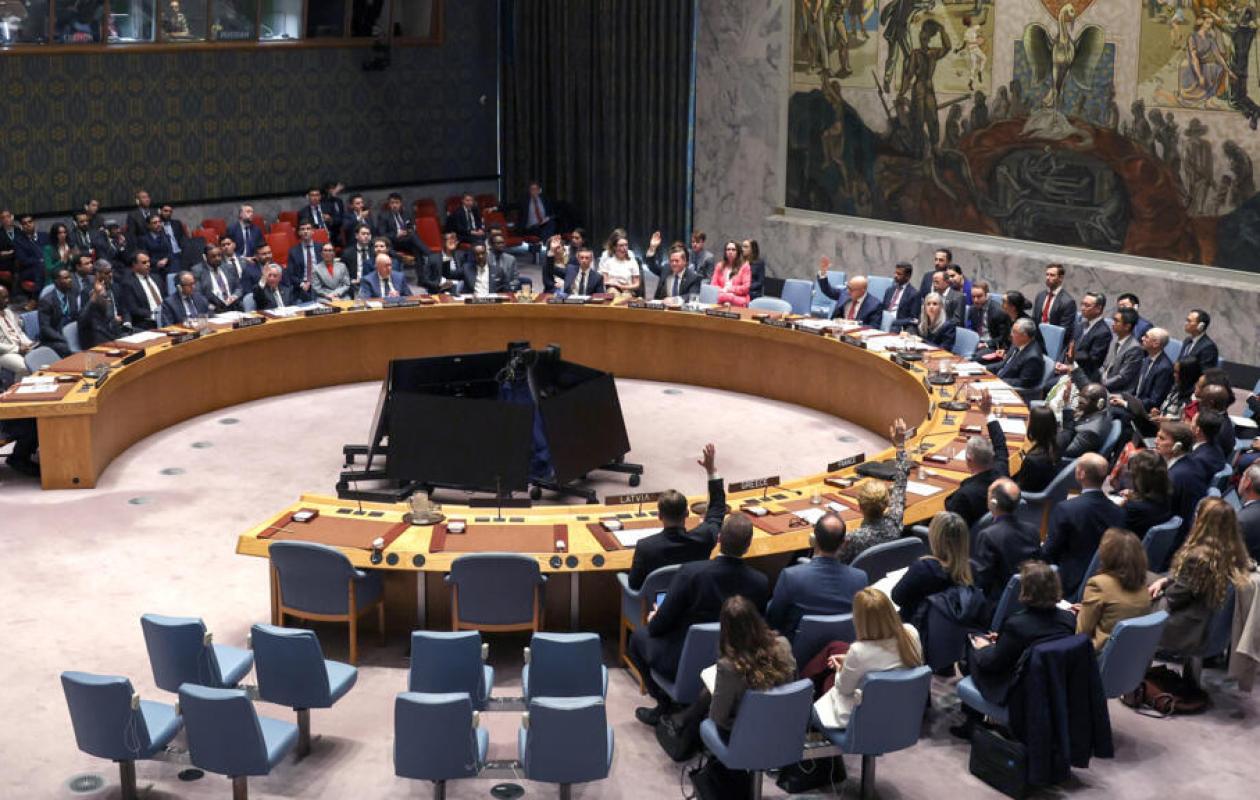
A l'ONU, Moscou et Pékin opposent leur veto au déblocage du détroit d'Ormuz
The draft resolution put forward by Bahrain, amended several times to try to avoid a veto, received 11 votes in favor, two against (Russia and China) and two abstentions (Pakistan and Colombia).
This vote comes just hours before the expiration of Donald Trump's ultimatum. The US president gave Iran until Tuesday at 8:00 PM Washington time (midnight GMT) to reopen shipping lanes in this vital maritime route, otherwise threatening to eradicate "an entire civilization".
Iranian ambassador to the UN, Amir Saeid Iravani, described the remarks on Tuesday before the Council as "deeply irresponsible", accusing Donald Trump of "openly revealing his intention to commit war crimes and crimes against humanity".
He also accused Bahrain's proposed text of "punishing the victim" of the Israeli-American attacks and of "providing the aggressors with political and diplomatic protection for further illegal actions."
The rejection of the resolution "does not prevent the United States from continuing to act in legitimate self-defense and to defend our allies and partners. And President Trump will continue the necessary actions to defend our people and the free world," reacted the American ambassador to the UN, Mike Waltz, just after the vote.
This vote "sends the wrong signal to the world": that threats to shipping lanes will not provoke "decisive action from the organization responsible for maintaining international peace and security," lamented Bahraini Foreign Minister Abdullatif bin Rashid Al Zayani. He then warned that the "patience" and "restraint" of the Gulf states in the face of Iranian attacks had "limits."
Backed by the Gulf countries and the United States, Bahrain had launched negotiations two weeks ago on a text that would have authorized any State or coalition of States to use "all necessary means" to guarantee the safety of ships and prevent the blockade of the strait.
But this idea has provoked strong objections, notably from France, Russia and China.
The addition last week of wording stipulating that the means employed could only be "defensive" had lifted French opposition.
After final modifications to try to convince Russia, a long-time ally of Iran, and China, the latest version of the text no longer mentioned authorization for the use of force, even defensive force.
It strongly encouraged the States concerned to coordinate efforts, of a defensive nature and proportionate to the circumstances, to ensure the safety of navigation in the Strait of Hormuz, including by escorting merchant and commercial vessels.
It also demanded that Iran "immediately cease all attacks against ships" and raised the possibility of the Council imposing "further measures" against those who undermine this freedom of navigation.
"Almost every paragraph (...) was full of unbalanced, inaccurate and aggressive elements," commented Russian Ambassador Vasily Nebenzia, justifying his veto.
While Security Council mandates authorizing member states to use force are relatively rare, Moscow regretted in 2011 having abstained from a vote giving NATO the green light for an intervention in Libya, which ultimately led to the fall of Colonel Gaddafi.
Asserting that he understood "concerns" regarding navigation in the Strait of Hormuz, Vassili Nebenzia announced that Russia and China would propose an alternative draft resolution for a vote, without giving a date.
The text, seen Tuesday by an AFP journalist, calls for respect for freedom of navigation, without mentioning the Strait of Hormuz. While Bahrain's text was primarily aimed at Iran, this one calls on "all parties" to cease attacks against civilians and civilian infrastructure. This wording is likely to displease the Americans.
Since the start of the conflict, triggered on February 28 by Israeli-American strikes on Iran, Tehran's near-paralysis of the Strait of Hormuz, through which normally a fifth of the world's oil production passes, as well as liquefied natural gas, has led to a sharp rise in hydrocarbon prices, with a global economic impact.
















Commentaires (2)
Participer à la Discussion
Règles de la communauté :
💡 Astuce : Utilisez des emojis depuis votre téléphone ou le module emoji ci-dessous. Cliquez sur GIF pour ajouter un GIF animé. Collez un lien X/Twitter, TikTok ou Instagram pour l'afficher automatiquement.