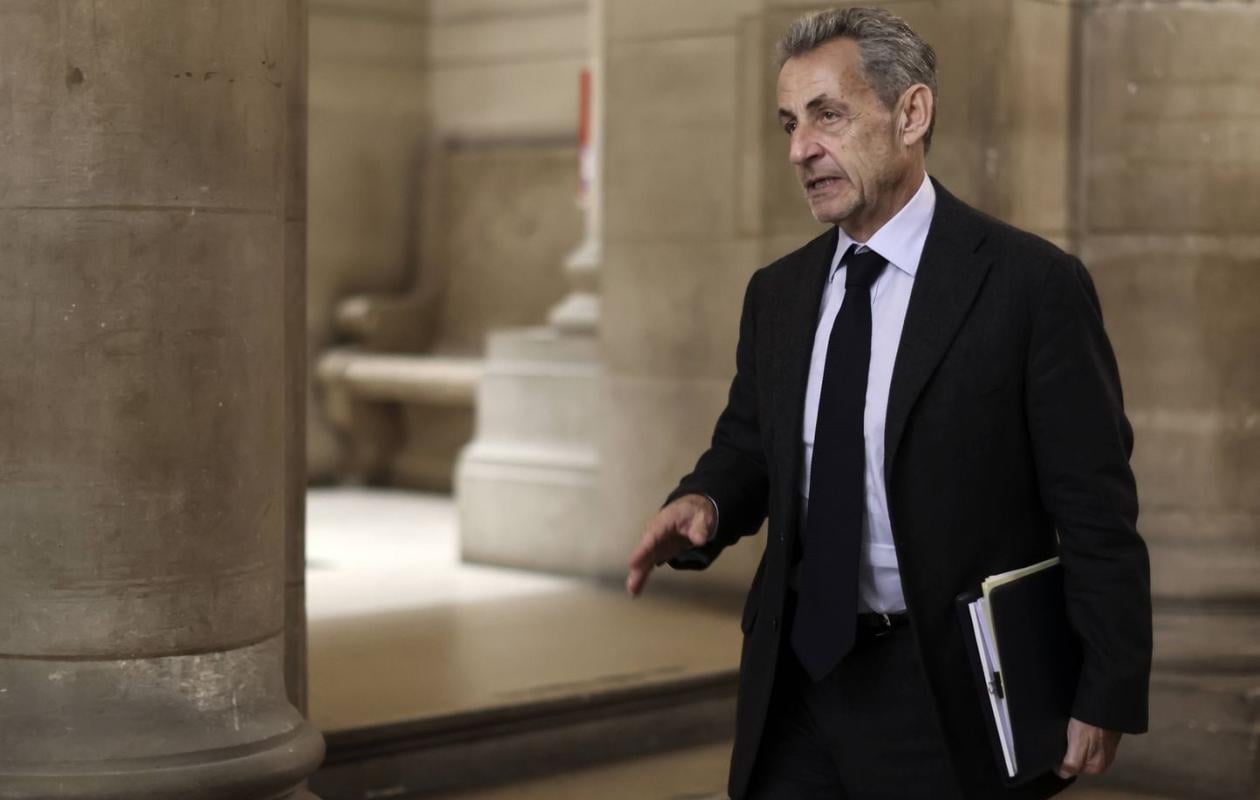
Nicolas Sarkozy arrive au palais de justice de Paris pour son procès en appel dans l'affaire libyenne, le 8 avril 2026 (Stéphane Lemouton/SIPA)
Former French President Nicolas Sarkozy is to be questioned on Wednesday before the Paris Court of Appeal about two documents written by his former right-hand man Claude Guéant, which amount to de facto divorces in the case of the alleged Libyan financing of the 2007 presidential campaign.
Nicolas Sarkozy has been on trial again since mid-March, suspected of having received secret funds from Libya under dictator Muammar Gaddafi for the presidential campaign that brought him to power from 2007 to 2012.
Ill, Claude Guéant, then Secretary General of the Presidency, was unable to attend the trial. He learned remotely of the accusations against his integrity by Nicolas Sarkozy, who suggested to the court that his former colleague, while certainly "remarkable," may also have been motivated by a desire for personal enrichment.
Mr. Guéant, 81, responded with statements dated April 11 and 26: without directly accusing him, he contradicts the former head of state and shatters their hitherto united front.
An essential cog in the conquest of the Elysée and then in the exercise of power, the former prefect only ever "followed (the) instructions" of Nicolas Sarkozy, he insists.
At stake in this trial, which will end at the end of May before a decision in November, is Nicolas Sarkozy's honor as a former president and his freedom as a citizen, he who has already spent 20 days behind bars after his conviction in the first instance to five years in prison for association of criminals.
He had been found guilty of allowing Claude Guéant and his friend Brice Hortefeux to discuss covert political financing with Libyan authorities, which the three men deny.
In exchange, the Libyans reportedly demanded diplomatic and economic concessions, as well as an examination of the legal situation of the brother-in-law of dictator Muammar Gaddafi and number two in the regime, Abdallah Senoussi.
He was the subject of an international arrest warrant after his conviction in France to life imprisonment for having ordered the attack against the UTA DC-10 (170 deaths in 1989).
Abdallah Senoussi is expected to be a major topic of discussion again during this fifth day of Nicolas Sarkozy's interrogation. Did he ask his secretary general, in the presence and at the request of Muammar Gaddafi, to consider the fate of the man whom France considers a terrorist, at the end of an official dinner in Tripoli on July 25, 2007?
Claude Guéant, who was sentenced in the first instance to six years in prison for a series of offenses, claims this, but Nicolas Sarkozy has issued "the most formal denial".
Another subject is a meeting in Libya at the end of 2005, which was allegedly attended by his friend and former lawyer, Thierry Herzog, and his colleague Francis Szpiner, on the legal examination of Senoussi's situation, according to various elements gathered during the investigation.
After initially claiming to know nothing about it, Nicolas Sarkozy now considers the trip credible, given the evidence in the case. However, he maintains he was not behind it and reiterated in court that "no one had informed him of this meeting." Without mentioning the meeting in Libya, Claude Guéant writes that "Thierry Herzog spoke to the president about the mandate he had received" on this matter.
This episode and the Tripoli dinner, Claude Guéant continues, made it "natural, and even unavoidable" for him to mention his own secret meeting with Abdallah Senoussi, a tête-à-tête on October 1, 2005, which he had previously stated he did not remember informing Nicolas Sarkozy about.
The prosecution is convinced that Act I of this "corruption pact" took place during this meeting, just before an official trip by Nicolas Sarkozy, then Minister of the Interior.
Finally, Claude Guéant asserts that the former president was "certainly aware" of his four trips to Libya between 2008 and 2010, undertaken "at (his) request," on diplomatic and commercial matters. Nicolas Sarkozy claims to have little recollection of them.
"What I do know is that nothing has been done to help Mr. Senoussi. Nothing has been promised," he insisted. On this point, Claude Guéant does not contradict him: if he inquired about the Libyan's legal situation, it was fully aware that nothing was possible. And if he was able to "leave things unresolved" with the Libyan authorities until 2009, it was "so as not to be too abrupt" in a nascent diplomatic relationship, he explained.
Speaking on France Inter radio on Wednesday, Claude Guéant's lawyer, Philippe Bouchez El Ghozi, stated that Nicolas Sarkozy's statements about his client "do not improve his state of health" and that they have dealt him "more than a blow to his morale".
"I think he will have a very hard time digesting it, assuming that it can ever happen," the lawyer also said.
AFP









Commentaires (0)
Participer à la Discussion
Règles de la communauté :
💡 Astuce : Utilisez des emojis depuis votre téléphone ou le module emoji ci-dessous. Cliquez sur GIF pour ajouter un GIF animé. Collez un lien X/Twitter, TikTok ou Instagram pour l'afficher automatiquement.