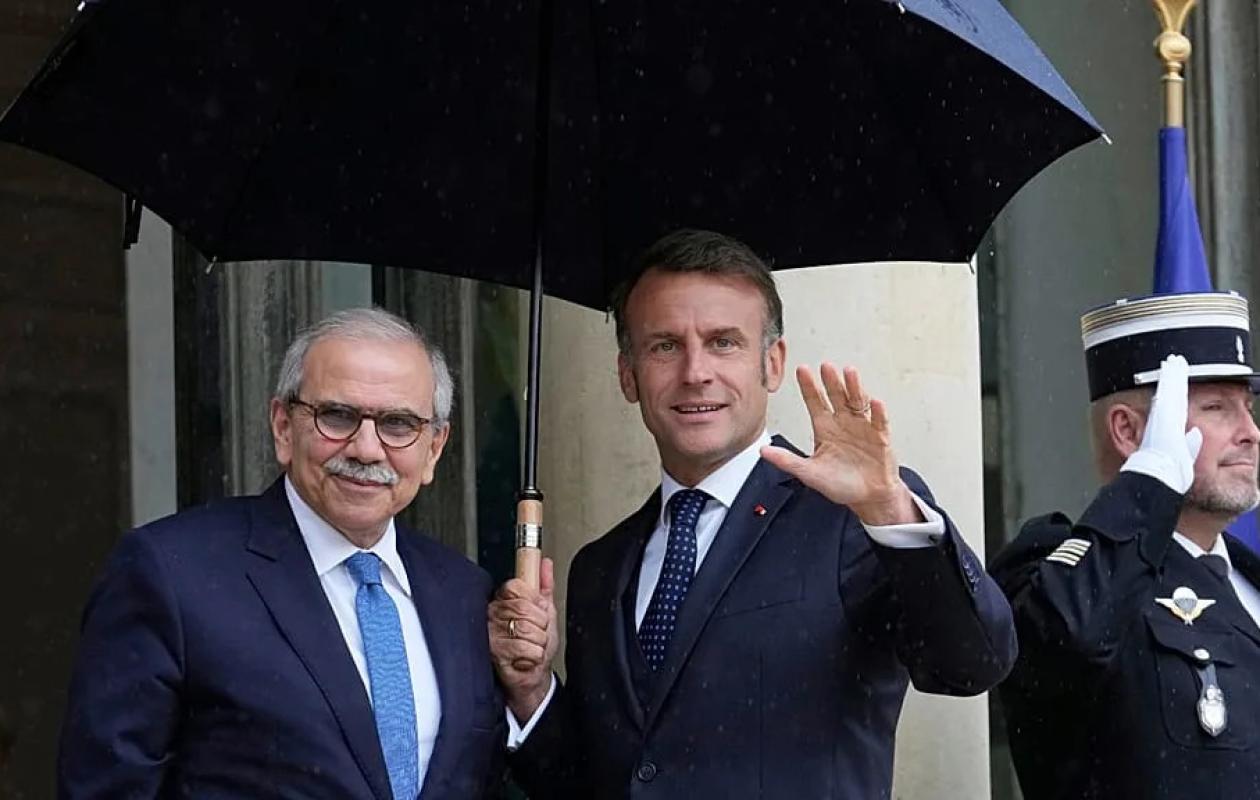
"La France s'engagera dans la reconstruction des zones touchées" au Liban, assure Emmanuel Macron
Emmanuel Macron received Lebanese Prime Minister Nawaf Salam on Tuesday, April 21, while new direct negotiations between Israel and Lebanon are expected on Thursday in Washington.
During this visit, Emmanuel Macron reaffirmed his commitment to strict adherence to the ceasefire. Its achievement "is a relief after a conflict lasting several weeks that the Lebanese people did not want," declared Emmanuel Macron after the meeting, adding that it is now necessary to "consolidate the truce."
"Mechanisms exist to ensure the implementation of the ceasefire. They must be reactivated and the truce must be extended in order to allow the start of a real dynamic of stabilization," he also judged.
He then cited the "disarmament of Hezbollah by the Lebanese themselves with the support of the international community," asserting that the armed group had made "a mistake in dragging Lebanon into the war" and urged them to "stop targeting Israel and pretending to replace the state in the exercise of its prerogatives."
But "the monopoly on weapons will not happen with the wave of a magic wand, it will be part of a comprehensive political strategy ," he stated.
Emmanuel Macron then called for "Israeli withdrawal from Lebanese territory" and asserted that the security of the Israeli state will depend on "a strong Lebanese state and not a policy of chaos" in the region.
During his speech, the head of state expressed his support for Lebanon's territorial integrity and praised "the historic decisions taken by the president to restore it throughout its territory."
"The only way forward is through a political agreement between Israel and Lebanon, which guarantees the security and integrity of both countries and lays the groundwork for the normalization of their relations ," he said.
For his part, Nawaf Salam demanded, as Lebanese President Joseph Aoun had done before him, a "complete withdrawal" of Israeli forces from his territory, as well as the return of prisoners and displaced Lebanese.
The head of government also estimated that his country would need "500 million euros to deal with the humanitarian crisis over the next six months".
Finally, Emmanuel Macron assured that the ceasefire should allow "the reconstruction of Lebanon and southern Lebanon in order to allow the return of all displaced persons" .
The head of state then reiterated to Nawaf Salam his support, which notably includes sending 60 tons of humanitarian freight "to meet the needs of the civilian population" and France's participation "in the Euro-Arab humanitarian bridge which is being set up and through which we will deliver, in the coming days, an additional 10 tons of humanitarian equipment" .
"France will commit to the reconstruction of the areas affected by the bombings ," he then affirmed. "If that is Lebanon's wish, France is ready to maintain its commitment on the ground after the scheduled departure of UNIFIL at the end of the year, within a framework that we will need to define ," he specified. Emmanuel Macron concluded: "You can count on France's support. France has always stood by Lebanon in the critical moments of its history and will continue to do so."
A meeting following an attack suffered by UNIFIL
This diplomatic sequence comes in a particularly tense atmosphere following the death on Saturday of a French peacekeeper from the United Nations Interim Force in Lebanon (UNIFIL).
The fifteen members of the UN Security Council condemned the attack and called for those responsible to be brought to justice without delay. The French president and the UN have pointed the finger at Hezbollah.
Emmanuel Macron on Monday accused the pro-Iranian Shiite movement of killing Sergeant Florian Montorio in an ambush against UN peacekeepers on Saturday, while maintaining that he was not targeted because of his French nationality.
"It was Hezbollah that targeted our soldiers (…) They did not target them because they were French. They targeted them because they were carrying out the mission," the head of state said at a press conference in Gdansk, Poland.
The French president also stated that "the Lebanese authorities have condemned this attack and will take the necessary steps to arrest the perpetrators and ensure they are punished." UNIFIL soldiers "must under no circumstances be targeted," his office declared.
What future for UNIFIL?
Beyond the truce, which is due to end Wednesday evening, the future of UNIFIL is also in question. The UN mission in Lebanon is scheduled to begin withdrawing its peacekeepers at the end of the year.
This prospect raises a central question: who will ensure security in the border area between Lebanon and Israel tomorrow, two countries that have been at war since 1948? UNIFIL, deployed since 1978, aims to restore peace and support the Lebanese authority in the south of the country.
Shortly before the meeting between Emmanuel Macron and Nawaf Salam, an advisor to the Elysée told journalists, including Euronews, that discussions were underway with European countries already involved in the UN mission, including Spain, Italy and Germany.
"These actors are now contributing very directly to the discussion on what an international force coming to support the Lebanese government might look like," he said, while clarifying that this did not necessarily mean that these countries would be involved in Lebanon after the UN withdrawal.
But this strategic reflection comes at a time when the French diplomatic position appears to have weakened.
Despite Paris' interest in playing a mediating role in the new direct talks between Israel and Lebanon in Washington, Israeli officials have insisted that France is not involved in the negotiations.






Commentaires (1)
Participer à la Discussion
Règles de la communauté :
💡 Astuce : Utilisez des emojis depuis votre téléphone ou le module emoji ci-dessous. Cliquez sur GIF pour ajouter un GIF animé. Collez un lien X/Twitter, TikTok ou Instagram pour l'afficher automatiquement.