Le futur porte-avions français portera le nom de «France libre», annonce Emmanuel Macron
Emmanuel Macron announced on Wednesday, March 18, that the next-generation aircraft carrier that will succeed the Charles de Gaulle in 2038 would be named "Free France", in homage to the "French spirit" of "resistance" embodied by the general.
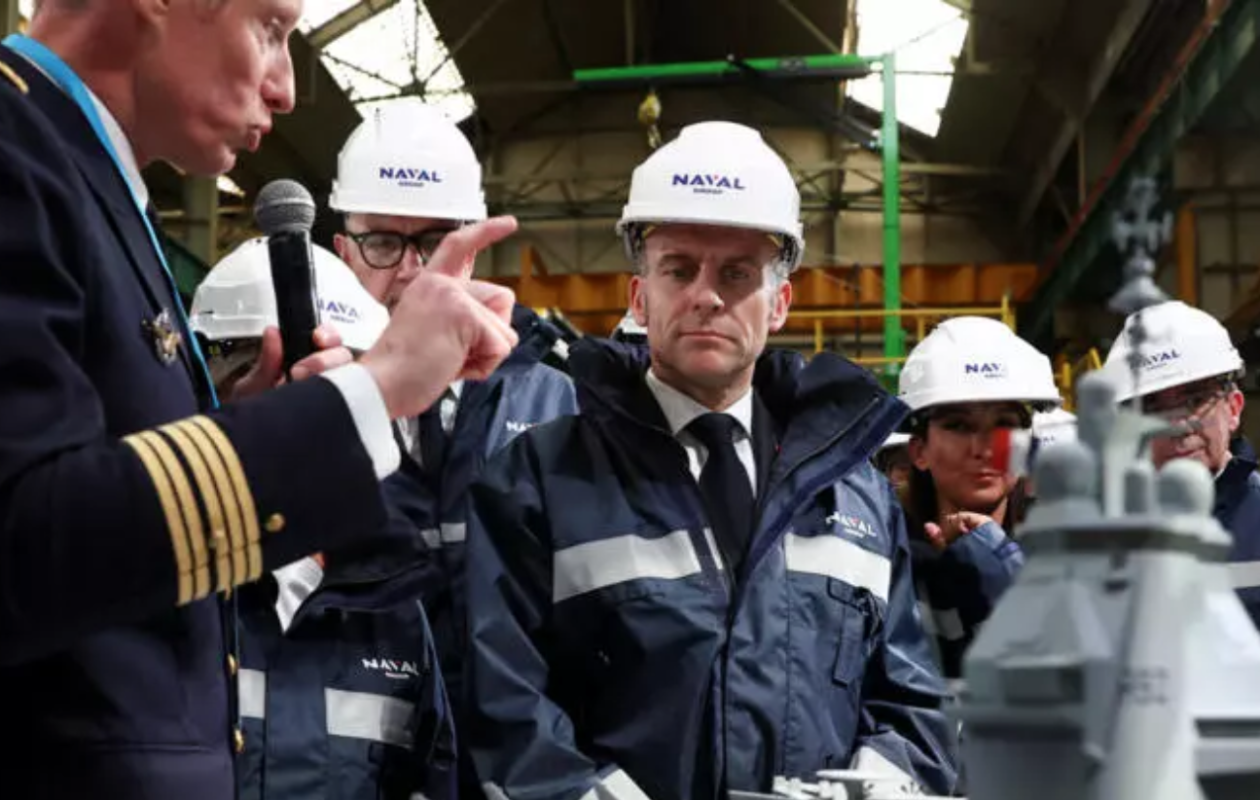
French President Emmanuel Macron looks at a model of an aircraft carrier during his visit to the Naval Group shipyard in Nantes-Indret, where construction of France's second aircraft carrier has begun, in Indre, near Nantes, in western France, on March 18, 2026.
“I wanted to place our future aircraft carrier within the legacy of General de Gaulle. His life, his destiny. The choices made as early as June 1940, after the defeat, express a certain idea of France,” the President declared at the construction site of the nuclear reactors for the future flagship of the French Navy in Indre, near Nantes. “For him, for us, the French spirit is a spirit of resistance. It is a will that nothing can stop. A will to resist in order to remain free. An irrepressible, invincible will,” he added.
"This desire to remain free is the desire for independence at all costs, for total and unconstrained autonomy of action, for the projection of our forces wherever the defense of France's interests requires it [...] To remain free, we must be feared. To be feared, we must be powerful," he added.
The head of state gave the green light to the construction of this new generation aircraft carrier in December, bringing to fruition a project that had been in development since 2018. All that remained was to give it a name to mark the start of construction.
The head of state has opted for an unprecedented choice, the last aircraft carriers having all carried great names in French political and military history, such as Charles de Gaulle, Georges Clemenceau or Marshal Ferdinand Foch.
"Will to power"
This new flagship, which will represent 10 billion euros of investment over about twenty years, is already adorned with all the superlatives.
"Our next aircraft carrier will be 310 meters long. It will displace 80,000 tons. It will have two nuclear reactors. It will represent a tonnage 1.8 times greater than that of the Charles de Gaulle. These figures show the scale of our ambition," Emmanuel Macron emphasized.
"Our aircraft carrier is France embodied in will and power [...] It is indeed the guarantee of our independence for the decades to come," he added, standing next to the model of the future giant of the seas.
This tool for projecting power but also for diplomacy, on board which the head of state traveled on March 9 off the coast of Crete, is currently deployed in the eastern Mediterranean to deal with the threats of the raging conflict spreading.
The future construction project is part of the defense effort on which Emmanuel Macron has placed particular emphasis since 2017, as evidenced by his recent speech on nuclear deterrence which marks the increase in the French arsenal and cooperation with eight European countries.
Only two countries in the world possess nuclear-powered aircraft carriers: the United States (11 ships) and France. China and India have conventionally powered carriers, while the others (United Kingdom, Italy, etc.) are equipped with less capable vertical takeoff and landing (VTOL) aircraft carriers.
Plan B
The future building "will be capable of both launching and recovering aircraft. Currently, on most aircraft carriers, you launch and then reconfigure the deck for recovery, which limits operational capacity," the presidency emphasizes.
With three catapult rails, instead of the current two, it will also maximize the takeoff capacity of the 40 embarked aircraft.
One major drawback, however: the electromagnetic technology of the future catapults will come from the American company General Atomics, a potential source of vulnerability in a world of heightened power dynamics.
"The choice has been made and it is an economic choice to work with the United States, which is perfectly consistent, but there are obviously other plans, a plan B, if we ever had particular constraints," a presidential advisor assures.
The building will also need to be "scalable" to accommodate all types of aircraft that will be deployed during its lifetime, but also drones, the new military challenge revealed by the wars in Ukraine and the Middle East.
"We will need drones that will penetrate opposing defenses, whether they are combat drones or remotely operated munitions, supply drones, surveillance drones...", emphasizes the Chief of Staff of the Navy, Admiral Nicolas Vaujour.







Commentaires (5)
Participer à la Discussion
Règles de la communauté :
💡 Astuce : Utilisez des emojis depuis votre téléphone ou le module emoji ci-dessous. Cliquez sur GIF pour ajouter un GIF animé. Collez un lien X/Twitter, TikTok ou Instagram pour l'afficher automatiquement.