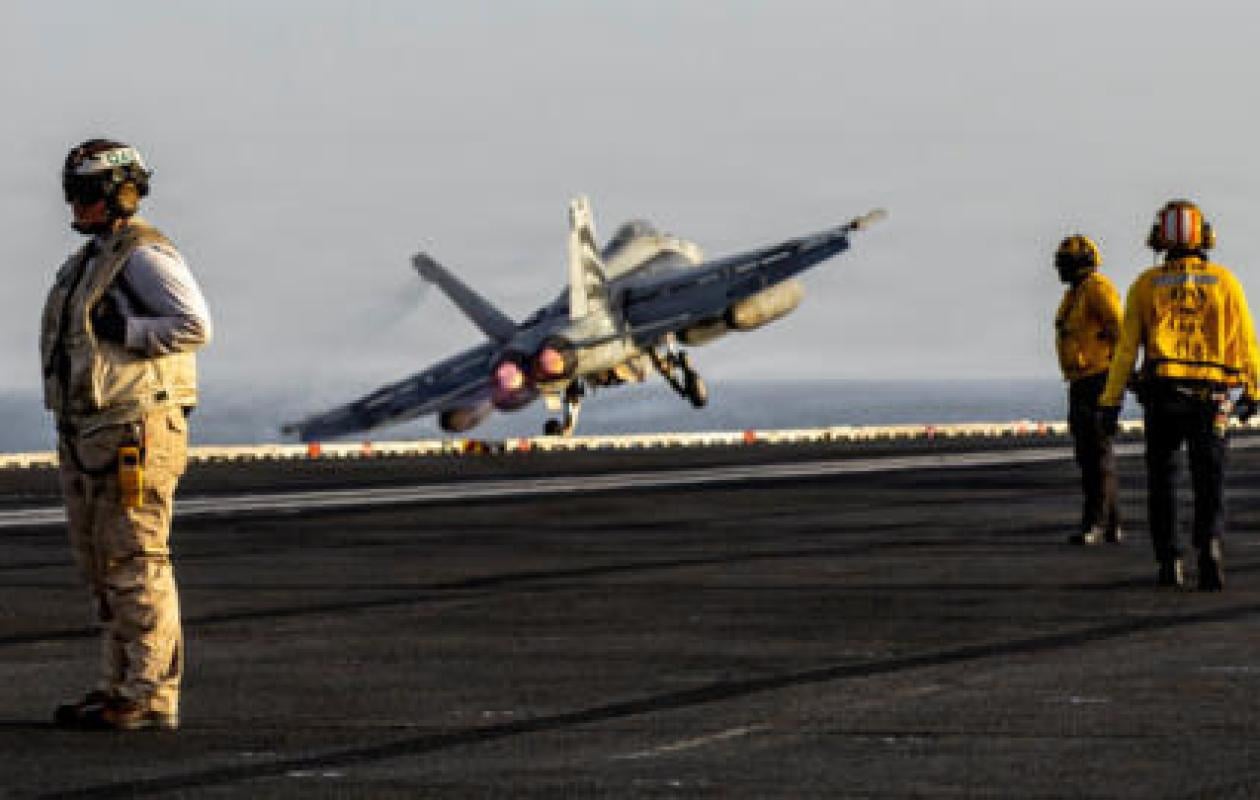
Les Etats-Unis vont imposer un blocus des ports iraniens après l'échec des pourparlers
The United States announced that it would impose a blockade on Iranian ports starting Monday after the failure of direct talks between the two countries, which Washington attributed to Tehran's refusal to renounce its nuclear ambitions.
As soon as the impasse was announced, Pakistan, the host of these negotiations, called for respect for the two-week truce agreed upon between the United States and Iran on Wednesday. However, neither side has commented on the future of the ceasefire, which is set to expire on April 22.
It is by accusing Iran of wanting to acquire nuclear weapons, which Tehran denies, that the United States justified the offensive launched with Israel on February 28, which triggered a war that has killed more than 6,000 people, mostly in Iran and Lebanon, and which is disrupting the world economy.
The US military announced Sunday that it would impose a blockade from Monday at 2:00 PM GMT on "ships of all nationalities entering or leaving Iranian ports and coastal areas", in the absence of an agreement to end the conflict.
But she specified that she would allow ships not departing from or heading towards Iran to pass through the Strait of Hormuz, a strategic passage for global trade and oil supply, according to a statement from the U.S. Central Command for the Middle East, Centcom.
- "A feeling of uncertainty" -
Although he assured that the discussions, which lasted more than 20 hours, had gone "well" and that "most points had been agreed upon", the American president reaffirmed on Sunday that he was ready to strike Iranian energy infrastructure, indicating that Tehran had refused to give in on the nuclear issue.
"We are overwhelmed by despair and a feeling of helplessness. We are fed up with this uncertainty," reacted Nahid, a 60-year-old housewife from Tehran, exhausted by six weeks of Israeli-American bombing.
The United States will begin a "BLOCKADE process of all ships attempting to enter or leave the Strait of Hormuz," Donald Trump wrote in his first reaction to the announcement overnight of the failure of negotiations.
Without detailing the modalities of such an operation, while the passage has been blocked by Iran since the beginning of the war, he stated on Fox News that the United Kingdom "and a few other countries" would send minesweepers.
Iran "will not give in to any threat," responded the Speaker of Parliament, Mohammad Bagher Ghalibaf, who led the Iranian delegation to Islamabad.
The Islamic Revolutionary Guard Corps, the ideological army of the Islamic Republic, threatened to trap their enemies in a "deadly whirlpool," claiming to have "complete control" of navigation in the strait, where Tehran has established transit rights.
The head of the Iranian navy, Admiral Shahram Irani, described Donald Trump's threats of a blockade as "ridiculous".
According to the Iranian news agency Fars, two Pakistani-flagged oil tankers heading there turned back on Sunday, while hundreds of merchant ships remain stranded.
"There is little reason to believe that a blockade would force Iran to capitulate. In fact, the resilience the country has shown so far suggests the opposite," says Danny Citrinowicz, a researcher at the Institute for National Security Studies (INSS) in Tel Aviv.
According to him, such a system would also require a "massive and prolonged deployment of American resources".
- Lebanese Front -
Although the delegations have left Pakistan, they have not closed the door to continuing negotiations.
"We are leaving here with a very simple proposal, an approach that constitutes our final offer and the best we can make," said US Vice President JD Vance before his departure. "We'll see if the Iranians accept it."
Iran, for its part, accused the United States of trying to "dictate their conditions" to it, with the spokesman for the diplomacy, Esmaeil Baqaei, referring to "an atmosphere of suspicion and mistrust".
For him, "it was obvious" that an agreement could not be reached "in a single session".
On the second main front of the war, Lebanon, talks are scheduled for Tuesday between Lebanese and American representatives in Washington, after the green light given by Israel under American pressure.
After the ceasefire came into effect, Israel maintained that Lebanon was not included in the agreement.
During his first visit to southern Lebanon since the start of hostilities, Israeli Prime Minister Benjamin Netanyahu asserted that his army, after advancing into Lebanese territory to establish a so-called "security" zone, had "thwarted the threat of an invasion."
His Lebanese counterpart, Nawaf Salam, assured that Beirut was working to obtain a total withdrawal of Israel through negotiation.














Commentaires (6)
Participer à la Discussion
Règles de la communauté :
💡 Astuce : Utilisez des emojis depuis votre téléphone ou le module emoji ci-dessous. Cliquez sur GIF pour ajouter un GIF animé. Collez un lien X/Twitter, TikTok ou Instagram pour l'afficher automatiquement.