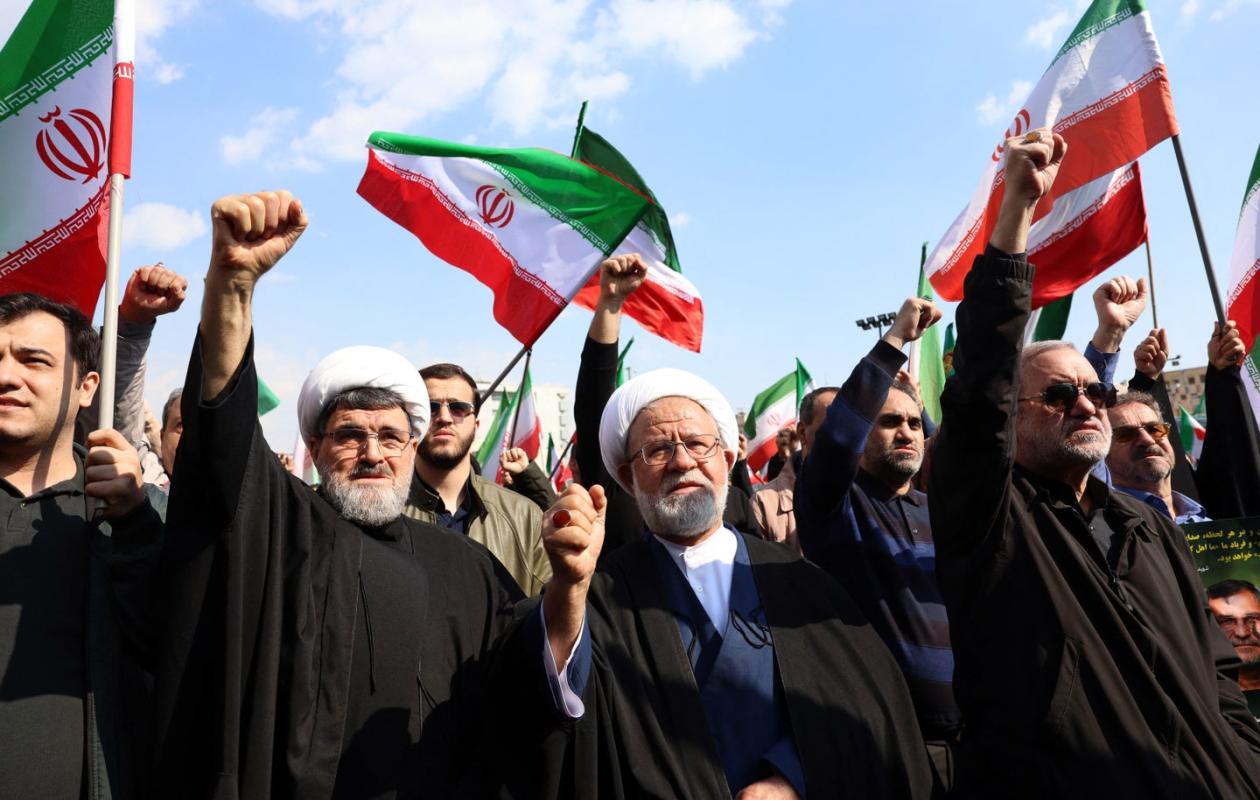
L'Iran promet des attaques "dévastatrices" après les menaces de Trump
New explosions rocked Tehran on Thursday after US President Donald Trump threatened Iran with massive bombings, with the Iranian military promising "devastating" attacks against the United States and Israel in return.
After more than a month of conflict marked by daily strikes and thousands of deaths in the Near and Middle East, the Israeli army, for its part, countered new missile attacks from Iran, in the middle of the Jewish Passover holiday.
The operational commander of the Iranian army asserted in a video statement that this war would continue until the "humiliation" of Iran's enemies, threatening "even more devastating" operations.
He was reacting to Donald Trump's speech on Wednesday evening, in which he promised to strike Iran for another "two to three" weeks, in his first address since the start of the conflict, triggered by an Israeli-American offensive on Iran on February 28.
This speech dashed the hopes of the stock and oil markets for a swift end to a war that is destabilizing the global economy.
In Tehran, strikes severely damaged the Pasteur Institute of Iran, and powerful explosions shook buildings in the city center at midday, with others hitting the west and east of the capital.
Iran’s two largest steel mills have announced they are forced to cease operations due to Israeli-American strikes.
While asserting that he was "close to achieving" his objectives in Iran, the American president nevertheless reiterated his intention to continue hitting the country "extremely hard over the next two to three weeks."
"We will send them back to the Stone Age to which they belong," he declared, justifying the war in particular by the need to prevent Iran from acquiring nuclear weapons.
An Iranian official, however, told AFP that his country had not resumed uranium enrichment after the Israeli and American strikes of June 2025 against some of its nuclear facilities.
"We have not restarted enrichment, and that was a (...) very big lie," insisted Iranian Ambassador to the International Atomic Energy Agency (IAEA), Reza Najafi, denouncing the recent attacks on the Bushehr nuclear power plant in southern Iran.
French President Emmanuel Macron, speaking from Seoul, stated that the American and Israeli offensive would not resolve the issue of Tehran's nuclear program "in the long term," advocating "in-depth negotiations."
Regularly criticized by Trump, along with other NATO allies accused of not sufficiently supporting the United States in this conflict, Mr. Macron also stressed that "liberating" by force the strategic Strait of Hormuz, sealed off by Iran since the beginning of the war, would be "unrealistic".
This maritime route is strategic for the global transport of hydrocarbons, and its near-blockade by Iran is driving up oil prices and raising fears of an inflationary spiral.
Donald Trump urged countries dependent on this passage for their oil supply to "take care" of the strait themselves.
The United Kingdom, France, Germany, Japan and about thirty other countries are to meet remotely on Thursday to find ways to restore and guarantee the safety of maritime transport in this strait after the war.
If Iran wants to close it to its "enemies", it has pledged, according to the Philippines, to allow oil shipments from that country to cross the strait to reach the archipelago, which is largely dependent on imports.
Oil prices, which had retreated on Wednesday amid hopes of a swift resolution to the conflict, surged after Trump's speech. The price of Brent crude, the global benchmark, climbed above $108 a barrel.
Financial markets also reversed the trend, turning red, both in Europe, where Paris was down 1.24% and Frankfurt 1.55% in early trading around 07:10 GMT, and in Asia where Tokyo's Nikkei index closed down 2.4%.
Beijing has accused US and Israeli operations against Iran of being the "primary cause" of the Hormuz blockade and urged the warring parties to begin peace talks "as soon as possible".
Mr. Trump did not mention a ceasefire in his speech Wednesday evening, after having asserted just hours earlier that his Iranian counterpart, Massoud Pezeshkian, was calling for one. Iranian diplomacy denied the existence of direct negotiations with Washington.
Donald Trump's Israeli ally, Prime Minister Benjamin Netanyahu, insisted on Tuesday evening that the campaign against Iran was "not over," although he also believes he has fulfilled part of his objectives by dealing "a blow" to Iran's nuclear and ballistic programs.
In Israel, targeted by four rounds of Iranian missile strikes, four people sustained minor injuries. The pro-Iranian Lebanese Hezbollah also claimed responsibility for attacks in the north of the country, though Israeli authorities reported no casualties or damage.
In Baghdad, the US embassy warned that pro-Iranian Iraqi armed groups could carry out attacks in the coming days against the center of the Iraqi capital, where it is located.
In southern Lebanon, where the Israeli army is gaining ground, an Israeli strike destroyed a building, and rescuers searched the rubble for victims, AFP reported.
The death toll from a month of Israeli strikes in the country has now risen to more than 1,300, according to the government.













Commentaires (4)
Participer à la Discussion
Règles de la communauté
💡 Astuce : Utilisez des emojis depuis votre téléphone ou le module emoji ci-dessous. Cliquez sur GIF pour ajouter un GIF animé. Collez un lien X/Twitter, TikTok ou Instagram pour l'afficher automatiquement.
Se connecter
Commentez avec votre profil, votre photo, et soyez averti des réponses.