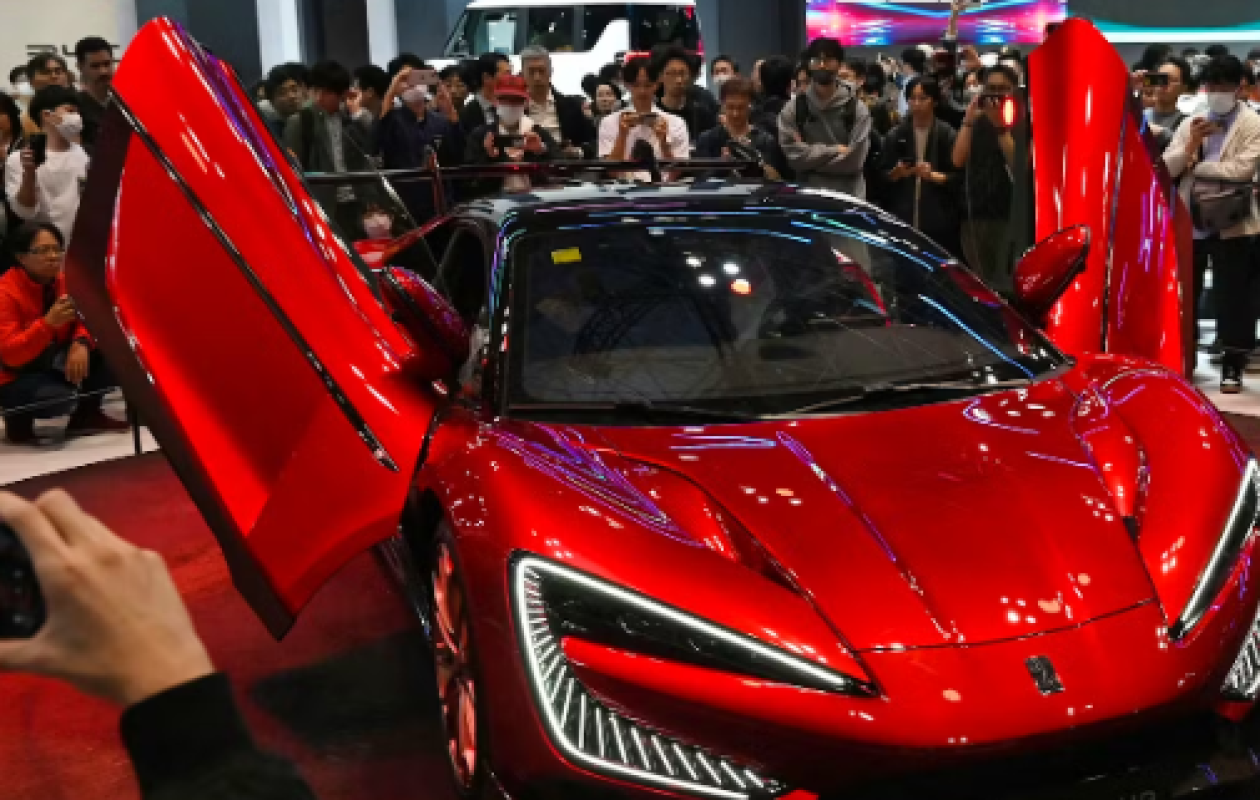
L'UE renonce au tout-électrique en 2035 pour les autos
Manufacturers will be able to continue selling a limited share of new internal combustion or hybrid cars.
The European Union on Tuesday abandoned plans to require car manufacturers to switch to all-electric vehicles by 2035, a key environmental measure, in the face of the crisis facing the sector in Europe.
Manufacturers will be able to continue selling a limited share of new cars equipped with internal combustion or hybrid engines after this deadline, subject to compliance with multiple conditions, including offsetting the CO2 emissions that will result from these "flexibilities", the European Commission specified.
A "pragmatic" approach
By relaxing the target for 2035, the EU is not abandoning its climate ambitions, but is adopting a "pragmatic" approach to the difficulties faced by the automotive industry, argued European Commissioner Stéphane Séjourné, who led this plan, in an interview with AFP.
"The objective remains the same, the flexibilities are pragmatic realities given the consumer support, the difficulty for manufacturers to offer 100% electric vehicles on the market by 2035," he stated.
The ban on selling internal combustion engine cars from 2035 was a flagship measure of the grand "European Green Deal", to help the EU keep its commitment to achieve carbon neutrality by 2050. But Europe, facing competition from China and trade tensions with the United States, has already postponed or scaled back several environmental measures in recent months, in a deliberate pro-business shift.
Reduce CO2 emissions by 90%
Instead of the planned ban on new internal combustion engine cars by that deadline, manufacturers will have to reduce CO2 emissions from their sales by 90% compared to 2021 levels, and offset the remaining 10%. Brussels thus assures that the sector will indeed be 100% decarbonized by that time.
Manufacturers in the Old Continent had been demanding "flexibility" for months, as they are weighed down by persistently sluggish sales, while their Chinese rivals, including BYD, are seeing their market share soar with their attractively priced electric models.
These relaxations were the subject of intense negotiations between the Commission and the Member States, who sought to best defend the interests of their respective industries until the very last moment.
On one side, a bloc of countries, including Germany and Italy, loudly defended "technological neutrality," meaning the continued use of internal combustion engines after 2035, while promoting more CO2-efficient technologies (plug-in hybrids, electric vehicles equipped with range extenders, etc.) and the use of alternative fuels.
Conversely, France and Spain called on the EU to deviate as little as possible from the 2035 target, so as not to undermine the efforts already made by some manufacturers to convert to all-electric, and not to destroy the burgeoning electric car battery sector.
Encourage battery production
To address these concerns, the Commission unveiled on Tuesday a series of measures to support the electrification of the sector, including incentives for the "greening" of company fleets (which will support demand for electric vehicles) and zero-interest loans for battery production.
Mr. Séjourné also confirmed the introduction of a "European preference" in the automotive sector, meaning that manufacturers receiving public funding will be required to source components "made in Europe." This is a very concrete way to support the entire supply chain, including equipment manufacturers, suppliers, and subcontractors.
Finally, the Commission wants to encourage the development of small electric vehicles at "affordable" prices. This project was announced in September by Ursula von der Leyen, "so as not to let China and others conquer this market."
"Our demands are not optional wishes, they are essential requirements to maintain the profitability of the sector, preserve jobs, finance decarbonization and remain competitive in the face of fierce global competition," argued Sigrid de Vries, head of the European Automobile Manufacturers' Association (ACEA), on the eve of these announcements.
The environmental NGO T&E warned, on the contrary, that slowing down the electrification of the sector would be "a strategic mistake", which would further widen the gap between Europeans and Asian competition.
However, if the announced safeguards are properly implemented "this is not a change of course", believes centrist MEP Pascal Canfin (Renew), for whom internal combustion engine cars will be confined after 2035 to a "premium, or even luxury" segment.









![[EXCLUSIF] Affaire PCD : Le cap des 100 arrestations franchi, le téléphone d'Ass Dione accable le fils d'un grand marabout](https://image.seneweb.com/content/news/2026-20-13//thumb_1260x800_6a04a22c82a84_ACA7PLyDxC.jpg)












Commentaires (2)
Participer à la Discussion
Règles de la communauté :
💡 Astuce : Utilisez des emojis depuis votre téléphone ou le module emoji ci-dessous. Cliquez sur GIF pour ajouter un GIF animé. Collez un lien X/Twitter, TikTok ou Instagram pour l'afficher automatiquement.