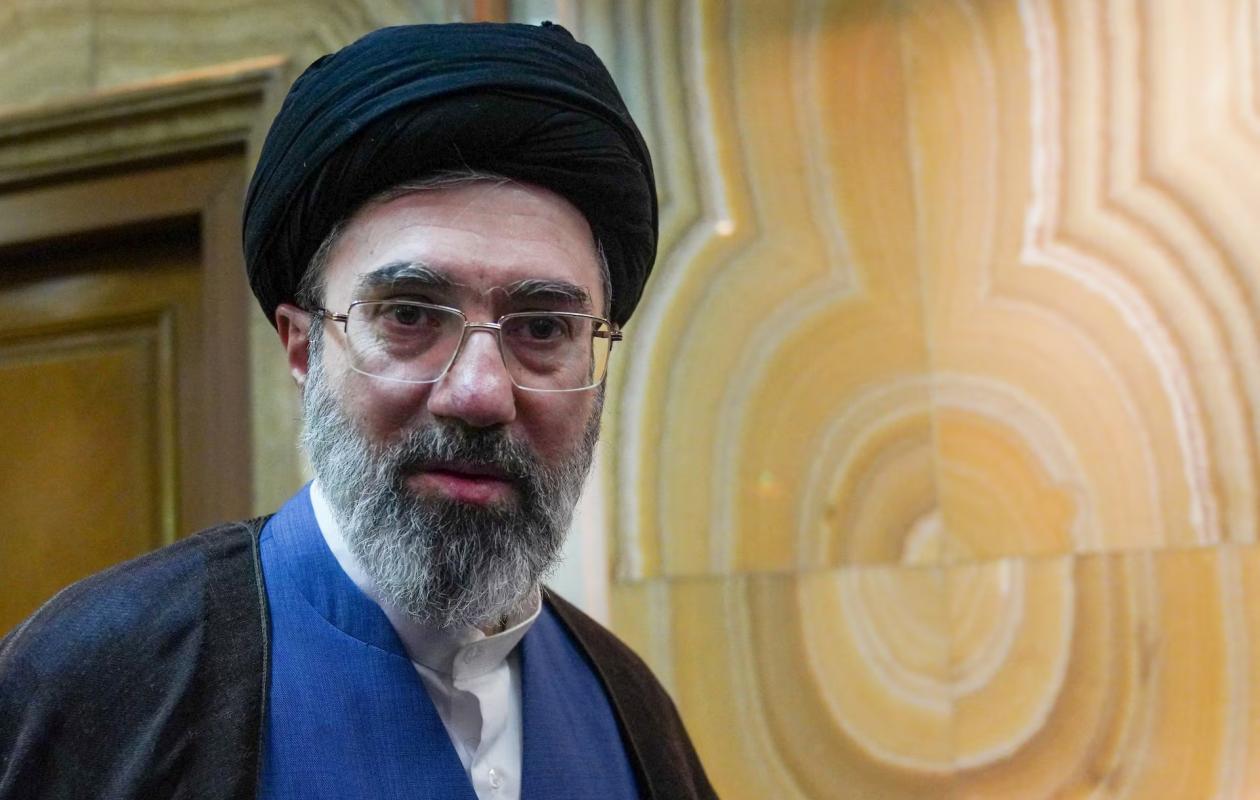
Mojtaba Khamenei va s'exprimer, l'approvisionnement en pétrole très perturbé
Iran is awaiting the first message from its new supreme leader Mojtaba Khamenei on Thursday, who has remained invisible since his appointment, as the intensity of the war causes a historic disruption to the world's oil supply.
The message will mention "the martyred leader of the revolution," Ali Khamenei, father of the current leader, who was killed on the first day of the Israeli-American attack. It will also address "the role and duties of the people, the armed forces, and the executive bodies," and "how to deal with enemies."
Appointed on Sunday evening, the new supreme leader has still not appeared in public and was himself injured in a strike.
His speech comes as the war in the Middle East is causing "the biggest disruption" to the world's oil supply in history, the International Energy Agency (IEA) warned on Thursday.
The conflict, triggered on February 28 by US-Israeli attacks against Iran, is penalizing the supply of black gold to the global economy, weakening production sites in the region and threatening its financial services.
Gulf countries are reducing their production by at least 10 million barrels per day due to the blockade of the Strait of Hormuz, which is de facto controlled by Iran, according to the IEA. On Wednesday, its 32 member countries agreed to a record release of 400 million barrels from their strategic reserves.
And on the 13th day of the war, the daily lives of the region's inhabitants are organized around deprivation, anxiety, and the hope of a better tomorrow.
"You can still do your shopping. The exception was the day they hit the oil depots: with the black rain, it looked apocalyptic," a 39-year-old resident, contacted from Paris, told AFP.
The strikes are certainly difficult to endure. But "I don't understand people who say 'no to war,'" she explains. After the violent crackdown on the January protests in Iran, "there is no other solution than foreign intervention" to change the political power structure.
Several explosions rocked the Gulf on Thursday. They occurred at a hydrocarbon storage tank in Bahrain, a huge oil field in Saudi Arabia, an airport in Kuwait, and a port in Oman.
At least three ships have been attacked, bringing the total to six since Wednesday and 23 since the start of the conflict, according to the British maritime agency (UKMTO).
Iraqi state television broadcast images of a ship from which impressive fireballs were rising. More than 50 crew members were rescued off the coast of Iraq, according to port authorities.
The threat now extends to banking and finance, essential services in the major Gulf capitals. The Iranian news agency Tasnim cited American tech giants as "future targets," noting that companies like Amazon, Google, Microsoft, IBM, Oracle, and Nvidia, as well as some major financial players, have already closed their offices in Dubai.
The Revolutionary Guards, the ideological army of the Islamic Republic, say they are ready for a long campaign to force Washington to retreat by bombarding Western interests.
Ali Fadavi, one of these representatives, brandished the threat of a "war of attrition" capable of "destroying the entire American economy" and "the world economy".
These developments raise questions following the remarks of the American president, who promised that "great security" would soon reign in the Strait of Hormuz, a bottleneck through which a fifth of the world's oil and liquefied natural gas (LNG) production usually passes.
The US Energy Secretary, for his part, stated that the military was "not ready" at the moment to escort oil tankers through the strait.
According to Pierre Razoux, academic director of the Mediterranean Foundation for Strategic Studies (FMES), the White House "is ignoring the lessons of history".
"The Iranian regime, which has nothing left to lose, will wage a war of attrition against the United States and Israel to punish them for their aggression," he told AFP.
Economically, the operation is a financial drain for the United States. The first week of the war cost them more than $11 billion, reports the New York Times, citing congressional sources.
The ports themselves could become a target. The US military has called on Iranian civilians to stay away from those in the Strait of Hormuz region, because if they are "used for military purposes, (they) lose their protected status."
Here again, Tehran threatens a symmetrical response, asserting that in the event of an attack, "all ports and docks in the region would become legitimate targets."
Iran will "abandon all restraint" and "shed the blood of the invaders" in the Gulf, insisted the influential Iranian parliament speaker, Mohammad Bagher Ghalibaf. He did not name any specific island, but the media outlet Axios recently suggested that an attack on Kharg, Iran's oil hub, was possible, based on American sources.
Some 3.2 million Iranians have been displaced within Iran since the start of the war, according to the UN High Commissioner for Refugees (UNHCR).
In Lebanon, a collateral victim of the Israeli-American attack, fighting has intensified, targeting the pro-Iranian movement Hezbollah. Israeli strikes have killed 687 people, according to authorities.
On Wednesday evening, according to Israel, in a coordinated attack with Tehran, Hezbollah fired 200 rockets, about twenty drones and ballistic missiles across Israel, representing the "largest barrage" of fire from the Lebanese Shiite movement since the beginning of the war.
Israeli Defense Minister Israel Katz says he is considering taking control of territories belonging to his neighbor and has ordered his army to prepare to "extend" its operations there.
"I warned the Lebanese president that if his government fails to control the territory and prevent Hezbollah from threatening northern communities and firing on Israel, we will take territories and do it ourselves," he said.




![[Billet d’humour] Diomaye Président : Mbour, le test qui interroge](https://image.seneweb.com/content/news/2026-19-10//thumb_1260x800_6a008342c328b_0bscHsJLlN.jpeg)








Commentaires (1)
Participer à la Discussion
Règles de la communauté :
💡 Astuce : Utilisez des emojis depuis votre téléphone ou le module emoji ci-dessous. Cliquez sur GIF pour ajouter un GIF animé. Collez un lien X/Twitter, TikTok ou Instagram pour l'afficher automatiquement.