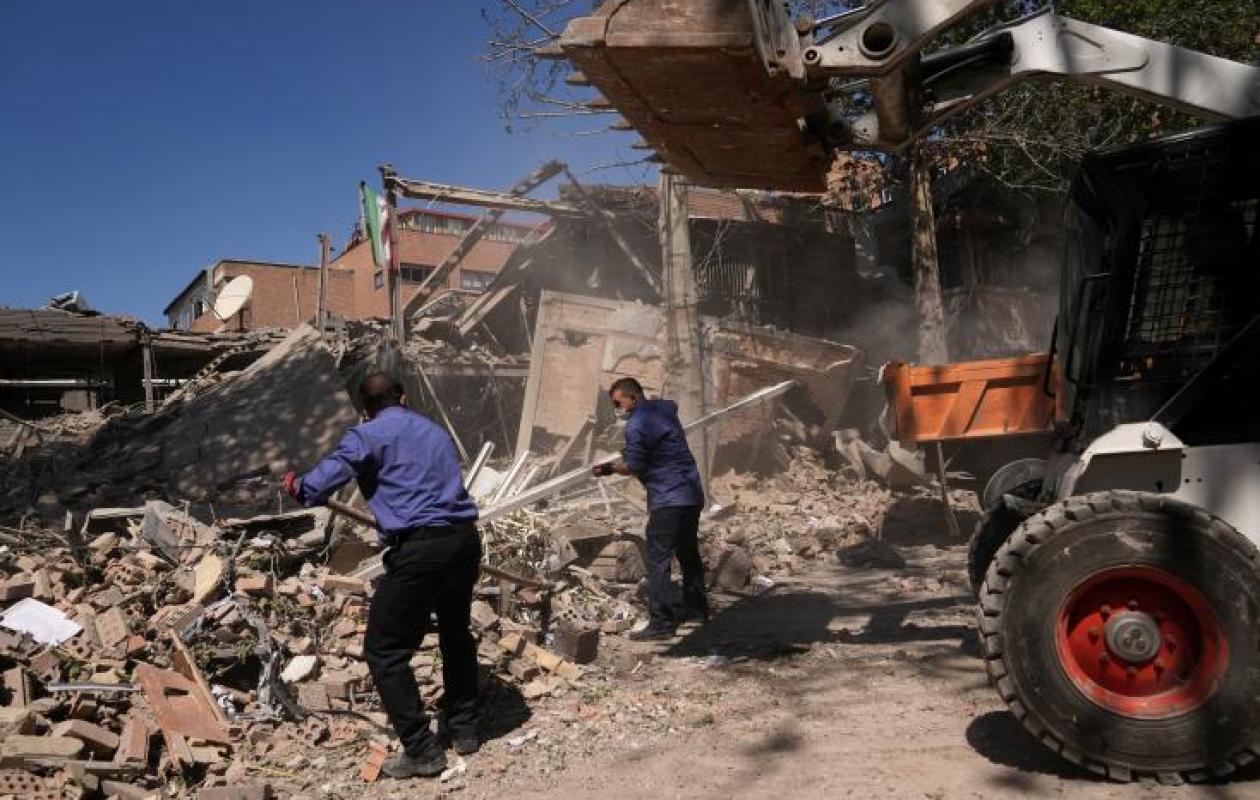
Nouvelles frappes en Iran à quelques heures du terme de l'ultimatum de Trump
Tehran suffered new strikes on Tuesday, just hours before the deadline of Donald Trump's ultimatum, which threatens to destroy essential infrastructure in Iran if no agreement is reached to reopen the Strait of Hormuz, vital for global oil supplies.
On the 39th day of the war, which has claimed several thousand lives in the Middle East, mainly in the Islamic Republic and Lebanon, where its ally Hezbollah operates, Iranians are torn between fear and a certain indifference to the warnings of the American president.
"I'm terrified, and everyone in this country should be too," Metanat, a 27-year-old student, told AFP, saying she had lost a classmate in an attack. "Some people are making fun of Trump and his threats," but "this is a war and there's nothing funny about it."
Morteza Hamidi, a 62-year-old retiree, expressed "sadness and pessimism about the future of Iran" but dismissed the new ultimatum, which expires Tuesday at 8:00 PM Washington time (midnight GMT Wednesday). He said that Donald Trump "has changed the dates so many times that we are now desensitized to his threats."
On Monday, Donald Trump warned that "the entire country could be destroyed overnight." He said he was prepared to strike Iranian power plants and bridges if the Islamic Republic did not reopen the Strait of Hormuz—a maritime route in the Gulf through which some 20% of the world's crude oil previously passed.
The Iranian army in turn denounced "arrogant rhetoric", stating through a spokesman that such statements had "no effect" on its operations.
Railways in the crosshairs
In the region, calls for a diplomatic solution are multiplying, even though Iran and the United States on Monday rejected a mediation proposal put forward by several countries, including Pakistan.
"The positive and constructive efforts deployed by Pakistan (...) to end the war are approaching a critical and delicate stage," wrote Iran's ambassador to Islamabad, Reza Amiri Moghadam, on X without further details.
Iranian Ambassador to Kuwait, Mohammad Toutounji, urged Gulf countries to do everything possible to avoid a "tragedy," in a statement to AFP.
On the ground, Tehran and its surrounding areas have been rocked by new explosions in recent hours, according to Iranian media. An AFP journalist confirmed hearing a series of detonations coming from the north of the city.
The Israeli army claimed responsibility for a "wave" of strikes aimed at "damaging" infrastructure in the capital and other regions of Iran. It also urged Iranians to refrain from traveling by train until 5:30 PM GMT, suggesting that strikes on the railway network were imminent.
Donald Trump stated that he was "not worried" about the risk of committing war crimes by destroying infrastructure primarily intended for civilian use. For the Republican billionaire, the "war crime" would be allowing Iran to acquire nuclear weapons.
"Not good enough"
According to the American news site Axios, mediators, including Pakistanis, have submitted the idea of a 45-day ceasefire.
The state-run news agency Irna claimed, without citing a source, that Iran had rejected the offer, demanding "an end to the conflicts in the region, a protocol for safe passage through the Strait of Hormuz," as well as "reconstruction and the lifting of sanctions" against Iran.
The New York Times, citing two Iranian officials who requested anonymity, specified that the Islamic Republic was demanding, among other things, a guarantee that it would no longer be attacked and an end to Israeli strikes on Hezbollah in southern Lebanon.
In exchange, Iran would be willing to lift the blockade of the Strait of Hormuz, imposing a passage fee of $2 million per ship which would be shared with the Sultanate of Oman, located on the other side of the seaway.
He would use these funds to rebuild infrastructure destroyed by Israeli-American strikes, rather than demanding direct compensation.
Donald Trump described the initiative as a "very important" step but judged it "not good enough yet to support".
For Sina Toossi of the Center for International Policy (CIP) in Washington, there is little chance that the destruction of new infrastructure in Iran will change Tehran's attitude because "the war has already crossed that threshold".
Iran "will not give up on its vital interests, above all its control of the Strait of Hormuz, whatever the cost," the analyst writes on the Dissident Foreign Policy website.
In retaliation, it continues to strike daily at Gulf countries accused of helping the United States.
A petrochemical complex located in eastern Saudi Arabia was hit by attacks overnight Monday to Tuesday, a witness told AFP, a few hours after similar facilities in Iran were struck.














Commentaires (1)
Participer à la Discussion
Règles de la communauté :
💡 Astuce : Utilisez des emojis depuis votre téléphone ou le module emoji ci-dessous. Cliquez sur GIF pour ajouter un GIF animé. Collez un lien X/Twitter, TikTok ou Instagram pour l'afficher automatiquement.