"Pas notre guerre": en Cisjordanie, la stupeur après une première frappe iranienne mortelle
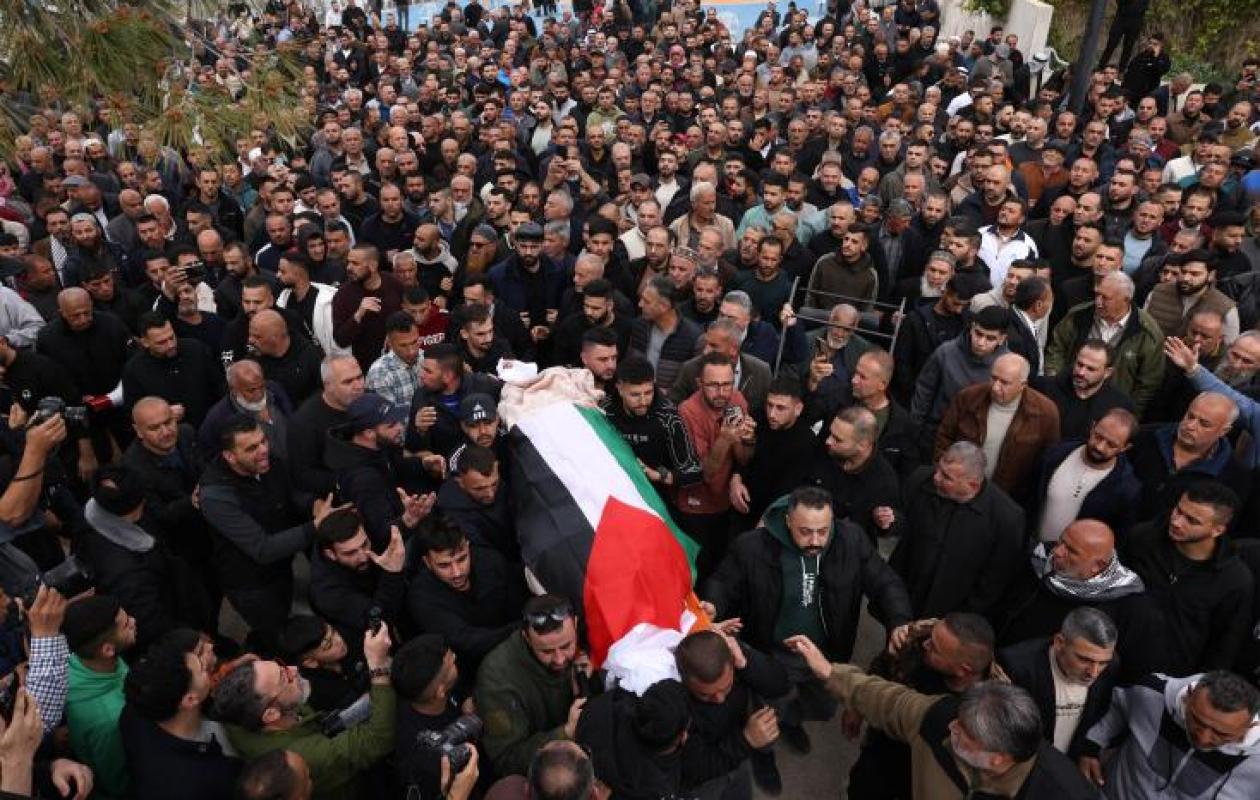
Suddenly, "without warning," the explosion ripped through a small beauty salon in Beit Awa. On Thursday, residents of this Palestinian town gathered for the funeral of the four women killed in this first deadly strike in the West Bank since the start of the Middle East war.
It was about 9:30 pm on Wednesday in this small town near Hebron, in the south of the Palestinian territory occupied by Israel, in the midst of preparations for the Eid al-Fitr festival, which marks the end of Ramadan on Friday.
"I was startled by a noise. I went outside. Then this object fell from the sky, without any warning," says Issa Masalmeh, a 60-year-old neighbor.
He then saw "debris, scattered over an area of about 200 square meters, not just at the point of impact", then "the mangled bodies of the three women".
A fourth woman, aged 32, six months pregnant and seriously injured, died a few hours later.
On Thursday morning, the crowd accompanied the three bodies, covered with the Palestinian flag, carried by uniformed members of the security forces, from the hospital in the nearby town of Doura to their burial in the cemetery of Beit Awa, 200 meters from the site of the strike.
The three bodies were laid to rest, awaiting the fourth, in the grave surrounded by men of all ages.
"To go towards death"
"We are plunged into shock and incomprehension," said Fawzi Abou Leil, the mayor of Doura, after the explosion caused by falling debris following the interception of an Iranian missile in the skies over the Palestinian territory.
Since the start of the war triggered by the Israeli-American offensive against Iran and the Iranian missile strikes in retaliation towards Israel, the inhabitants of the West Bank regularly hear explosions caused by interceptions above their heads.
But unlike in Israel, shelters are scarce in this territory.
"The Israelis can avoid all of this because they have shelters (...) alerts, sirens," the mayor noted. "But we have nowhere to go that offers protection." "If we flee, we risk fleeing death only to go towards death," he said.
According to the Palestinian news agency Wafa, the three women killed instantly on Wednesday were 17, 36, and 50 years old. Among the wounded, according to the mayor, was a young girl who lost her mother.
On site, AFP journalists saw the walls and roof of the beauty salon, housed in a small metal shack littered with debris, riddled with shrapnel. On Thursday morning, firefighters continued to clean the bloodstains from the floor using high-pressure hoses.
Screams, and horror
In the adjoining house, Hanane, the mother of Sahra, one of the women killed, sobs silently, surrounded by her other daughters.
Fawzi Abu Leil explains that shrapnel from the explosion spread to ten different areas of Hebron province. According to Israeli media, Iran once again used cluster munitions overnight, which release a multitude of small charges.
Issa Masalmeh asserts that in 20 days of war, debris "has already fallen more than twenty times" in the surrounding area. But this time, he adds, "a sensitive location has been hit."
Abdelrazek Masalmeh, a 32-year-old neuroscience researcher who lives 200 meters from the site of the strike, was one of the first to rush to the scene.
"I heard screams and I ran out of my house. I found Sahra's mother who told me, 'My daughter has been killed.'" He tried in vain to reassure her before entering the living room and discovering the horror.
"It's a shock, a disaster," said the researcher, who is nonetheless accustomed to emergency situations. "We are the victims. This war is not ours. All of this must end."





















Commentaires (2)
Participer à la Discussion
Règles de la communauté :
💡 Astuce : Utilisez des emojis depuis votre téléphone ou le module emoji ci-dessous. Cliquez sur GIF pour ajouter un GIF animé. Collez un lien X/Twitter, TikTok ou Instagram pour l'afficher automatiquement.