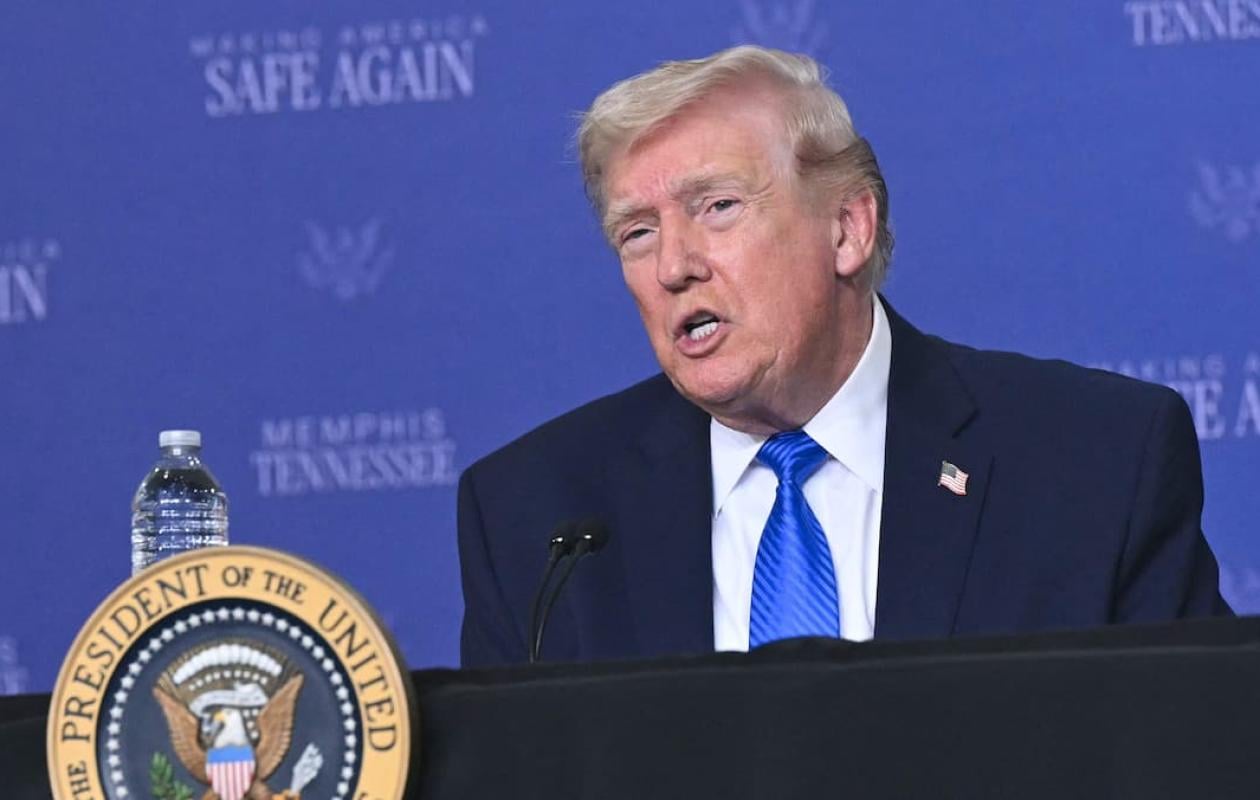
Sur l'Iran, Trump opère sa plus spectaculaire volte-face à ce jour
Since his return to power, he has openly admitted to governing "by instinct".
On the conflict in the Middle East, the American president made numerous contradictory statements about the objectives and the timetable, before finally declaring on March 13 that the war would end when he "felt it in his gut."
Donald Trump "has mastered the art of sudden turns and changes. It is therefore difficult to say whether there is a strategy or if it is improvisation," Garret Martin, a professor at American University, told AFP.
These reversals always follow the same trajectory.
The Republican issues commercial, diplomatic or military threats, often accompanied by ultimatums, which stun the entire world.
Then he suddenly returns to his plans, claims to have secured crucial concessions which he rarely details, and promises a way out of the crisis, causing very violent movements on the markets.
On Monday, oil prices plunged dramatically after Donald Trump announced on his Truth Social network that discussions were being held with Iranian officials regarding a cessation of the conflict.
Immediately after the publication of his message, the price of a barrel of Brent crude from the North Sea briefly fell by more than 14%. Its American equivalent, West Texas Intermediate, lost nearly 10%. These are very large swings.
The change in tone could hardly be more abrupt.
On Saturday, he had given Iran "48 hours" to reopen the Strait of Hormuz, a crucial passage for oil trade, under threat of massive strikes on the country's power plants, without mentioning any dialogue.
On Monday, he gave a new deadline, this time of five days, to allow time for dialogue to continue.
He mentioned "very productive" discussions with "very respected" and "very solid" Iranian officials, without identifying them.
"My whole life has been a negotiation, but with Iran we have been negotiating for a long time. And this time they are serious!", the American president asserted in a speech in Memphis (south), highlighting his business instincts rather than specific concessions from Tehran.
The pattern is so familiar that it has a dedicated acronym, coined by Financial Times journalist Robert Armstrong in May 2025: "TACO" for "Trump always chicken out".
The term originally referred to a stock market strategy, consisting of taking advantage of the fall in assets or indices after a thunderous announcement by Donald Trump to buy, in the hope of reselling at a good price after the American president has changed his mind.
Commentators, for example, referred to it as "TACO" when the president - who hates this expression - announced heavy global tariffs on April 2, 2025, only to then decree a 90-day pause.
Or when he suddenly abandoned threats about Greenland, or those directed against the head of the US central bank, Jerome Powell.
Often, these U-turns, while delighting the markets, remain vague regarding the "agreements", "discussions" or "pauses" announced by Donald Trump.
On Monday, Iranian leaders denied that negotiations were taking place, which partly dampened the enthusiasm seen on the stock markets.
The United States' partners or adversaries now know "that there is always something precarious with this administration, promises are only valid the second they are made," notes Garret Martin.
The international relations expert believes that regarding Iran, Donald Trump backed down due to three factors: market nervousness, possible pressure from Gulf countries, and the emergence of "tensions" within his "MAGA" (Make America Great Again) political movement over the cost of the conflict.









Commentaires (6)
Participer à la Discussion
Règles de la communauté :
💡 Astuce : Utilisez des emojis depuis votre téléphone ou le module emoji ci-dessous. Cliquez sur GIF pour ajouter un GIF animé. Collez un lien X/Twitter, TikTok ou Instagram pour l'afficher automatiquement.