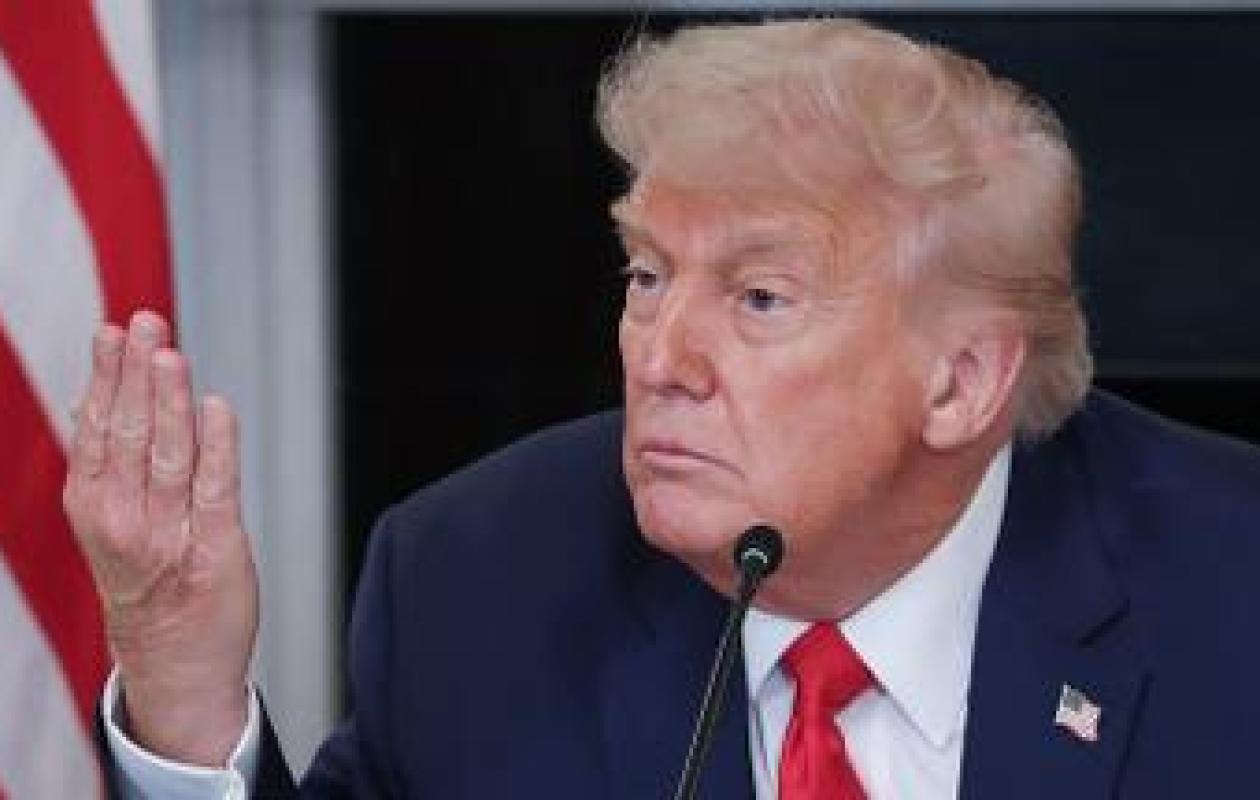
Trump annonce le sauvetage de l'aviateur américain recherché en Iran
The American pilot who had been wanted since Friday after his plane was shot down in Iran was rescued in a "daring" military operation and is "safe and sound," President Donald Trump announced Sunday.
The aircraft, an F-15E fighter-bomber, was shot down in southwestern Iran, and its two occupants ejected in flight, according to American and Iranian media. Tehran had offered a reward for the capture of the second occupant, the first having been quickly extracted during an operation by US special forces. Washington has not officially confirmed that the aircraft was shot down.
"Over the past few hours, the U.S. military has carried out one of the most daring search and rescue operations in U.S. history, to come to the aid of one of our incredible flight officers, who also happens to be a highly respected colonel, and I am pleased to announce that he is now SAFE AND SAFE!" the U.S. president wrote on his Truth Social network.
He specified that the soldier had been injured and that the rescue operation had mobilized "dozens of aircraft".
For its part, the Iranian news agency Tasnim, citing a provincial official, reported that five people were killed during the American operation.
And the Iranian joint command stated that two American Black Hawk helicopters and a C-130 military transport plane participating in the search operations had been "hit and are burning".
Washington did not immediately react.
Since the start of the war, no American soldiers have been reported killed or captured on Iranian soil, but 13 have died in Kuwait, Saudi Arabia and Iraq.
On the 37th day of the war triggered on February 28 by an Israeli-American offensive, Iran again attacked the Gulf countries and Israel, on the eve of the expiration of a 48-hour ultimatum given by Donald Trump to Tehran to conclude an agreement or reopen the strategic Strait of Hormuz, under penalty of "unleashing hell".
- Attacks in the Gulf -
The Iranian army, quoted by the Fars news agency, threatened to attack the water and energy infrastructure of Israel and the Gulf states after Israeli-American strikes on a petrochemical site in the Mahshahr special economic zone that killed five people and injured 170 on Saturday.
In the United Arab Emirates, authorities in Abu Dhabi reported battling fires at a petrochemical facility after intercepting Iranian fire. In Bahrain, an Iranian drone attack caused a fire, which was later brought under control, at a storage tank belonging to the state-owned oil company.
Kuwait announced that Iranian attacks on two power and water desalination plants, as well as on the ministerial complex in the capital, had caused extensive damage, but no casualties.
Quoted by the official news agency Irna, the Iranian army said it was targeting military sites in Kuwait as well as the aluminum industry in the Emirates, which it accuses of being used to produce parts for American aircraft, missiles and armored vehicles.
An alert was also triggered Sunday morning in Israel, where the army said it was facing a new barrage of Iranian missiles. Attacks were also reported by authorities in Bahrain.
- Strikes in Lebanon -
On the Lebanese front, Hezbollah announced it had launched a cruise missile toward an Israeli warship cruising offshore, the first such attack since the start of the war with Israel more than a month ago. The Israeli army stated it had "no knowledge" of such an event.
For its part, Israel continues its offensive in Lebanon, where its bombings and fighting have killed more than 1,400 people since the beginning of March.
The Israeli army announced on Saturday evening its intention to attack the main border crossing between Lebanon and Syria, that of Masnaa, accusing Hezbollah of using it to bring in weapons.
A Lebanese security source in Masnaa told AFP that "the border crossing was being evacuated following the Israeli threat." On the Syrian side, the border facilities were virtually deserted at dawn on Sunday, with only a few guards still on duty, according to an AFP correspondent on the ground.
Donald Trump reminded everyone on Saturday that his ultimatum, issued to Iran on March 26 to reopen the Strait of Hormuz, a strategic passage for global hydrocarbon trade, under threat of strikes against its power plants, was still in effect.
- "Angry and stupid" -
"Remember when I gave Iran 10 days to either MAKE A DEAL or REOPEN THE STREET OF HORMuz? Time is running out - 48 hours before I unleash hell on them," he wrote Saturday on his Truth Social platform.
Set by Donald Trump for "Monday, April 6 at 8:00 PM, Washington time" (00:00 GMT Tuesday), the ultimatum was rejected by the Iranian central military command.
"After suffering successive defeats, the American president has undertaken, in a helpless, unstable, agitated and stupid manner, to threaten Iran's infrastructure and assets," reacted General Ali Abdollahi, head of the Central Command.
"The gates of hell will open for you," he threatened.
Iranian Foreign Minister Abbas Araghchi spoke by phone on Saturday evening with his Pakistani and Egyptian counterparts, whose countries are conducting diplomatic efforts to resolve the conflict, Tasnim reported.
In the midst of war, Iran hanged two men on Sunday who were found guilty of acting on behalf of Israel and the United States during the wave of anti-government protests at the beginning of the year, the judiciary announced.















Commentaires (5)
Participer à la Discussion
Règles de la communauté :
💡 Astuce : Utilisez des emojis depuis votre téléphone ou le module emoji ci-dessous. Cliquez sur GIF pour ajouter un GIF animé. Collez un lien X/Twitter, TikTok ou Instagram pour l'afficher automatiquement.