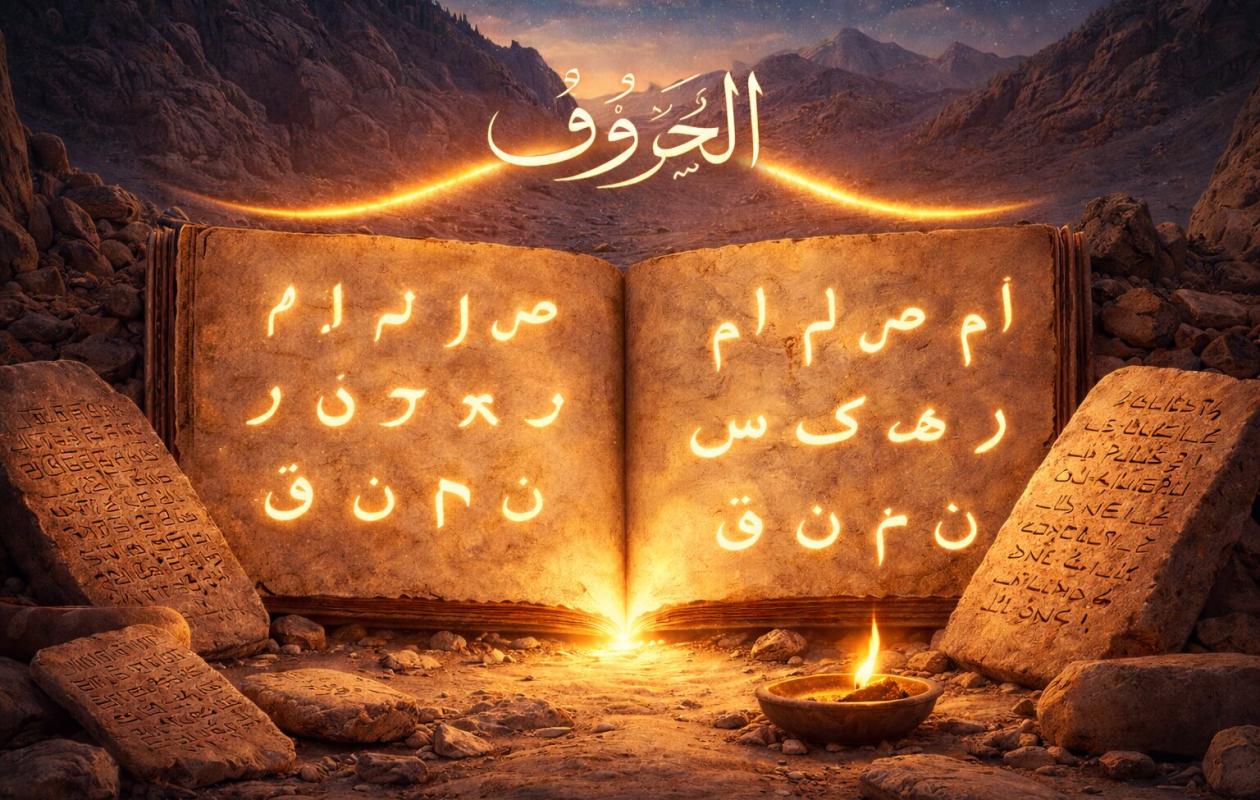
Une nouvelle explication des lettres mystérieuses du Coran Hurūf al-muqaṭṭaʿāt
In Muslim tradition, the ḥurūf al-muqaṭṭaʿāt, that is, the isolated letters that open twenty-nine surahs of the Qur'an, are considered to be among the mysteries of revelation. The majority of classical exegetes maintain that their ultimate meaning is known only to Allah, which is the reality for the entire universe.
Other interpretations have been proposed, however: some scholars see them as a reminder that the Quran is composed of the same letters as the Arabic language while remaining inimitable, while others interpret them as symbols, abbreviations of divine names, or signs with a spiritual dimension. Despite these different hypotheses, the most widespread position in Islamic tradition remains that these letters belong to the realm of divine mystery.
By the grace of Allah ﷻ, you will find below a new vision which I hope, in sha' Allah, will be enlightening. The ḥurūf al-muqaṭṭaʿāt are the following fourteen letters:
| Letter | a | ل | م | ص | ر | ك | ح | ي | a | ط | س | ح | ق | ن |
| Name | Alif | Lām | Mīm | Ṣād | Ra | Kāf | Ha | Yā | ʿAyn | Your | Sin | Ha | Qāf | Nūn |
By presenting isolated letters at the beginning of certain surahs, the Quran seems to address itself particularly to the literate, especially the Children of Israel, referred to as "the People of the Book." Conversely, the Meccans are often described as "illiterate." This link between these mysterious letters and the ancient scriptures, particularly the Torah, therefore deserves further exploration.
In Book 13.7 The Code of the Universe Encrypted in Muslim Prayer: Salat and the article I Present to You the Pharaoh of Moussa , we proposed a dating of the beginning of the mission of Moussa (Moses) to around 1800 BC, as well as an identification of his adversary Pharaoh.
This period led us to question the language of the revelation transmitted to Moses. Since the Hebrews lived in Egypt for at least a millennium, several questions arise: was the original Torah revealed in ancient Egyptian? Or in an earlier script, such as Proto-Sinaitic? Archaeology provides an interesting element here: Proto-Sinaitic inscriptions, discovered in Egyptian mines in southern Sinai and dated to around 1800 BCE, are considered the ancestors of Paleo-Hebrew. It is in this context that we make the connection between the ḥurūf al-muqaṭṭaʿāt and the alphabet of the earliest ancient revelations.
The Paleo-Hebrew alphabet and their figurative meanings of origin
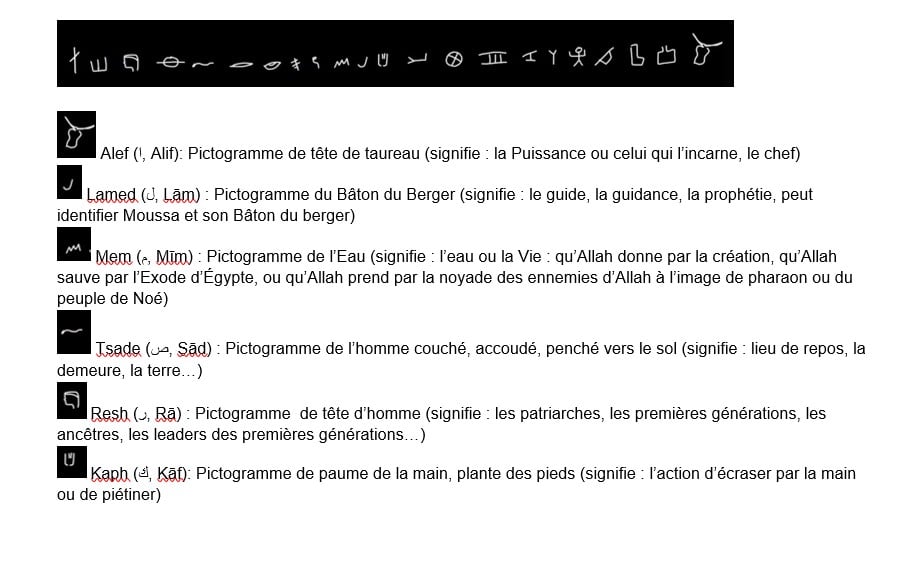
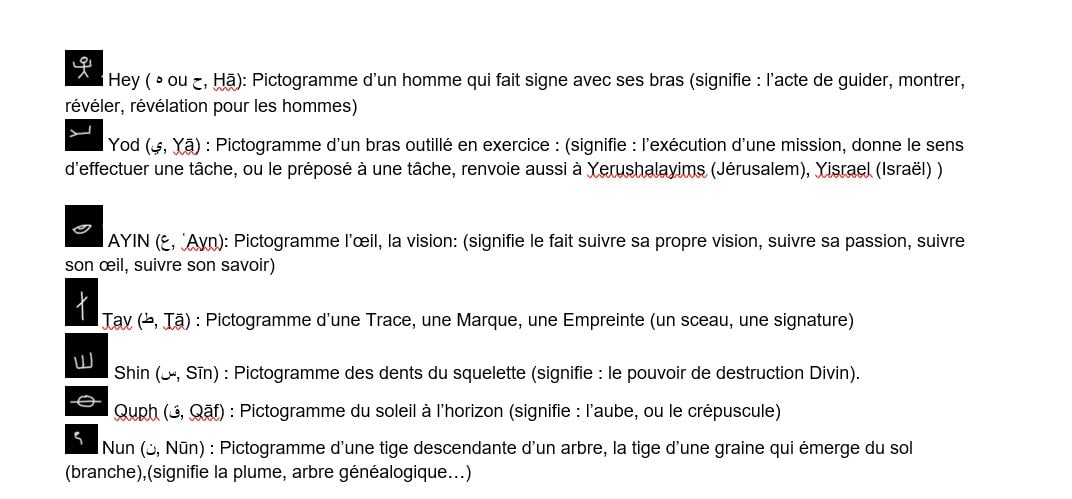
In the hieroglyphic writing of ancient Egypt, a single sign could fulfill several functions at once. It could represent a sound (like a letter), but also a word or an idea directly, as a meaningful image. Thus, hieroglyphs simultaneously combined phonetic and symbolic value , making them a writing system that was at once sonic, visual, and conceptual.
Archaeological discoveries of the earliest Proto-Sinaitic script, related to Paleo-Hebrew, date back to 1800 BC (precisely during the time of Moses), and other recent research has revealed other writings near Luxor dating back to 1900 BC. Therefore, we can conclude that Proto-Sinaitic and Hieroglyphic existed simultaneously in the same region and argue that their alphabets served the same functions: a writing system that was simultaneously auditory, visual, and conceptual.
As we will demonstrate throughout this document, we maintain that the Proto-Sinaitic (Paleo-Hebrew) alphabet originated in the religious writings of the Abrahamic scrolls, which must have followed the lineage of Isaac and Jacob (Israel) and been preserved as a cultural and liturgical heritage among the children of Israel (as it was until the 6th century BC, or alongside Latin within the Catholic Church). The phonetic and even formal correspondences with the Arabic of the descendants of Ishmael (the eldest son of Abraham, peace be upon him) reinforce our hypothesis of a shared Abrahamic heritage between the Jews and the Arabs.
In this document, we will demonstrate how the correspondence between the Hurūf al-muqaṭṭaʿāt and the Proto-Sinaitic (Paleo-Hebrew) alphabet, the alphabet of the true Torah, reveals the meaning of these mysterious letters. For indeed, as the Quran tells us, the Torah, the Gospels, and the Quran are different parts of the same Book: By Allah! We have certainly sent (messengers) to communities before you. But Satan made attractive to them that which they used to do. He is their ally this day [in this world]. And they will have a painful punishment . (16:63 ) And We have not revealed to you the Book except that you may make clear to them that in which they differed and as guidance and mercy for a people who believe. (16:64)
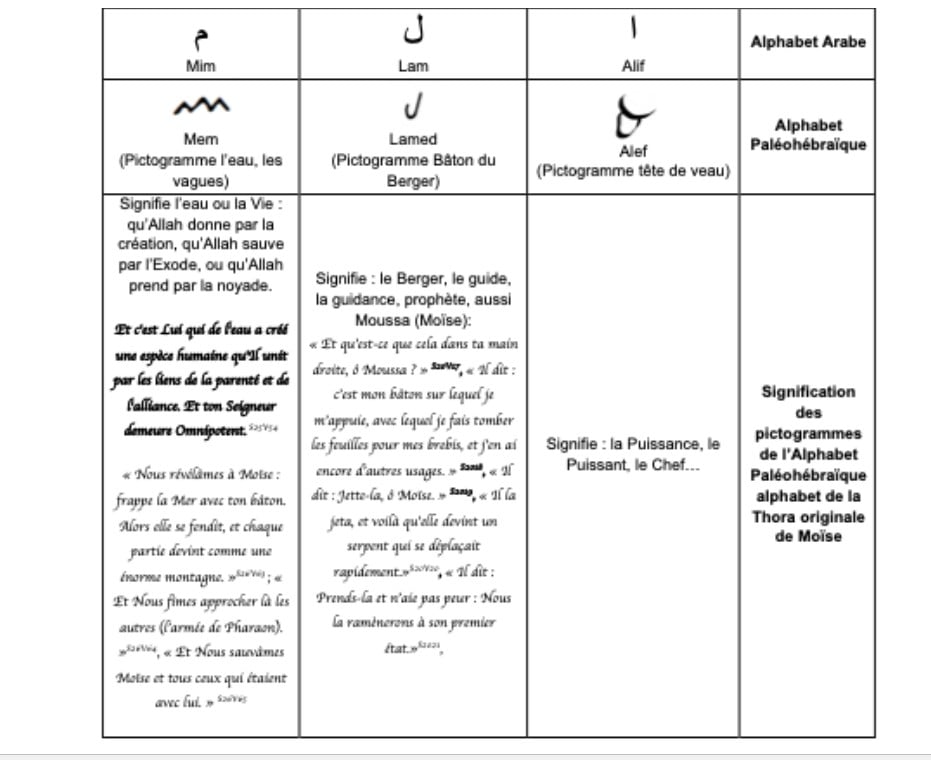
Study of the Alif, Lam, Mim: ا ل م (reading from right to left in Arabic reading) present at the top of Surahs 2, 3, 29, 30, 31, 32.

Comment 2: Historical Remarks
The Jews (sons of Israel) were deported to Babylon in Iraq by Nebuchadnezzar II. Before the exile, the Israelites used the Paleo-Hebrew script. However, once deported to Babylon, the Judeans found themselves in an environment where the dominant language and script was Aramaic, which served as the administrative language throughout the Near East. Over time, Aramaic gradually became the language of daily communication for the exiled Jewish communities. Hebrew, meanwhile, continued to be used primarily in religious and liturgical contexts. Along with this change in language, a change in script also occurred. Under the influence of the Aramaic administration, Jewish scribes gradually adopted the Imperial Aramaic script. This script would evolve into what is known today as Square Hebrew script, which is still used in manuscripts of the Hebrew Bible and in modern Hebrew.
Thus, after the return from exile in the 6th century BC, sacred texts began to be compiled in this new script, while the old Paleo-Hebrew script (that of the true Torah of Moses) gradually disappeared, except in certain traditions such as that of the Samaritans.
Moreover, everything suggests that Proto-Sinaiticus coexisted with hieroglyphs among the Jews of Egypt. They certainly possessed it, as a religious text, from the sacred scrolls of Abraham via Jacob (Israel) more than 1000 years before Moses.
Comment 3: The Quran is a permanent visual miracle, a rehabilitation of ancient lost Books.
With the Hurūf al-muqaṭṭaʿāt, the Quran rehabilitates the earlier parts of the Holy Book, connects to them, and clearly demonstrates to Jewish scholars that the Prophet Muhammad (peace be upon him) is indeed a prophet, that he is the heir of Abraham (peace be upon him), and that he comes to restore the original Book of Moses. This is a merciful message to the world, which now has access to the original message of Allah, the only authoritative source free from all doubt.
All the surahs beginning with Alif Lam Mim relate, for the most part, the creation of life, the life that Allah gives out of mercy, the lives destroyed for disbelief, the Exodus, and the acceptance of Islam which revives hearts. Alif, Lam, Mim thus acts as a kind of subtitle, similar to the books of the Bible (Book of Exodus, Book of Genesis, etc.).
One question arises: how could an illiterate 6th-century Arab living in Mecca, 500 km (a two-week caravan journey) from the nearest Jewish community, know that Proto-Sinaitic script existed, that it was the language of the true Torah, and that it was the ancestor of Paleo-Hebrew? And moreover, how could he have mastered its deepest secrets, even though the Hebrews themselves had lost it centuries before? Only through revelation from Allah.
In a lower dimension, I myself dreamed that I was served milk and advised to be mindful of the purity of the silver I use. Upon waking, I find myself with the understanding of what I am about to explain to you concerning the Hurūf al-muqaṭṭaʿāt. I will, in sha' Allah, offer you a series of articles on this subject, accessible at www.at-tawbah.org .



















Commentaires (4)
Participer à la Discussion
Règles de la communauté :
💡 Astuce : Utilisez des emojis depuis votre téléphone ou le module emoji ci-dessous. Cliquez sur GIF pour ajouter un GIF animé. Collez un lien X/Twitter, TikTok ou Instagram pour l'afficher automatiquement.