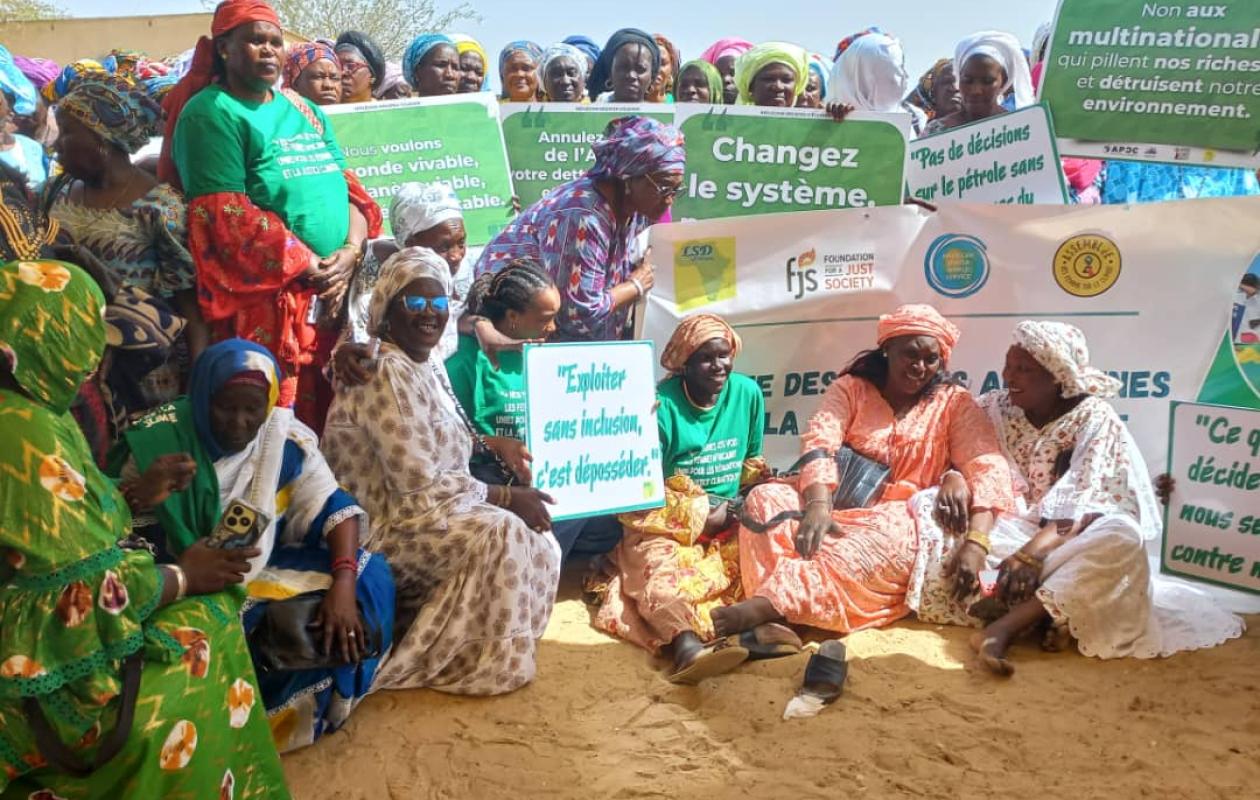
Justice climatique : des femmes en première ligne dénoncent un « fonds intergénérationnel » déconnecté des réalités
On the occasion of the first African Women's Day for Climate Justice, celebrated on April 15, 2026, powerful voices rose from the Saloum Delta to Saint-Louis, passing through Dakar and Bargny. Women from different regions, affected by the GTA gas project, the Bargny coal-fired power plant, or the Regional Express Train (TER), converged to share their experiences.
In Marlodj, hundreds of women environmental defenders, belonging to community organizations, mobilized to exchange ideas on the theme: "Our lands, our voices: African women united for reparations and climate justice!", but also on the impacts of extractive projects in their localities.
From promises of development to realities of impoverishment
Fatou Samba, vice-president of the board of directors of Lumière Synergie pour le Développement (LSD) and a prominent figure in the women's movement, did not mince words. According to her, projects financed in particular by the African Development Bank (AfDB), initially perceived as economic opportunities, have instead contributed to weakening communities.
She strongly criticizes the concept of an intergenerational fund, which she considers unfair because those who already suffer the consequences gain absolutely nothing from it. "Women had believed that these projects would enrich them. Today, they understand that they are impoverishing them even more," she laments.
This observation is shared in several coastal areas of Senegal, where oil and gas exploitation is disrupting socio-economic balances. Between restrictions on access to fishing grounds and dwindling fish stocks, women fish processors see their livelihoods threatened.
Solutions-oriented women ignored by the State
In the Saloum Delta, women stand out for their environmental commitment. For years, they have been restoring mangroves, ecosystems essential to biodiversity. "Thousands of hectares have been reforested thanks to their efforts. Every year, they contribute their own funds to carry out these actions. This is work that the State should support and compensate," insists Fatou Samba.
Despite this commitment, these initiatives remain largely underfunded and poorly recognized by public policies.
The intergenerational fund at the heart of the controversy
The main source of tension is the issue of the intergenerational fund, financed by oil and gas revenues for future generations. For Fatou Samba, this approach is profoundly unfair: "Providing resources for generations yet to be born, while those currently suffering the impacts do not benefit, is to skew the fight from the outset."
She denounces a disconnect between official pronouncements and the reality on the ground. The affected communities see neither concrete economic benefits nor an improvement in their living conditions.
A mobilization to demand reparations
In Saint-Louis, Fama Sarr, a fish processor, advocates for women's voices to be heard in decision-making bodies. This first edition of the African Women's Day for Climate Justice, supported by movements such as the Women's Climate Assembly (WCA) and LSD, aims to highlight solutions developed by women themselves.
Beyond simply denouncing the situation, the participants are calling for an overhaul of public policies, demanding a fair redistribution of resources and reparations for the harm suffered. "We cannot talk about fairness if those who are suffering today are left behind," concludes Fatou Samba.









Commentaires (0)
Participer à la Discussion
Règles de la communauté :
💡 Astuce : Utilisez des emojis depuis votre téléphone ou le module emoji ci-dessous. Cliquez sur GIF pour ajouter un GIF animé. Collez un lien X/Twitter, TikTok ou Instagram pour l'afficher automatiquement.