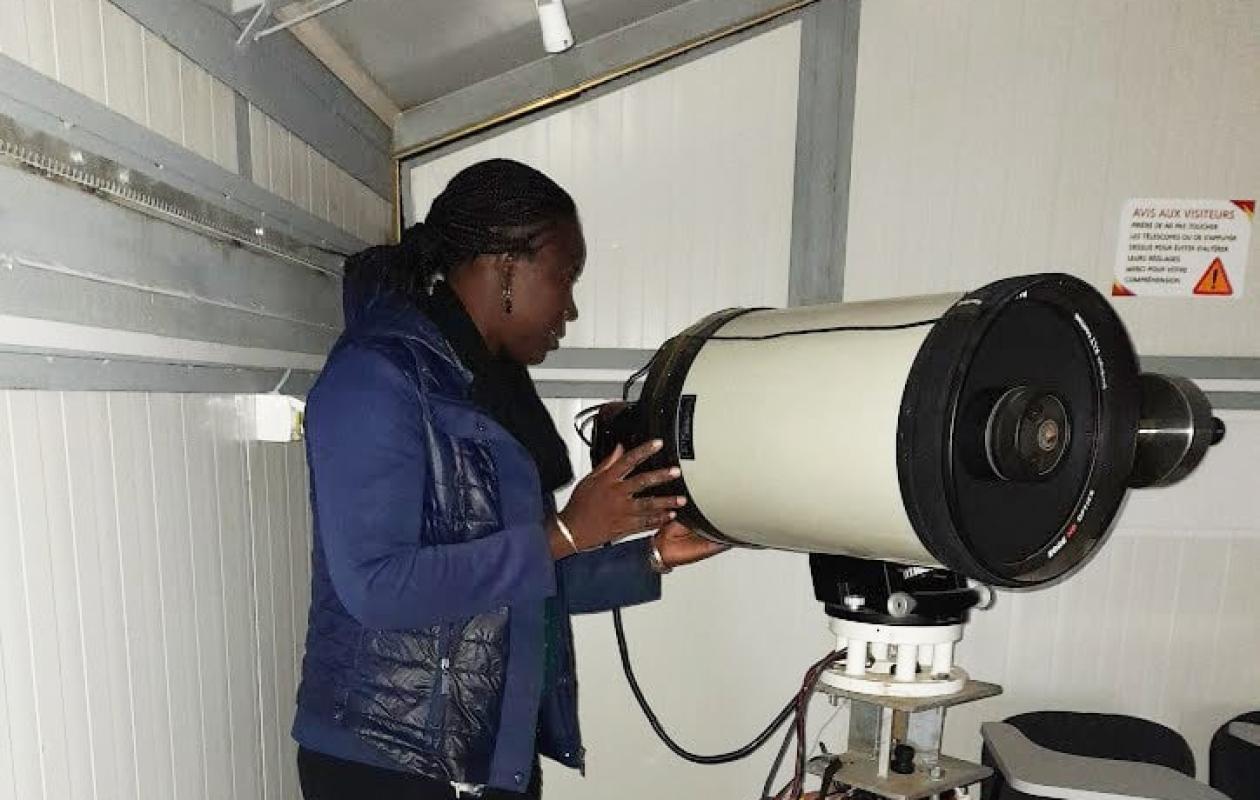
[Portrait] Salma Sylla : la fille qui contemplait les étoiles
As a little girl, Salma Sylla used to observe the stars at her grandmother's house in Kaffrine. Since May 2, 2026, this UCAD graduate has become the first female astrophysicist in Senegal.
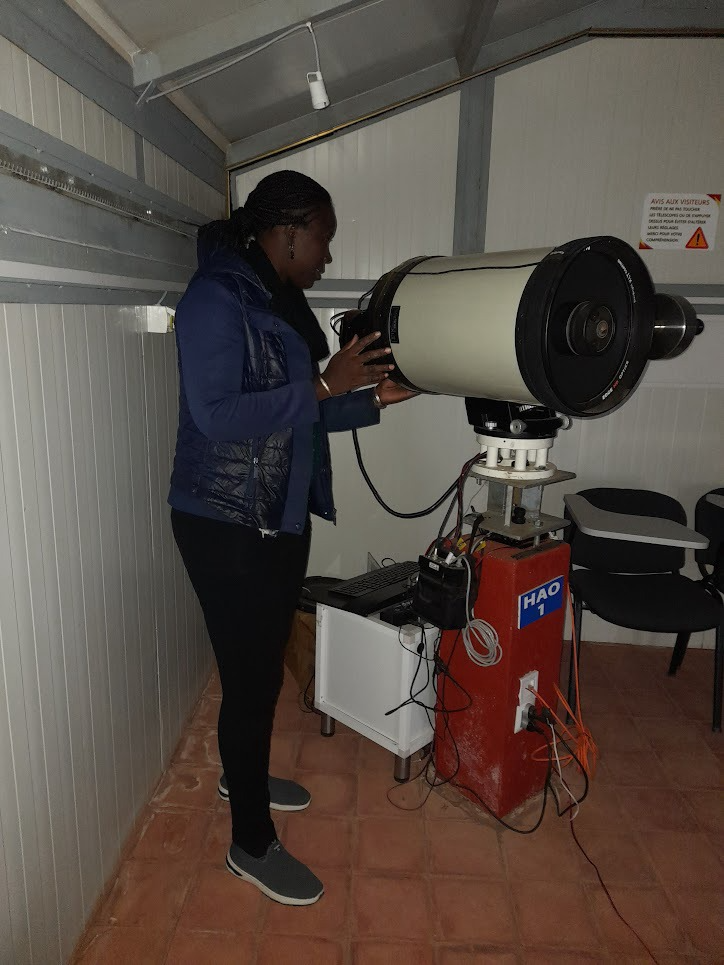
It all began on the starry nights of Ndoukoumane, at a time when electricity was the least common commodity in Senegal. In the middle of a courtyard in Kaffrine, bathed in moonlight, small children listened to African folktales during the hot summer months. Among them was a little girl named Salma Sylla, particularly interested in the stars. "I would observe the sky. From a very young age, I was drawn to space," recalls the former student of the Tagouti Waly Ndao school.
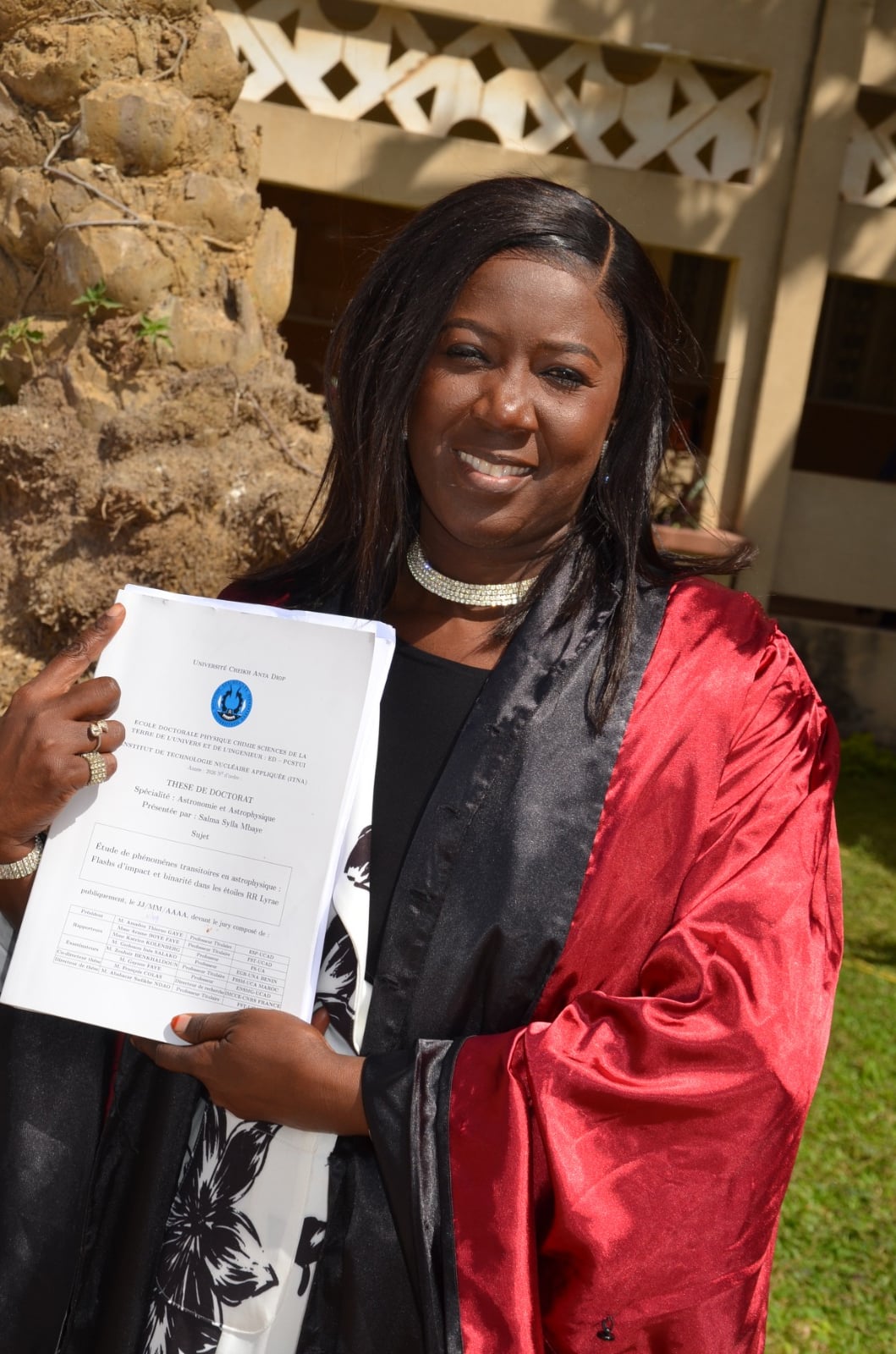
To these little children, it was said that when there were many stars in the sky, it was the turn of "leuk," the hare. With fewer stars, it was the turn of "bouki," the hyena. In middle school, she was drawn to books about space, without having the slightest idea of the related disciplines, namely astronomy and astrophysics. This mystery, which remained in the young girl's mind, culminated decades later in a doctoral thesis in astrophysics, defended on May 2, 2026, at Cheikh Anta Diop University in Dakar. Salma Sylla thus became the first female astrophysicist in Senegal.
If Salma explains what she's working on and you understand, it's either because you're a scientist or she explained it poorly. Her topic is titled "Study of Transient Phenomena in Astrophysics: Impact Flashes and Binarity in RR Lyrae Stars." Her explanations can leave a literature student reeling, so tightly does she use the esoteric language of scientists.
In short, she studies impact flashes on the planet Jupiter to date the outer solar system. This dating method involves looking at the number of impact craters (holes) on celestial bodies to determine their age. "To simplify things a bit, let's say it's like a person: when you see a lot of wrinkles on their face, you can say they're old. If there are fewer wrinkles, they're young," the researcher explains. The second phenomenon studied in her thesis concerns variable stars.
A series of opportunities and acts of kindness
To have a career like Salma Fall's, you need resources. Otherwise, you need to be born under a lucky star, know how to wait for your moment, and seize opportunities. For Salma, the path wasn't laid out immediately. After earning a baccalaureate in science (S2 series) from the Malick Sy high school in Thiès, the new graduate was directed to medical school. But her fear of blood would forever keep her away from the medical profession. She then transferred to the Faculty of Science and Technology, where she completed her entire academic journey. First, she earned a degree in telecommunications engineering, which allowed her to work at the Information Technology and Information Systems Department (DISI) of Cheikh Anta Diop University (UCAD). She then pursued her master's degree at the Institute of Applied Nuclear Technology (ITNA). The idea of writing a thesis was discussed with her supervisor, Professor Ababacar Sadikh Ndao. But the opportunity didn't present itself right away.
It wasn't until 2017 that the doors to the stars began to open for the former student of CEM Mamadou Diao (Thiès). At a conference organized at UCAD in partnership with the French Research Institute for Development (IRD) and the Senegalese Association for the Promotion of Astronomy (ASPA), the passionate young woman discovered a scholarship opportunity in France. The application process began immediately with the support of David Baratoux from the IRD. Meanwhile, Professor Katrien Kolenberg informed her of another scholarship opportunity in Belgium.
Katrien Kolenberg had participated, a few years earlier, in an international conference organized by ITNA which brought together physicists from diverse backgrounds. Her presentation had impressed the student.
"She inspired me a lot, especially with her theme on the music of the stars. She played a very important role in this trajectory as a scientist-astrophysicist," says Salma.
The scholarship to Belgium was the first to materialize. It was there that she learned the fundamentals of astronomy. This marked the beginning of her doctoral studies. Then came a stay in France, followed by another opportunity in Morocco… It was in this context that NASA selected Senegal for its observations. The doctoral student was invited to participate. “It was wonderful to collaborate with people who are at the forefront of this field, to see how these people work.” It was all the more wonderful because the Minister of Higher Education at the time, Mary Teuw Niane, was present and had decided to provide the support of the Senegalese government. Salma would later receive a scholarship of excellence from the Ministry of Higher Education, Research and Innovation (MESRI) for a stay at the Observatoire du Midi in France.
The decisive support of the husband and sister
Married and a mother of two, this Senegalese woman needed more than just financial support to succeed. Given the societal constraints placed on women, she was able to rely on a supportive network of scientists and family who cared about her success. Her supervisor, Ababacar Sadikh Ndao, was a tremendous help in this regard. "Sometimes he would tell me: 'If there isn't someone at home to look after the children, you can trust my wife; she can help.'"
While she was supposed to leave for France for a study trip during the Covid pandemic, the embassy refused to allow Ms. Mbaye to travel with her newborn. She was therefore left with no choice but to cancel her scientific visit. But Providence intervened: her sister had given birth at the same time. "She told me I could leave with complete peace of mind; she would take care of breastfeeding the baby," she recalls.
As the first female astrophysicist in Senegal, Salma Sylla is very active in raising awareness and popularizing science, particularly among young girls. She is involved in several organizations, including the African Organization for Women in Astronomy. This ambassador for the Organization of Women in Science for the Developing World represents the International Astronomical Union in Senegal, promoting astronomy.
This is a picture that suggests an enviable professional status. Except that, for the moment, this woman, who is the pride of Senegal, is just a part-time lecturer in the physics department at the Faculty of Science and Technology. She remains optimistic nonetheless. "With the opportunities available at local universities, I hope my position will become more secure." Like in the nights of her childhood in Ndoukoumane, the little girl fascinated by the stars continues to search for her place in the universe.















Commentaires (6)
Participer à la Discussion
Règles de la communauté :
💡 Astuce : Utilisez des emojis depuis votre téléphone ou le module emoji ci-dessous. Cliquez sur GIF pour ajouter un GIF animé. Collez un lien X/Twitter, TikTok ou Instagram pour l'afficher automatiquement.