70 ans de présence au Sénégal : Air France inaugure sa nouvelle agence à Dakar
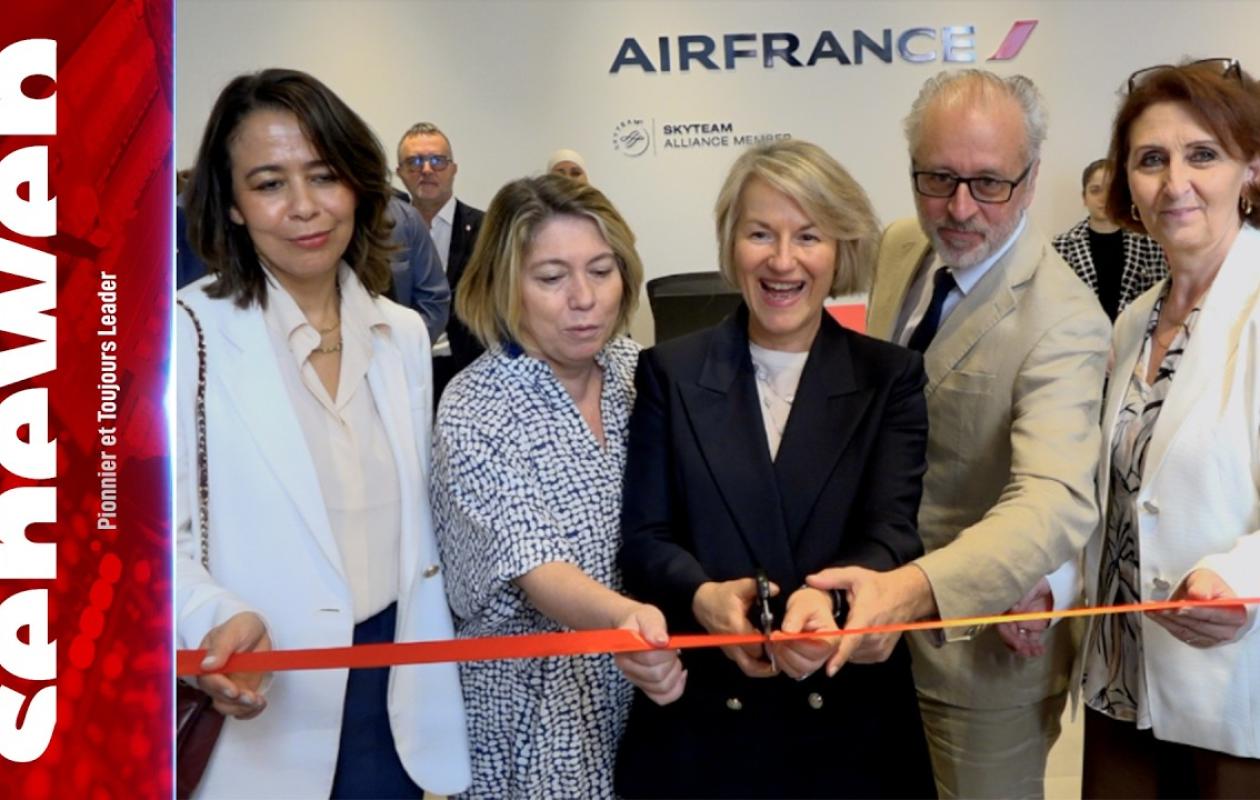
In the Senegalese capital, the long history of commercial aviation is reflected in the windows of a new location. At 15 Boulevard El Hadj Djily Mbaye, Air France has opened a new agency, following its 55-year-old branch on Avenue Hassane II. The event coincides with the airline's 70th anniversary in Senegal. The ceremony brought together the French Ambassador to Senegal, Christine Fages; Air France CEO, Anne Rigail; General Manager for France, Northwest and Central Africa, Henri Hourcade; Regional Director for North, West and Sahel Africa, Nadia Azale; as well as employees and guests. After the ribbon-cutting, which officially opened the agency, the event provided an opportunity for a press conference to discuss the airline's history, strategic direction, and future prospects.
Henri Hourcade retraced the foundational steps of Air France's presence on the continent and in Senegal. "Air France is African because it was born from the merger of several companies, including Aéropostale, which had begun operating routes as early as the 1920s, carrying mail until 1936, which is why we're celebrating its 90th anniversary today. 1936 marked the first passenger flight, with a Dewoitine 333 aircraft carrying 10 passengers departing from Toulouse." He mentioned the first connections to Dakar, "with several stopovers in Spain, Casablanca, and then Dakar once a week," and a journey that lasted nearly thirty hours. He continued his account by highlighting the technological advancements that have marked the Paris-Dakar route. “The Paris-Dakar route has witnessed all the stages of aviation history, from the post-war era with the DC-4, to the Super Constellation in 1953, the first large propeller-driven aircraft to carry significantly more passengers, and then the Boeing 707 in 1960, with its very significant acceleration, reaching 1,000 km/h. This led to travel times that are almost the same as today.” He also mentioned the Concorde era, with “the first Paris-Dakar-Rio flight in 1976,” 50 years ago.
Building on this long-standing relationship, the Dakar-Paris route is now naturally among the most prominent in Air France's African network. "We serve Air France with a 777-300 with 48 seats in business class, 48 seats in premium economy, and 370 seats in total, offering the best of our cabins and the best of our products. We continue to invest in this route, which is a flagship of our network and our network in Africa." When asked about the overall strategy, Anne Rigail emphasized a focus on moving upmarket and investing. "The company's strategy is exactly what I said earlier: to offer our customers the highest standards in the airline industry so that Air France becomes the preferred choice, the go-to travel option." She mentioned the accelerated fleet renewal, with "more than one billion euros per year," as well as the reconfiguration of the cabins to standardize the product across the entire network.
The CEO detailed the cabin upgrades. “In business class, you may have seen our new seats with doors that offer more privacy. We've also replaced all our premium economy seats to provide greater comfort in this class.” She added that economy class is also benefiting from improvements, particularly in terms of comfort, screens, and connectivity. The overall offering also includes ground services: “It's about onboard comfort, but we also have the entire product, the cuisine, and the fact that we have lounges around the world offering an enhanced experience.” Air France serves more than 170 destinations in over 70 countries from Paris-Charles de Gaulle, giving Dakar the role of a gateway to a vast network. “Half of the customers departing from Dakar have connecting flights, and nearly half of them are at Roissy. So, this obviously allows for a very diverse range of options,” she explained.
Regarding Senegal, Anne Rigail announced that a partnership with Air Senegal will soon be established. "Air Senegal will very soon be able to sell flights from Dakar to Paris. But also connecting flights on 12 routes within France, Europe, and also to Canada. So, it's a partnership we want to be mutually beneficial," she said. She specified that having strong partners in the local market is part of Air France's strategy and that exchanges already exist, particularly for skills transfer. The CEO also mentioned the company's human and technological presence on the continent. "In Africa, we have approximately 700 employees. We have employees, as you can see here in Dakar," she explained. She mentioned the recent opening of a Bluelink center dedicated to customer relations and call center services, with around 140 employees, as well as the use of artificial intelligence in several operational areas.
During the discussions, environmental issues were also addressed. Anne Rigail presented a comprehensive action plan aimed at reducing the airline's carbon footprint: "Environmental issues are at the heart of our concerns." She indicated that fleet renewal is the main lever, with each new-generation aircraft enabling a 20 to 25% reduction in CO₂ emissions per passenger-kilometer. She added: "Before Covid, we had 7% new-generation aircraft. Today, we have 45% new-generation aircraft, and the ambition is to reach over 70% by 2030." Continuing, the CEO of Air France mentioned the use of sustainable aviation fuel for flights departing from Europe and the option for customers to voluntarily purchase it. Eco-piloting practices are also among the levers being used, with taxiing procedures on a single engine, optimized trajectories, and climb profiles designed to reduce fuel consumption. The company is also studying ways to limit contrails and is using artificial intelligence to optimize flight paths.
Still on the environmental front, Henri Hourcade addressed the complementarity between air and rail within the network. He explained that the station at Charles de Gaulle Airport allows for seamless connections between air and TGV trains, with integrated journeys and end-to-end fares. "Dakar-Lille, Dakar-Brussels, etc. And it's becoming increasingly popular," he said.
When asked about the message intended for Senegalese customers on the occasion of the new branch's opening, Henri Hourcade emphasized the symbolic and operational dimensions of the establishment. "First, it's a sign that we are investing in our commercial presence, in our service to our customers. This branch represents a significant part of our business in Senegal, and it represents our commitment to serving, to being there, to being there when things are going well, to being there when there's a problem. It's a sign of confidence in the future," he stated.