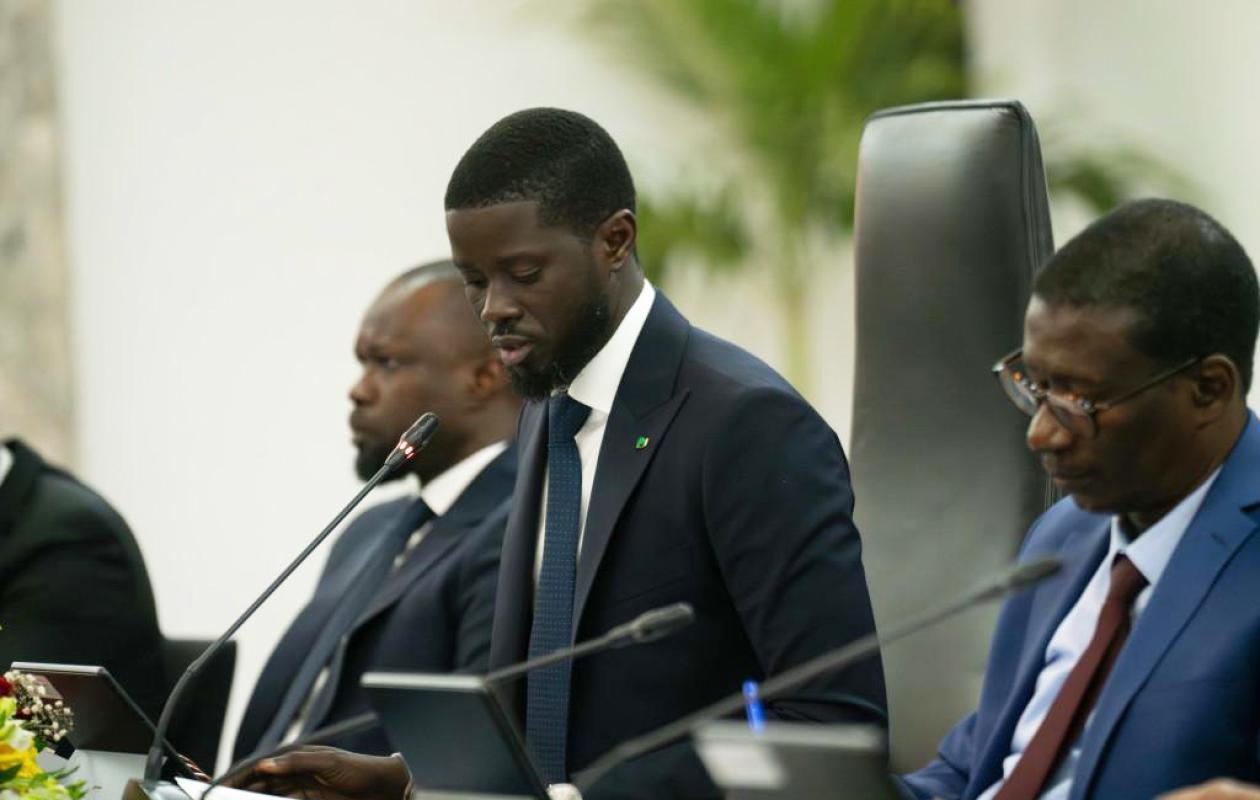
Communiqué du Conseil des Ministres du Mercredi 8 Avril 2026
The Council of Ministers was held on Wednesday, April 8, 2026, under the chairmanship of His Excellency Mr. Bassirou Diomaye Diakhar FAYE, President of the Republic.
UNDER THE HEADING OF THE PRESIDENT OF THE REPUBLIC'S COMMUNICATION
In his opening remarks, the Head of State reiterated, in the context of the Easter celebrations, his message of congratulations and solidarity to the Christian community, before continuing his address, which focused on the following points:
National Day Celebrations
The President of the Republic recalls that Senegal celebrated, on April 4, 2026, with unity and collective pride, the 66th anniversary of its independence. He commends the resounding success of the celebrations throughout the country, marked by the relocation of the military ceremony and the Grand National Parade to Thiès under his presidency, in the presence of his counterpart from the Gabonese Republic, President Brice Clotaire Oligui NGUEMA, the guest of honor at the event. He thanks and congratulates the people of the Thiès Region, the administrative authorities, and all the mayors and local elected officials for their warm welcome and remarkable mobilization, which ensured the success of this exceptional event on the national calendar.
The Head of State also congratulates the Minister of the Armed Forces, the Chief of the General Staff of the Armed Forces, the High Commander of the National Gendarmerie and Director of Military Justice and all the Defense and Security Forces (FDS) for the good organization which testifies to their recognized professionalism and exemplary conduct.
He expressed his commitment to strengthening the presence, equipment, modernization, and excellence of the security forces in the territories, in order to establish a sovereign Senegal in a rapidly changing world. Finally, he reminded the Government, with a view to decentralizing state action, of the need to continue implementing the policy of decentralizing celebratory activities, with the controlled deployment of the Special Infrastructure Development Program in the designated host regions and regional capitals.
Operation and regulation of highways
The President of the Republic observes that the construction and operation of highways contribute to opening up production areas, improving the quality of regional planning, accelerating urbanization, and enhancing urban and interurban mobility. In this context, he commends the progress of the Mbour-Fatick-Kaolack highway project, which is 92% complete. He therefore requests the Minister of Infrastructure to take the necessary steps to open up the fully completed sections of the new Mbour-Fatick-Kaolack highway, particularly the Mbour-Thiadiaye section. Furthermore, the Head of State directs the acceleration of work on the Thiadiaye-Kaolack section and on the Dakar-Tivaouane-Saint Louis highway, as well as improvements to traffic flow and road safety on the Dakar-Thiaroye-Rufisque-Toglou-Kirène-Malicounda-Mbour route. Finally, he instructs the Minister of Infrastructure to propose an integrated framework for the governance and regulation of highways in operation in Senegal.
Governance of land transport
The President of the Republic stresses that road safety and the modernization of land transport management must remain priorities for the Government, in conjunction with stakeholders in the sub-sector, before noting a recurrence of cyclical strikes in road transport, which hinders the movement of people and goods and slows down economic activities.
Recalling the imperative of fostering listening, dialogue, and a strong sense of responsibility in compliance with laws and regulations, he emphasized the urgent need to strengthen social dialogue between the State and road transport stakeholders, with a view to building a lasting pact for the immediate return to full and normal operation of road transport. Reiterating his commitment to good governance of road transport, the Head of State instructed the Prime Minister, in conjunction with the Minister of Land Transport, to ensure the effective and inclusive implementation of the recommendations from the National Transport Conference.
He emphasizes the imperative of ensuring optimal road control and of ensuring strict compliance with the Highway Code and the traffic regulations for the different categories of public transport vehicles.
In this regard, he reminds the Government of the urgent need to accelerate the implementation of transport vehicle renewal programs and improve the efficiency of the public transport system, by strengthening the fleets of the "Dakar Dem Dik" company and the Bus Rapid Transit (BRT), as well as those owned by approved private associations and operators. The President of the Republic asks the Government to ensure the efficient operation of the Regional Express Train (TER), the Senegalese Railways (CFS), and the Grand Trains of Senegal (GTS), with a view to the optimal development of multimodal urban and intercity transport.
Finally, he instructs the Minister of Land Transport to present him, before the end of April 2026, with a comprehensive report on the constraints and prospects for inclusive transformation of road transport in Senegal, including a precise timetable.
Agenda of the President of the Republic, followed by integration, cooperation and partnerships
The Head of State informs the Council that he will preside over the solemn opening of the Bar Association on Thursday, April 9, 2026, before undertaking an economic tour in the Kolda Region from April 12 to 14, 2026.
UNDER THE HEADING OF THE PRIME MINISTER'S COMMUNICATION
The Prime Minister presented his statement on the following points:
Reform of the National School of Administration (ENA)
Addressing the role of human capital in Senegal's transformation policy, the Prime Minister presented the reform project for the National School of Administration. This project will contribute to the training of highly qualified human resources capable of effectively implementing public policies aligned with Vision 2050 and preserving the credibility of this institution, a true engine of social mobility and a lever for national cohesion and the democratization of access to high-level government positions.
Faced with the limitations of decree n°2011-1704 of 06 October 2011 establishing the ENA and setting its rules of organization and operation and the imperatives of systemic transformation consisting of reinventing the appropriate profile of the public manager, the Prime Minister proposed a reform according to a global, anticipatory, inclusive and integrated approach, promoting a synergy of actions for objectives of modernity and performance.
To this end, he announced the establishment of a Steering Committee, placed under the supervision of the Minister, Secretary General of the Government, and including key stakeholders, to lead the reform. This Committee, a permanent forum for consultation, expanded to include all relevant stakeholders, will initiate consultations and formulate proposals aligned with the public policies of the various sectors.
The Prime Minister gave indications not only relating to legal and institutional reforms, but also to educational and scientific reforms, including the development of a draft decree repealing and replacing the decree governing the ENA, the modernization of management tools, the increase in financial resources and their rationalization, the new configuration of sections, the modernization of teaching materials allowing digital technology to be at the center of teaching, the establishment of the Institute for Distance Training (IFD) as well as adaptation to the LMD system and the opening of a doctoral track.
New doctrine of the informal sector
Recalling that the informal economy is a structural weakness in our development model, the Prime Minister stated that formalizing the so-called "informal" sector is both a prerequisite for our competitiveness and a challenge. This economy is characterized by low productivity, a narrow tax base, insufficient social protection, and fragmented institutional governance. Furthermore, the National Integrated Strategy for the Formalization of the Informal Economy (SNIFEI 2022-2026) has not yet achieved all of its expected results.
Consequently, the Prime Minister ordered a rigorous independent evaluation of this strategy, leading to a revamped strategy based on a new doctrine that strongly encourages formalization and penalizes organized fraud. From this perspective, he argued, formalization will no longer be a constraint, but a lever for competitiveness, the creation of decent jobs, and the structural transformation of our economy.
The Prime Minister categorized the informal sector into four (4) groups: survival informal, transitional informal, optimization informal, and illicit informal. He emphasized the importance of aligning support mechanisms and adopting an inter-ministerial approach, as well as strategic decisions including the effective implementation of the entrepreneur status, registration as a prerequisite for accessing public benefits, visible and accessible social protection, and finally, a strengthened fight against organized fraud.
Consequently, the Prime Minister instructed the Minister, Secretary General of the Government, to submit, within fifteen (15) days, a proposal for organizing an interministerial council dedicated to formalizing the strategy. This council should facilitate the adoption of a revised national strategy, accompanied by an operational roadmap, quantified objectives for each ministry, and clear budgetary and regulatory decisions.
The project for the overall restructuring of the public transport network (rtC)
The Prime Minister announced that the comprehensive restructuring project for the Dakar Public Transport Network (RTC), totaling 267 billion CFA francs and led by the Dakar Sustainable Urban Transport Executive Council (CETUD), is a key initiative for urban mobility in the capital. It will reorganize the bus network to better connect users to mass transit, improve service to outlying areas, and deploy low-emission buses.
This project also includes the deployment of modern infrastructure, the acquisition of high-quality rolling stock, and the professionalization of sector operators. For the Prime Minister, the implementation of this project requires a decisive impetus to remove the remaining obstacles. Having identified the operational roadblocks hindering its effective launch, the Prime Minister instructed the Minister of Economy, Planning and Cooperation and the Minister of Finance and Budget to take all necessary steps without delay to remove these obstacles and enable the project to begin.
Finally, he asked the Minister of Infrastructure, the Minister of Land and Air Transport, the Minister of Urban Planning, Local Authorities and Territorial Development and the Minister of the Armed Forces, after consultation, to present him with an opinion on the feasibility of the Ouakam Stadium on the site of the Old Runway.
UNDER THE HEADING OF COMMUNICATIONS FROM MINISTERS
• The Minister of Energy, Petroleum and Mines and the Minister of Finance and Budget made a joint statement on the impact of the war in the Middle East on the supply and price evolution of petroleum products and electricity.
• The Minister of Public Service, Labour and Public Service Reform made a communication on the presentation of the draft law on the Labour Code and the draft law on the Social Security Code.









Commentaires (41)
Participer à la Discussion
Règles de la communauté
💡 Astuce : Utilisez des emojis depuis votre téléphone ou le module emoji ci-dessous. Cliquez sur GIF pour ajouter un GIF animé. Collez un lien X/Twitter, TikTok ou Instagram pour l'afficher automatiquement.
Se connecter
Commentez avec votre profil, votre photo, et soyez averti des réponses.