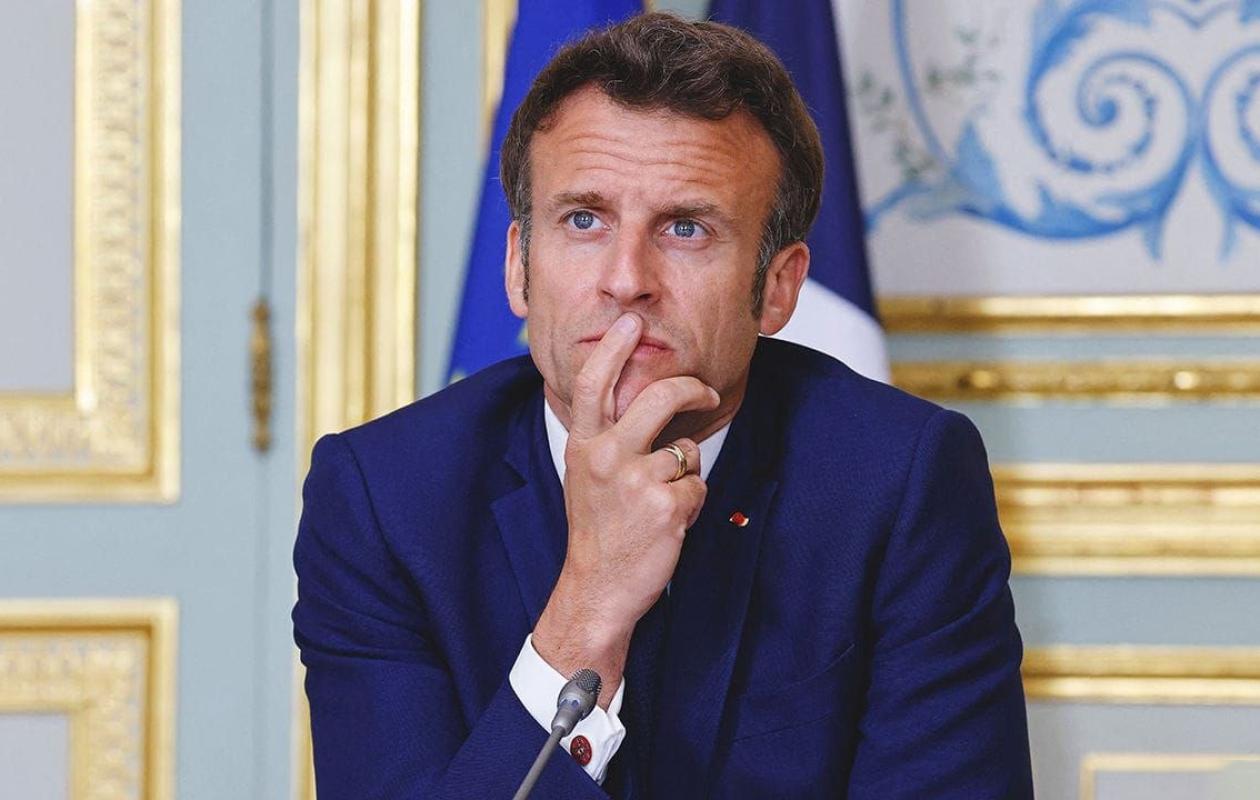
"L'influence française appartient au passé" : Macron face au mur du sentiment anti-français au Kenya
Desperate times call for desperate measures: this is the case for French President Emmanuel Macron, who has no permanent presence in either West or Central Africa. He is traveling to Kenya for the first "Africa Forward" summit, bringing together English-speaking African countries.
The former colonial power, which has no permanent presence in either West or Central Africa, is expected to participate in this summit themed "Africa Forward".
France is participating in this year's Africa-France summit not as a powerful partner, but as a country rapidly losing its foothold in Africa. Its influence on the continent is waning—particularly in the Sahel—and it enjoys little legitimacy in Africa today.
"The fine French rhetoric of 'mutual cooperation' and 'shared development' no longer hides its ruthless ambition to partner with Africa solely for resource extraction and geopolitical presence. There is little respect for African sovereignty."
"France is desperately trying to redefine its commitments in Africa in order to relocate its military bases and pursue its brutal quest for strategic minerals – not out of love or respect for the well-being of Africa or Africans," according to author and political analyst Kim Heller.
As this summit continues, African leaders must remain vigilant, Mr. Heller said, adding that "France's footprint on the continent remains marked by coercion, economic plunder and the structural suppression of African self-determination. It continues to apply the same strategy since the post-independence era."
“France’s influence is weakening on the continent and globally. It is imperative that African leaders cease being pawns in the imperialist games of foreign nations and begin to define the playing field, the rules, and the desired outcomes. If France cannot abide by the principles of fairness and respect for African sovereignty, it should not be a partner of choice.”
"African leaders must take the lead," she added.
France has lost influence both economically and militarily over the years: Africa now represents only 1.9% of its foreign trade, 15% of its supply of strategic minerals and 11.6% of its oil and gas supply.
To make matters worse, France's two main trading partners in sub-Saharan Africa are Nigeria and South Africa, former British colonies that have never hosted a French military base.
With Macron withdrawing South Africa's invitation to the G7 summit scheduled for June in France in favour of Kenya, President Cyril Ramaphosa is expected to skip the upcoming Nairobi summit.
At this summit, the French ambassador to Kenya, Alexis Lamek, admitted that the summit should address the issues of restitution and reparations, which are at the heart of the African Union's agenda.
In 2024, French troops left Senegal at the end of 2025, ending 65 years of French military presence in the country. This withdrawal follows similar departures across the continent, as former colonies increasingly turn their backs on the nation that once ruled them.
France's withdrawal from Senegal also occurred amidst growing anti-French sentiment in the Sahel region. Political changes in Mali, Burkina Faso, and Niger further weakened French neocolonial dominance in the Gulf of Guinea countries.
After gaining independence in 1960, Senegal became one of France's most loyal African allies, hosting French troops throughout its history. Following a landslide victory in the 2024 elections, promising sweeping change, Senegalese President Bassirou Diomaye Faye demanded that France withdraw its troops by 2025 at the latest.
But that's not all: Faye also demanded that France apologize for colonial atrocities, including the massacre on December 1, 1944, of dozens of African soldiers who had fought for France during World War II.
The winds of change are blowing across Africa, where progressive governments are increasingly challenging the French military presence, forcing Paris to close or reduce the size of its bases in its former empire.
In February of last year, France returned its only remaining base in Ivory Coast, ending decades of French presence in the country.
The previous month, France had ceded the Kossei base to Chad, its last military stronghold in the Sahel region.
The coups d'état in Burkina Faso, Niger, and Mali between 2020 and 2023 brought military strongmen to power. Their governments collectively expelled 4,300 French troops. These three countries severed ties with France and turned to Russia for assistance in combating the unrest that has plagued the Sahel for a decade.
The Central African Republic, also a former French colony, likewise demanded the withdrawal of the French.
Meanwhile, the French army has transformed its base in Gabon into a camp shared with its Central African host.
Only the tiny Horn of Africa, Djibouti, will host a permanent French military base after the withdrawal. France intends to make this base, which has approximately 1,500 personnel, its military headquarters for Africa.
According to Thierry Vircoulon, associate researcher at the French Institute of International Relations and expert of the Global Initiative against Transnational Organized Crime, it is important to distinguish between countries that have chosen to break their military cooperation agreements with Paris (such as Chad and Senegal) and those that have simply closed their military bases while maintaining military cooperation (such as Ivory Coast).
"The announcement of the closure of bases by African leaders, rather than by Paris, symbolizes a rejection of French policy. This marks a significant loss of influence for France in the countries concerned," explains Mr. Vircoulon.
Macron forced to adapt
In a speech delivered in Ouagadougou in 2017, Macron declared that French policy towards Africa had undergone a fundamental shift, stating that "there is no longer a French policy for Africa." He added that France was "seeking partnerships that were not based primarily on historical or linguistic ties and did not automatically prioritize Francophone countries."
“We rightly reviewed our military bases. We eliminated the military component, which was no longer understood by the countries and by younger generations,” while rebuilding “relevant” partnerships, particularly in Benin.
Many in Africa have stated that it is not true to say that France decided to withdraw. France was forced to adapt to new realities.
France is seeking to expand its relations with English-speaking African countries, thus moving away from its traditional French-speaking partners.
"This development is motivated both by political considerations, but above all by the desire to gain market share and to bring added value to the French economy," according to Seidik Abba, a Nigerien academic specializing in the Sahel, who disputes the idea that France is behind these changes.
Security analyst Emmanuel Dupuy puts it more bluntly when he states: "France is very poorly equipped – or even completely disarmed – to be credible in this region of the world."
Macron's African policy is being criticized for its unequal response to military coups.
In a recent opinion piece published in the Beninese newspaper La Nouvelle Tribune, the author accused Macron of applying double standards by adopting a hard line towards the juntas in Mali, Burkina Faso, and Niger, while being more conciliatory towards the perpetrators of coups in Gabon, Guinea, and Chad. According to him, this selective approach by France undermines its democratic rhetoric and fuels anti-French sentiment.
Dupuy acknowledges this double standard, but argues that not all coups d'état should be treated the same way.
He suggests that the succession of Mahamat Déby in Chad in 2021 was a transfer of power tacitly tolerated by France, rather than a coup, and that the military takeovers in Gabon and Guinea followed deeply contested electoral processes rather than explicit breaks with Paris.
With France “in decline” on the African continent, Macron will certainly use the Nairobi summit to wage what he has called a “battle of narratives”.
“We must not lose this battle,” Macron said, adding that French interests were also being defended by combating disinformation and responding to accusations that France represents a new colonial power. He argued that these narratives often rely on “anti-colonial,” “anti-European,” and “anti-French” rhetoric and require a stronger response.
Whatever Macron's plans may be in Nairobi, the idea of a dominant French influence is now a thing of the past.






![[Billet d’humour] Diomaye Président : Mbour, le test qui interroge](https://image.seneweb.com/content/news/2026-19-10//thumb_1260x800_6a008342c328b_0bscHsJLlN.jpeg)











Commentaires (7)
Participer à la Discussion
Règles de la communauté :
💡 Astuce : Utilisez des emojis depuis votre téléphone ou le module emoji ci-dessous. Cliquez sur GIF pour ajouter un GIF animé. Collez un lien X/Twitter, TikTok ou Instagram pour l'afficher automatiquement.