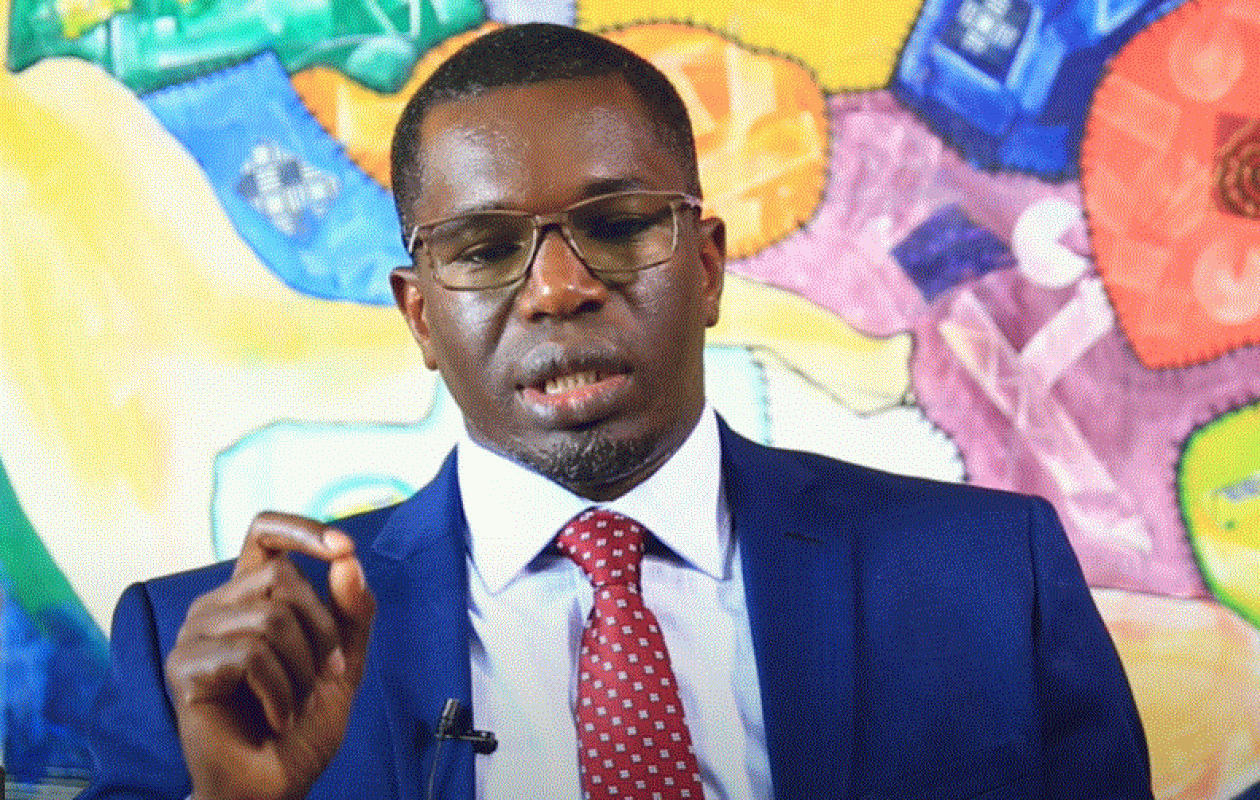
Transparence, fonds spéciaux, accès à l’information : «Juge Dème» interpelle le régime en place !
Ibrahima Hamidou DEME, president of the Together for Work, Integrity, and Citizenship (ETIC) movement, spoke out on Wednesday. He addressed the country's governance nearly two years after Pastef came to power. The former magistrate, commonly known as "Judge Dème," challenged those in power on the crucial issue of transparency, particularly regarding access to information. His statement is below.
“On March 24, 2024, the Senegalese people expressed, through their vote, their deep aspiration for change, for a break with the past, and for the advent of a governance more firmly based on ethics, transparency, and accountability. Good governance and its corollary, transparency, are indeed the essential pillar for rebuilding trust between those who govern and those who are governed.”
This democratic choice should logically lead the new authorities to combat economic and financial crimes more resolutely, which calls for a two-pronged approach. In a publication dated February 21, 2025, following the release of the Court of Auditors' report, I emphasized, firstly, the need to adopt strong repressive measures, notably through the effective criminalization of these offenses. Secondly, I stressed above all the importance of preventive measures, through the implementation of safeguards designed to prevent the misappropriation of public funds. Indeed, it is essential to address the root causes to prevent the problem from recurring.
I therefore proposed "the implementation of a chain of controls, both internal and external, throughout the administration, in order to significantly reduce the shortcomings observed in the management of public finances." I added that "effective prevention also relies on sound civic education and the continuous provision of information to the public, enabling them to fully exercise their civic oversight."
I also called for "increased citizen vigilance, as well as the constant engagement of civil society actors and the media, whose role in monitoring and raising awareness remains crucial in the evaluation of public policies and the use of public funds." In that same publication, I finally stated that "this citizen oversight can only be exercised effectively if there is permanent public access to information and regular, timely publication of reports."
It is in light of this legitimate hope and this demand for a break with the past that the central issue of transparency must be assessed today, particularly through the adoption of Law No. 2025-15 of September 4, 2025, concerning access to information. This law, which was a long-standing demand of the National Consultations and a constant call from civil society, political actors, and citizens, was met with great hope.
Presented by the government as a major step forward for democracy, its explanatory memorandum sets out a clear and laudable ambition: "...to establish a constructive debate and give citizens the legal and operational means to base their opinions on information from authentic and reliable sources."
It was in this context of hope that, on January 8, 2026, I initiated a citizen-led approach aimed at contributing to the effectiveness of this law and, consequently, to the concrete practice of transparency. Letters were sent simultaneously to three of the highest institutions of the Republic: the Presidency, the Prime Minister's Office, and the Ministry of Finance. The purpose of the request was specific and of major public interest: to obtain the exact amount of the special funds, commonly known as "political funds," allocated to the President of the Republic and the Prime Minister for the 2025 and 2026 fiscal years.
I wish to clarify that this request concerned exclusively the exact amount of these funds, the subject of recurring speculation in public opinion, and not their destination or use. The intention was in no way polemical, but fundamentally educational. It was a matter of demonstrating, by example, how any citizen, political actor, or member of civil society can now use the law to access official and credible information. The ultimate goal was to promote a culture of verification and sourced information, in order to protect public debate from the scourge of fake news and to prevent, in the future, the perverse use of this offense to silence citizens, and more specifically, opposition political actors.
The request having been submitted on January 8, 2026, the maximum legal processing time, set at fifteen clear days by article 19 of the law, has long since expired and none of the three institutions solicited (neither the Presidency of the Republic, nor the Prime Minister's Office, nor the Ministry of Finance) has deemed it necessary to respond, either to communicate the requested information or to justify a possible refusal.
It should be recalled that the law strictly regulates the processing times for requests for information by those subject to the law, defined in Article 5 as the persons, bodies or entities that hold or produce the information: Article 17: the response to a request for information must, in principle, be immediate; Article 18: when a preliminary investigation is necessary, the response must be given within eight clear days; Article 19: in any event, ''the processing time for the request may not exceed fifteen clear days from the date of receipt''.
These provisions constitute mandatory legal obligations for the administration. They are at the very heart of the right of access to information, transforming a simple option into a fully enforceable right for the citizen.
The silence observed in this case constitutes a clear and deliberate violation of the law. Even more serious, this violation emanates from the highest authorities of the State, the very same ones who initiated and promulgated this legislation. This reflects a manifest failure to break with past practices of opacity and contempt for the law, and places the government in the position of being the primary offender of a rule it itself enacted, thereby undermining its credibility and the authority of the law.
Another crucial dimension of this affair lies in the direct link between the withholding of information by the state and the proliferation of disinformation. By refusing to release official data on such a sensitive subject as special funds, the executive branch creates an information vacuum, inevitably filled by rumors, speculation, and unverified, or even deliberately false, information.
This results in an unacceptable paradox: the state prosecutes and convicts citizens for spreading fake news, while simultaneously being the source of the uncertainty that fuels this phenomenon. By depriving citizens and journalists of authentic and reliable information, it exposes them to error or manipulation before punishing them. The fight against disinformation can only be credible if the state itself sets an example of transparency. The best antidote to fake news remains free, rapid, and effective access to accurate information.
Faced with this failure of the highest state authorities, I therefore ask the following question: if the right of access to information is not respected by the public authorities themselves, would it be fair to condemn citizens for spreading alleged fake news?
A judge cannot fairly assess the falsity of an allegation when the factual truth is deliberately concealed by those entrusted with its preservation. It therefore becomes necessary to reverse the logic. The authorities who have failed to keep their word, their commitments, and who have knowingly violated the law they themselves enacted, must now be held accountable.
The law on access to information establishes, for this purpose, a system of sanctions against those subject to it in the event of a breach of their obligations. Consequently, I solemnly announce my decision to implement these penal provisions by filing a complaint against the Prime Minister and the Minister of Finance and Budget for refusing access to information, an offense stipulated and punishable under Article 30 of said law.
I firmly believe that accountability (that is, the obligation for those who wield power and hold positions of responsibility to be accountable for their actions) is a categorical imperative. One cannot seek the votes of one's fellow citizens, nor accept high and prestigious positions, without assuming the corresponding responsibility of acting with complete transparency and being accountable. This imperative is all the more crucial in our developing countries, which are still facing alarming levels of unemployment, poverty, and lack of access to basic social services.






![[EXCLUSIF]De Ziguinchor au Méridien : Le déballage explosif de Ndiaga Seck qui livre les noms et numéros de 10 de ses amants](https://image.seneweb.com/content/news/2026-21-18//thumb_1260x800_6a0b129f253e7_EAmQ8XmZt5.jpg)
![[EXCLUSIF] Ndiaga Seck : Ce qu'il a dit sur Ousmane Sonko](https://image.seneweb.com/content/news/2026-21-18//thumb_1260x800_6a0b59b4699aa_zsVjCNITAk.jpg)











Commentaires (16)
Participer à la Discussion
Règles de la communauté :
💡 Astuce : Utilisez des emojis depuis votre téléphone ou le module emoji ci-dessous. Cliquez sur GIF pour ajouter un GIF animé. Collez un lien X/Twitter, TikTok ou Instagram pour l'afficher automatiquement.