Alerte sur les amas coquilliers du Delta du Saloum
The shell mounds of Toubacouta require urgent protection to save this endangered cultural heritage. Hence the launch of a project led by UCAD, the Directorate of Cultural Heritage, and UNESCO.
Resting on the palm of the Director of Cultural Heritage's hand are two seemingly worthless pieces of stone. But seeing the intense attention Omar Badiane pays to what he has just picked up, one cannot help but wonder. In reality, these two fragments are evidence of a cultural heritage in danger. They are two pottery shards found at the vast shell mound site in the Saloum Delta. These shell islands, designated a UNESCO World Heritage Site in 2011, are now threatened with extinction by the advancing sea.
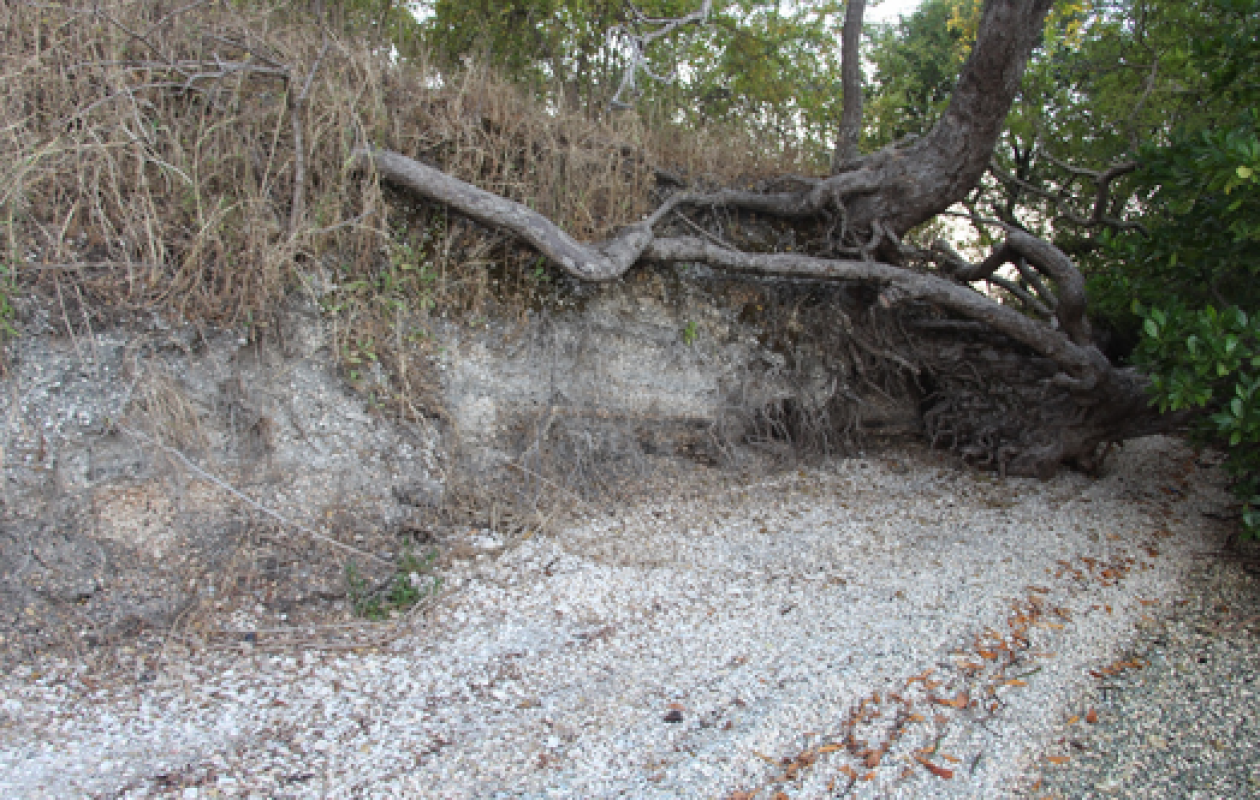
That day, a tripartite delegation composed of researchers from UCAD, the Directorate of Cultural Heritage, and UNESCO visited the site to personally assess the damage suffered by the shell islands. The clean, white layer that has appeared on the seaward face of the mounds is the clearest evidence of the advancing water, which has now reached the very heart of the tumuli. Hence the appearance, in broad daylight, of bones and mud fragments.
Added to this are striking examples of the damage, such as this tree, once firmly perched atop the mounds, now lying on the water. "In 2014, I wrote an article to raise awareness of the risks. At the time, this tree was in the middle of the shells," recalls Professor Moustapha Sall, an archaeologist at UCAD. A tour guide cites the example of a baobab tree that was about six meters from the water and has now completely disappeared.
It is therefore essential to take urgent action to protect the site. Hence the launch, on Saturday, November 29, 2025, in Toubacouta, of the project entitled "Emergency Safeguarding Measures for Shell Mounds in the Saloum Delta Against Coastal Erosion." This project brings together Cheikh Anta Diop University (UCAD), responsible for the scientific component, the Ministry of Culture, the state supervisory body, and UNESCO, the technical and financial partner.
On site, visitors were treated to a presentation by Professor Moustapha Sall on the process of formation of shell mounds.
Originally, he explains, it was a place for oyster farming to meet consumption needs. The oysters were harvested and boiled, the meat extracted, and the shells discarded as waste. Faced with this accumulation, the islanders then had the idea of burying their dead there, adopting a whole set of cultural practices reflecting the beliefs of the time.
Even today, the harvesting of oysters and shellfish provides a link between the past and the present. "From the 1st millennium to the present day, the activity that created the shell mounds continues. You go to Sipo, you go everywhere in the Delta: depending on the season, we simply harvest the oysters and then discard the shells. This shows that this age-old practice is still relevant," explains Moustapha Sall.
The state has opened Pandora's box.
But to ensure visitors and expert accounts in the future, action must be taken now. Otherwise, Professor Sall and his colleagues will have to definitively abandon their ambitions of archaeological excavations in the Saloum Delta. And they won't be alone. The numerous foreign tourists currently in the area will also have to look elsewhere for such an idyllic location. Here, nature offers a landscape of exceptional beauty: crystal-clear water, pure air, mangroves, sunsets, birdsong… Everything combines to make this island a site with unique tourist, cultural, economic, and heritage potential.
But the breaching of the Sangomar sandbar in 1987 changed everything. Since then, the arrival of sand has remained a threat to the mangroves, the natural barrier of the shell islands. There are also human pressures. Moustapha Sall points out that it was the Senegalese government that first used shells in road construction in 2007. Since then, local communities have followed suit. Some have used them to build their homes; others have turned them into a business.
This dual action, both natural and human, has ultimately dealt a serious blow to this exceptional site. "Generally speaking, we can say that the state of conservation of the shell mounds is good. However, there is now a challenge linked to climate change and coastal erosion. Urgent measures must be considered for the main sites, which are a true scientific and popular attraction," acknowledges the Director of Cultural Heritage, Oumar Badiane.
Having scientific data
It is in this context that the UCAD team's intervention takes place. Visually, there is no doubt that the shell mounds are collapsing under the force of the waves. The observation is clear. But this reality must be documented in order to obtain scientific data that will allow for a better understanding of the site and an appropriate intervention. The chosen method involves forming three groups of researchers—aquatic, aerial (drone), and terrestrial—to map and re-inventory the site in order to accurately determine the area lost, the speed of the advancing water, the number of threatened mounds, and so on.

At Diorom Bumak, for example, researchers collected geographical coordinates, measurements, and all other relevant information about the eight tombs identified. This work will also allow them to compare older dating methods with technological advancements, either confirming or refuting them. Researchers also hope to obtain more information about the populations who created these burial mounds, including their DNA.
For now, scientific work suggests that the site called Diorom Budaw presents the greatest urgency. "Here, the tumuli are located on the shore, unlike Diorom Bumak where they are in the center of the site," emphasizes a member of the UCAD team.
How then can these threatened sites be protected? The question remains open. In some areas, mangrove reforestation has been successful and protects part of the site. However, in other areas, the presence of sand has limited this option. Therefore, other methods must be considered, likely involving civil engineers. Hence the importance of a multidisciplinary approach to find the best solution.
"A single burial mound can fill an entire museum."
In the meantime, to better preserve this heritage, researchers recommend excavating the burial mounds while they are still intact. "A single mound can fill an entire museum," says Moustapha Sall. This work would allow the Toubacouta interpretation center, planned as a mandatory stop before visiting the site, to become operational. Tourists will benefit from a comprehensive presentation—complete with images—before experiencing the site firsthand.
Beyond preserving the site, the goal is to further enhance the tourism and cultural potential of the Saloum Islands. The interpretation center will then be fully operational, as will the craft village, currently deserted by artisans. This project will provide training for guides to offer a consistent, scientific narrative. An entrance fee will also be introduced.
All of this will not only generate revenue for the municipality, but also ensure the rational management of visitor flows, in order to limit pressure on the site and structure the economy around this ecosystem. "On sites where there is real potential, if tourists only stay two or three days, it's a waste. Ideally, we need to find a way to showcase the entire heritage of these regions, in order to extend stays, by strengthening the visitor circuit and the reception facilities," argues Oumar Badiane.
To succeed in this endeavor, it is necessary to meet the challenge of community ownership. In other words, informing the local population about what is happening. Because, as the Director of Heritage acknowledges, until now the protection of the site has been perceived as a matter for UNESCO and the Directorate of Cultural Heritage.
"Beyond research activity, it is important to put in place a real program capable of strengthening education and information dissemination mechanisms among the population, the tourism sector which benefits from what the country has to offer, but also among other actors such as associations, NGOs and the communities themselves," concludes Badiane.
A dynamic has been set in motion with the launch of the joint project. Stakeholders hope that it will be maintained for the greater good of the locality, but also of Senegal, which, through the Toubacouta shell mounds, possesses the largest shell island in the world.















Commentaires (4)
Participer à la Discussion
Règles de la communauté :
💡 Astuce : Utilisez des emojis depuis votre téléphone ou le module emoji ci-dessous. Cliquez sur GIF pour ajouter un GIF animé. Collez un lien X/Twitter, TikTok ou Instagram pour l'afficher automatiquement.